Monday, 10 October 2022

Drowning in Nineties Anime, Pt. 120

So much for posting more regularly!  Ah well, I've a few of these on the go and my day job situation is hopefully settling down a bit, so there's hope yet, though I dimly remember saying much the same not so long ago.  As for a common thread, the closest we have is "titles that are really hard to find these days," which is likely to be an extremely prominent theme for the foreseeable future.  All of which is to say that I have nothing to say and we might as well just get on with looking at Dragoon, Megaman: Upon a Star, Voltage Fighter Gowcaizer, and Iron Virgin Jun...

Dragoon, 1997, dir: Kenichi Maejima

If there's one thing you need to know about Dragoon, it's that it has nary an original idea anywhere in its head, except perhaps for the incorporation of science-fictional elements like giant airships into an otherwise fantasy-style narrative - only, by 1997 that had in itself become a cliché in the wake of Hayao Miyazaki's Nausicaä of the Valley of the Wind and Laputa: Castle in the Sky, and thinking about it, if there's one thing you really need to know about Dragoon, it's that it wants very much to be mentioned in the same breath as those two classics.  Though the conversation would need to be along the lines of "Laputa sure is a great movie, but have you ever considered how much better it would be with lots of bare breasts?"

And having summed up Dragoon as Laputa with a fraction of the budget and endless shots of boobs, I could certainly call this review done, with the only caveat being that, depending on your preferences, I've either made it sound awful or awesome and it isn't either.  The word I'd opt for, rather, would be "pleasant", in the way that only something wholly predictable and unchallenging can be.  While its obsession with lingering over its female characters' exposed upper halves, regardless even of whether they're adults or not, is certainly sleazy, that aside it's all quite sweet and good-natured and relatively bloodless.  If you like straightforward fantasy tales, and if you especially like straightforward fantasy tales that toy at incorporating the odd sci-fi element, it's safe to say you'll get on fine with Dragoon.

None of this would be half as true, mind you, were it not for some surprisingly and consistently decent animation, which makes an out-sized difference in pushing Dragoon up from the realms of not-badness.  Were there more to visually differentiate it, was the world-building more imaginative, say, I'd go further, but as it is, only some reasonably nice character designs do much to make the show stand out.  Still, anime that's made with a measure of talent and care is generally better than anime that isn't, and Dragoon's tendency to punch above its budgetary weight is a definite boon.

All of which would add up to a modest recommendation were it not for one last problem, the only one I'd consider a reason to definitely avoid Dragoon if you should find yourself craving some hackneyed nineties fantasy anime: as rote as its storytelling is, the characters are sympathetic enough that I wanted to see how things played out for them, so that the three episodes here end without so much as a cliff-hanger, having resolved nothing, is quite frustrating - and more so for how the opening sequence is a flash-forward to major events we'll never see play out.  It's not ruinous, simply because what's come before isn't good enough and the tale it's been telling isn't unpredictable enough that never finding out where it's heading is especially painful.  The best of endings wouldn't have nudged Dragoon into the realms of greatness, but the lack of even a half-decent one definitely does it no favours.

Mega Man: Upon a Star, dir's: Katsumi Minoguchi, Naoyoshi Kusaka, Itsurô Kawasaki, Minoru Okazaki

Given what an extraordinary amount of anime we've covered here, it's surprising how little we've come across that was expressly and primarily made for kids.  Probably it's my memory being rubbish, but Mega Man: Upon a Star feels like practically a first.  It has no interest in adding one iota of sophistication or nuance to cater to an older viewer and is wedded so hard to the perspective of its child characters that regular logic immediately flies out the window.  On discovering that their reality has been invaded by video game characters, for example, the first concern of our young protagonist Yuuta's parents isn't to wonder at how the heck such an obvious transgression of the basic laws of reality might occur or what dangers having a mad scientist of apparently unlimited power and ingenuity running around their nation might pose but to question how their son is meant to fit all this commotion in around his schooling.

Honestly, that's kind of refreshing.  Mega Man: Upon a Star is dumb as bricks, but it's the right sort of dumb, the sort that gets that we - and by "we", I definitely mean the under-ten viewer - want to be amused and entertained, and maybe if we get enough amusement and entertainment we must possibly tolerate a dash of education entering the mix.  It strikes me only now that one aspect that sets this apart from most of what's aimed at children is that it's not very interested in humour.  Its stakes are ridiculous, but Mega Man: Upon a Star takes them as seriously as can be.  It actually plays quite fairly toward its young audience, and while it's absurd, it isn't pandering.  Even that educational aspect I touched on comes from a charming, albeit baffling, place: since Mega Man the character is apparently American, the show is determined to have him learn a bit about Japanese culture, geography, and identity, for all that there's nothing here you wouldn't expect the average Japanese schoolchild to already know.

This makes no sense, but it makes no sense in harmless, appealing ways, which is Mega Man: Upon a Star all over.  Its three stories are energetic and fast-paced enough that the silliness never becomes obnoxious.  In the first, Mega Man escapes because Yuuta falls asleep at the controls of Mega Man 5 - which raises so many questions the show hasn't the tiniest interest in exploring! - and is rapidly followed by the nefarious Dr. Wily, who immediately builds an army of robots and takes over an amusement park so that they can enjoy themselves, a plan that's actually not very nefarious at all, come to think of it, though once foiled, he does try and harness the tectonic forces of Mount Fuji to annihilate Japan.  Maybe you should have just let him entertain his robots for a few hours, huh, Mega Man?  Then in the second episode, Dr. Wily steals a time machine and uses it to travel back to kill Mega Man in the womb.  Ha!  No, he uses it to visit various of Japan's annual festivals and at one point steal some sweets, and also to gather a bunch of meteorites to drop on the nation, something it's fair to assume he could have done just as easily without a time machine.  Though his half-hearted attempts to muck with the fabric of time still make more sense than what Mega Man gets up to in part three: suspecting that Dr. Wily is again up to no good, he starts roving forward into the future in search of a point when something outright bad enough is happening that it's definitely the work of an evil genius.

It's a lazy approach to hero-ing that has no right to succeed as well as it does, and by that point I have to admit I was firmly on the side of Dr. Wily, who's a good bit more proactive and benefits from Kenichi Ogata's delightful performance, which brings him to life as both gleefully wicked and ever-so-slightly senile.  By comparison, Mega Man himself is rather dull, as are Yuuta and his sister, though it's fair to suppose that everyone involved is aware of this failing given that we're never apart from Wily for long.  Still, all the voice acting is pretty good, and mostly so is the music, so long as it's adhering to what I take to be revamps of the game's themes and not hurling terrible rock ballads at us over the closing credits.  But what surprised me was the animation, which is never what you might call impressive, exactly, yet always stays on the right side of decent to a degree it's fair to say would be wasted on its target audience.  (Granted, the designs are a bit ghastly, but I guess we have to blame the game at least partly for that.)  And so, as seems to be routinely the case these days, we're left with a title that I'm happy to recommend on its own merits - assuming you have a handy child you want to keep amused for an hour and a half while gently teaching them a bit about Japanese culture - and which is almost totally impossible to find.  Hey, at least the crummy dub is on YouTube...

Voltage Fighter Gowcaizer, 1996, dir: Masami Ôbari

Of all the directors active throughout the nineties with a distinctly recognisable style, I'd argue that Masami Ôbari was unique in that he never once made anything you could hands-down describe as good. Oh, I know the Fatal Fury movie has its defenders, and sure it could be worse, but who else was there who combined such a unique MO with such a thudding lack of genuinely stand-out work? Once you know what you're looking for, you can't miss an Ôbari character design, and there are other elements that carry over from project to project as well; the only one I have any wholly positive feelings for is his sure grasp of how bodies look in motion, which, when your CV contains a disproportionate number of fighting game adaptations, is certainly a virtue to cultivate.  But then at the other end of the spectrum, he had a marked tendency towards levels of misogyny that stands out even in a decade when female characters being treated as victims, window dressing, or both was more or less the standard in anime: his women are invariably vixens or airheads and, whichever category they fall into, it's a safe bet their breasts will be bigger than their heads.

Now, this isn't a review of Masami Ôbari.  I mean, obviously it has been for the whole of a paragraph, but it's not meant to be.  Still, it seems to me a fair way into talking about Voltage Fighter Gowcaizer because Voltage Fighter Gowcaizer is about as Ôbari-ish as it's possible to be.  It has all of his flaws on unmistakeable display, and, to be fair, all of his virtues as well.  And, like Fatal Fury before it and Battle Arena Toshinden, released the same year, it's based on a video game beat-em-up, in this case one Ôbari also provided the character designs for.  It's definitely possible to imagine this material in the hands of another director, but the result would have been a very different beast: better, perhaps, and surely more coherent, but perhaps a bit less interesting.

On paper, Voltage Fighter Gowcaizer has no right to be any level of interesting.  The plot is boilerplate and stupid, unnecessarily overwrought boilerplate at that.  It dances around the crucial elements enough that everything seems vastly more complicated than it really is, and that's primarily the fault of Kengo Asai's script, which dresses up the stuff of fighting game plotting as though it were Greek tragedy, but Ôbari makes no moves to check that tendency.  Barring an eleventh-hour twist that's only a twist if you've never played a video game, this could barely be more of a straightforward tale of disparate heroes banding together against an evil villain, yet it somehow drags that threadbare material out for a hundred minutes, for a good proportion of which the central conflict barely rears its head.

There was probably never going to be a good version of Voltage Fighter Gowcaizer, and it's even harder to imagine such a version flowering out of Asai's florid prose - though I guess he had to pad the material somehow, and why shouldn't that be by having the cast spout nonsense philosophy at every opportunity?  At any rate, I don't know that it's reasonable to criticise Ôbari for not transforming this into a classic for the ages.  He does his own share of harm, though, and that's even supposing you aren't as horrified by his character designs as I am; but if you are, their flaws are harder to miss when he's this determined to show off their tackiest aspects.  Even by nineties anime standards, the number of times a dialogue scene is shot from crotch or bum height is astounding, and there's so much unmotivated jiggling of boobs that at one point I burst out laughing because it kind of looked as though two characters' breasts were having their own private conversation.

Actually, Voltage Fighter Gowcaizer is generally quite obsessed with sex, and the bouncing bosoms and endless shots of barely concealed crotches and bottoms become somewhat less noticeable when they're up against, say, an antagonist who's a monstrous hermaphroditic hybrid formed by an incestuous brother and sister.  Yet, in common with all of Ôbari's work, it's also resolutely unsexy, in part because it's so hard to reconcile these designs with actual human beings.  So the sexiness becomes yet another way for Voltage Fighter Gowcaizer to be strange and unexpected, and that's what really saves it, in so much as anything does.  Well, that and some frequently terrific animation, along with a few moments of visual genius: the "secret" final antagonist, in particular, is such a superb bit of design work that you can't but wonder how Ôbari managed to screw up so many of the others.  Which is why, I suppose, I've spent so much of this review discussing him rather than the title in question: here as elsewhere, I find myself just impressed enough - by a terrific bit of action there, a perfectly composed image there, or just by the distinctiveness the man brought to such generic subject matter - to wish Ôbari had managed, just once, to conjure up a masterpiece.

Iron Virgin Jun, 1992, dir: Fumio Maezono

The perfect, they say, is the enemy of the good, and perhaps that explains how Iron Virgin Jun can be both a largely faultless version of what it's trying to be and at the same time slightly hard to recommend.  Then again, maybe that's inevitable when what it's trying to be is a 45-minute OVA adaptation of a short Go Nagai series.  I'm not exactly a fan of Nagai's oeuvre on the whole, and I can't imagine a time when I'll ever be on side with the mean-spirited efforts to be vicious and gross that mark out a title like Violence Jack, yet the list of anime based on his creations that I have a measure of affection for is getting surprisingly long by this point.  But with most of it, I fall into a middle ground of being amused by the absurdity and over-the-top imagination but let down by the lack of much else: there are plenty of solid Nagai adaptations but vanishingly few that push beyond that.

The manga of Iron Virgin Jun sounds startlingly unpleasant: if the Wikipedia entry is anything to go by, its "highlights" include a spot of bestiality and the potential rape of the protagonist as a major plot point, and the anime loses the former and tones down the latter, so it's already ahead of the game for those of us who aren't on Nagai's wavelength.  Still, there's only so much you can do to sanitise a work by someone who's so eager to shock, and, in fairness, only so much you should do without losing the gleeful bad taste that's one of Nagai's hallmarks.  So the threat of rape is still there, it's just introduced late and not taken terribly seriously, which arguably doesn't make it better but at least leaves room for Iron Virgin Jun to put its best foot forward.  Plus, while my heart sank when the Golden Cherry boys were introduced, they being the gang dispatched to rob our hero Jun of her virginity, their character designs perfectly nail the balance of crass and ridiculous that Nagai thrives on: I won't spoil the gag, but I'll admit I laughed.

The Golden Cherry boys, however, are much nearer to the back of Iron Virgin Jun than the front, and what we start out with is the kind of goofy setup that's ideal for one of these shorter OVA films.  Jun's - perhaps literal, to judge by appearances - ogre of a mother wants her to get married.  Jun disagrees, and strongly enough so that she's gone on the run to make her point.  But her family is outrageously wealthy and has no end of colourful henchpeople at their disposal and Jun's mother isn't beyond squandering those resources if it gets her daughter to comply, all the more so since her motives have little to do with wanting to ensure Jun's future wedded bliss.  Fortunately for Jun, and for us since there'd be no plot otherwise, her iron physique and stock of wrestling moves mean she's more than capable of taking care of herself, which doesn't stop the sympathetic and slightly smitten servant Ohnami from tagging along.

There's plenty of material there for comedy, romance, and regular bouts of action, and that would probably suffice for something this short; but having set out its wares, Iron Virgin Jun then delivers enough of a larger plot that it actually manages to have a bit of meat on its bones.  The animation is entirely fine, Maezono's direction is suitably energetic, and so is the unusually present score, which does more than its share of keeping the pace lively.  As far as the source material goes, it's a mostly triumphant attempt at fitting it to the form of a short OVA movie, and thus we return to the opening point: it's possible to get most everything right and still end up with something that's merely okay.  If you were determined to adapt a Go Nagai work that has many of his flaws and not quite enough of his virtues, and you had less than an hour to play with, I can't imagine how things would have turned out an awful lot better, but that's not to say it was ever a brilliant idea to try.

-oOo-

I guess it's always nice to have nothing bad, right?  Then again, it's also nice to have at least one thing that's categorically good, and I want to say that's Mega Man: Upon a Star, but that would be a lie brought on by going in with low expectations and being pleasantly surprised.  Still, if we're looking at four distinctly average titles, at least they're the interesting sort of average: where else but in the world of vintage anime could you apply such a word to titles as merrily bonkers as Iron Virgin Jun and Voltage Fighter Gowcaizer?  So I'm calling this one a win regardless.


[Other reviews in this series: By Date / By Title / By Rating]

Sunday, 14 August 2022

Drowning in Nineties Anime, Pt. 119

So, we're back in the eighties - but let's not grumble too much about how this nineties anime blog is yet again drifting back into the wrong decade, and this time even brushing the very bottom of said decade. Because if we're getting awfully close to exhausting the best stuff from the nineties, the eighties at least still has the odd gem left to offer, and frankly it's nice to be reviewing some titles that range from decent to excellent for a change, with more towards the top end than the bottom. In fact, we only have one arguably duff title - I say arguably because it's a well-loved classic! - from amongst Be Forever Yamato, Lupin the Third: The Fuma Conspiracy, Tomorrow's Joe The Movie, and Barefoot Gen...

Be Forever Yamato, 1980, dir's: Toshio Masuda, Leiji Matsumoto, Tomoharu Katsumata

While this is the first Space Battleship Yamato movie I've covered here, due to my determination not to be reviewing seventies anime in a blog series that's meant to be about nineties anime and has already strayed too far into eighties anime, I have actually watched the three preceding entries.  So hopefully I have some idea what I'm talking about when I say that the problem with the series is that the first film neither wanted nor needed any sequels.  Granted, the original run of the TV show was so unsuccessful that the episode count was cut by a third, but I've not seen it suggested that the follow-ups were an attempt to restore that lost material.  Rather, it was the belated but monumental success of the film condensation of the series that gave birth to four sequels in a mere six years and which led to them so meticulously following the template it had set.

But Space Battleship Yamato the movie wasn't trying to set a template, it was merely making the best job it could of the nigh-impossible task of cramming twenty-six episodes into a moderately acceptable running time and cobbling together a coherent plot that didn't just feel like a bunch of disconnected things happening for two hours and change.  I doubt anyone involved was thinking, "Hey, this is something that could stand to be replicated three or four times with slavish precision!"  Yet Space Battleship Yamato was a hit, and the sort of ginormous, lightning-in-a-bottle hit that doesn't incline anyone to go all experimental on their audience.

Thus we come to Be Forever Yamato, a film that, while veering slightly further afield than either of the previous two sequels, nevertheless hangs so desperately to Space Battleship Yamato's coattails that it ends up making nary a shred of sense.  That's most obvious in the astonishing two-and-a-half-hour running time, which nothing in the story begins to justify, but really it's everywhere else as well.  With that, said, though, the first third or so does at least give the impression we might be in for something different this time around, and most dramatically so in its opening scenes, in which the oft-embattled Yamato is conspicuous in its absence as an unknown force of alien invaders tear through our solar system, wreaking death and destruction and not stopping until they've enslaved the Earth and ensured there'll be no resistance by erecting a bomb with the potential to erase all life on the planet.

It's at this point that we're finally reunited with the Yamato and its crew - what's left of them, anyway, since Be Forever Yamato isn't above the odd cheap death to give some sense of stakes - and it's also at this point that the plot, such as it's been, starts to unravel hard.  The entire business with the aliens and their weapon of last resort that they seem determined not to use is the major driver for everything that happens and it's brutally dumb if you pause to think about it, as is basically everything to do with them. They're a series of hazards and twists for our heroes to navigate rather than rational characters acting according to their own motivations, and since one of the things the Yamato franchise has been rather good at until now is giving its antagonists a proper measure of autonomy, this is more disappointing than in many another film that only bothered to think through half its conflict.  There are developments in the back third that don't possess a shred of logic; I was reminded at points of Star Trek V: The Final Frontier and its hilarious "What does God need with a starship?" shenanigans, and if there's one thing you don't want your epic space drama to remind you of, it's Star Trek V: The Final Frontier.

Still, I'd argue that all this is salvaged by a couple of things.  One is that there's something inherently appealing about the Yamato movies, which are vast and serious and absurd and occasionally thrilling in ways it's hard not to feel a touch nostalgic for if you're an anime fan of a certain age and inclination, and the other is that, while the animation isn't terribly reliable, there are shots scattered throughout that are absolutely marvellous: put them together with a suitably sweeping score and there's definitely something intermittently special here.  Yes, I would argue that, except that the only available release in the West is a very aged DVD from some outfit called Voyager Entertainment, and it sucks, and sucks that bit harder than their releases of the other films because, around the midway point, Be Forever Yamato decides to shift aspect ratios: you have to assume the idea was that the picture would get bigger in cinemas, but that isn't the route Voyager Entertainment went down, so half the movie ends up double-letterboxed.  Should this ever get a blu-ray release in the West, I'd be a lot more kindly disposed toward it: a great print that showed off the better moments of animation would make its various problems far easier to ignore.  But that's not what we've got right now, and what we've got really is quite a slog.

Lupin the Third: The Fuma Conspiracy, 1987, dir: Masayuki Ôzeki

Given how quickly the series settled into a comfortable groove, it's easy to forget there was a time when nobody quite knew what it meant for something to be a Lupin the Third film.  Oh, the core elements were there, of course, in Monkeypunch's manga and in the TV series, which had clocked up hundreds of episodes across three seasons by 1987; but what works in a comic book or in twenty minute bursts is hardly guaranteed to fill a feature-length running time.  And it's also easy to forget that the three animated films prior to this point hadn't been reliably successful either with audiences or critics; bizarre though it seems in hindsight, Miyazaki's The Castle of Cagliostro was a notorious flop, no doubt in part because of its eagerness to break from the formula of Lupin-ness as it was then.

And so we find ourselves with the fourth animated Lupin feature and the first that wasn't a cinema release but an OVA, which at the time was quite a different beast to a TV special, of which the first of many would soon follow.  No, in 1987, an OVA wasn't much of a step down, and yet it's worth mentioning because The Fuma Conspiracy feels smaller in scope than any of its predecessors.  That's partly due to the running time, which doesn't quite break seventy-five minutes, but as much to do with the story's confinement to a single location, and a single location in the depths of rural Japan, picked apparently because the creators were sick of seeing Lupin in London and Paris but also because researching your own country is a heck of a lot cheaper than researching someone else's.

Another twist: The Fuma Conspiracy opens with a wedding, and not just any wedding but the wedding of regular cast member Goemon - a bum note, frankly, that hangs over the entire movie, since we know Goemon isn't going to get married and the film makes little attempt to convince us otherwise, so that the nuptials, which almost immediately get interrupted and transform into a treasure hunt, seem much like the clotheshorse to hang the plot around that they are.  Nevertheless, for all that it doesn't hold up, it's certainly a novel way into the story, and an early indication of what I was trying to get at in the opening paragraph: The Fuma Conspiracy feels like the work of people who've gone back to square one on how to make a Lupin the Third film and are probing their way forward accordingly.

Which brings me at last to the point, which is that the most striking detail about The Fuma Conspiracy from a modern perspective isn't its quirks, of which it has a few - at the time it was lambasted for not using the regular voice cast in another bid to keep the budget down, and the shift to a more wallet-friendly composer certainly does the movie no favours - but how well it predicted what was to come.  For all that it's definitely its own thing, with a softer, warmer visual style that's closer to Cagliostro than its successors, and the oddness of seeing Lupin running around the Japanese countryside, and the unconvincing hook of Goemon's wedding, the plot soon transforms into something remarkably familiar: Lupin and co square off against a band of colourful enemies in search of a McGuffin treasure, Zenigata and the local cops give lukewarm pursuit, and ultimately everybody comes together in the labyrinthine death-trap that houses said treasure, which you can be confident nobody will get away with.

A strange combination then: had The Fuma Conspiracy occurred a decade later, it would stand out barely at all, and I guess that if you choose to ignore its context, it wouldn't much now, though the setting and the marriage gimmick are striking while you're watching.  But to be clear, the formula that began to take its definite form here is one that works, and, done well, a formulaic Lupin can be a hell of treat.  The Fuma Conspiracy turns out to be a pretty good stab, with few surprises but plenty of polish, and that's most evident in the animation, which is often splendid: the film's centrepiece is a mammoth car chase, and though a car chase might be the least unexpected element of a Lupin the Third movie, this one stands out by its sheer loveliness and ingenuity.  Sad to say, loveliness and ingenuity aren't quite enough to make it genuinely fresh, and the one thing that could have pushed The Fuma Conspiracy into the highest tier of Lupin films is some genuine surprises, so we're left with an above-par entry that's historically interesting more than it's intrinsically interesting and frustratingly difficult to find.  Hopefully that last matter will get sorted eventually; this is a title that would benefit enormously from the uplift to blu-ray.  If and when that happens, it'll be one to jump on, but in the meantime, I guess it's only for completists and those eager to see a Lupin adventure dressed up in more than TV animation.

Tomorrow's Joe The Movie, 1980, dir's: Yōichirō Fukuda, Osamu Dezaki

I feel bad for starting off a review of a beloved classic by focusing on the negatives, but it's better that I get it off my chest right away: The animation in Tomorrow's Joe is precisely as bad as you'd expect of a film cobbled together from a long-running early-seventies TV show and then some.  But it's also worse than that, because the TV show was, one assumes, in the old 4:3 aspect ratio, whereas the film, as presented on blu-ray and presumably as it was shown in cinemas, more or less, comes to us in the widescreen 16:9 ratio, which was almost certainly accomplished by cropping the existing footage.  That, anyway, is how practically every shot across its two-and-a-half-hour running time looks: as though it's been zoomed in on to an uncomfortable degree.  It's hard not to notice and hard not to be distracted by once you've noticed it, especially when the animation is so rudimentary in the first place.

Would you believe me if I said none of that matters?  Would you believe me if I suggested that, just possibly, it works to the benefit of Tomorrow's Joe?  Honestly, I'm not sure I would believe me, because great animation is a big part of what I love about anime and it logically follows that severely not-so-great animation is a major turn-off.  Yet there are benefits, arising not only from the crudeness of the animation but from the crudeness of the designs as well, which are almost elemental in their simplicity.  The most obvious is a sense that the events portrayed belong to the past: what we have here is an eighties movie of a seventies anime of a sixties manga telling a story from earlier in that same decade, and I don't know that slicker animation could get at that accumulated weight of years in the same way the rough-and-ready work here does.  Equally, there's an energy that's perfectly fitted to the material - and I guess, two paragraphs in, it's high time to be mentioning that what we're discussing is a boxing movie, a genre that doesn't really need to look pretty but very much does need to draw you in with its physicality to the point where you practically feel the blows landing.  This Tomorrow's Joe absolutely does, and if it did so any better, I for one would have found it a tough watch, because - even putting aside the boxing scenes themselves - the events it shows are often staggeringly brutal, and I don't know that a more realistic portrayal would have stayed watchable for this sort of duration.

Again, for all that that sounds like criticism, I don't mean it to be.  Tomorrow's Joe is a pummelling movie and ought to be: our protagonist and definitely not hero is Joe Yabuki, who we meet as a cocky street kid picking a fight with a bunch of petty gangsters, ostensibly to help out a little girl but obviously as much or more so because he loves to scrap and has crappy impulse control.  This we'll soon learn for a fact, as Joe's headstrong and self-destructive nature lands him in a juvenile detention centre, and from there in an even worse juvenile detention centre, all despite the efforts of well-meaning drunk Danpei Tange, a former boxer who's determined to harness the young man's potential whether Joe agrees or not.

Eventually, Joe relinquishes, though not for any real reason other than a desire to do better in the fights he's endlessly starting; it's a long way indeed into the film before he shows an interest in boxing as anything other than a medium for doing what he'd be doing anyway.  And in that sense, While Tomorrow's Joe is definitely a boxing movie, it manages to be far more than merely a movie about boxing: there's a tremendous amount of material here, and I wouldn't be surprised if an hour goes by before Joe so much as steps inside a ring.  Then again, the fact of being adapted from a 79-episode TV show gives the film an edge that perhaps no other boxing film has ever had: it gets to be an epic that's established its characters and arcs and themes well before it really commits to its primary genre, and in so doing, plumbs depths that boxing films rarely get close to.  And here I should admit that I don't remotely like boxing, for all that it seems to be an uncommonly good wellspring for cinematic material - yet I can't remember the last time I was as glued to the edge of my seat as I was during the last twenty minutes of Tomorrow's Joe, a single bout shown in what has to be practically real time and played out as something akin to a chess match in an abattoir.

I didn't expect a classic of Tomorrow's Joe, for all its reputation.  There are surely limits to what you can accomplish by hacking together TV show footage, especially when it looks as though nobody thought retouching the roughest patches might be a nice idea before they pointed it toward a cinema.  So maybe the greatest accomplishment here is the editing, or whatever precisely the word is for the job of picking what out of thirty or so hours of footage makes it into a theatrical cut: this material works as a movie to a shocking degree, moving through clear arcs to be sure but always with momentum and an unmistakeable direction.  While there's plenty to admire - I haven't even mentioned the tremendous voice acting or Kunihiko Suzuki's aggressively jazzy, funky score, which proves a far better fit than it has any right to - the greatest triumph is surely the phenomenal job Tomorrow's Joe does of carving out the leanest, most bare-boned version of its vast story and delivering it with propulsive force.

Barefoot Gen, 1983, dir: Mori Masaki

The 1983 film Barefoot Gen is up to at least three significantly different things, and, on the face of it, one of them is practically irreconcilable with the other two.  First and foremost, it's a tale of survival during wartime, initially amid the increasingly intolerable depredations of the last months of WW2, when the writing was clearly on the wall for Japan's defeat, and then in the aftermath of the atomic bombing of Hiroshima, one of the most desperately horrible periods of suffering that any population has known.  And lest we fail to note just how horrible it is to be in a city under nuclear attack, Barefoot Gen is also quite explicitly a horror movie: its representation of what the bombing did to human bodies both during and after is unflinching and unsparing in a manner that would be impossible in live action, since no special effects shot could be so excruciatingly effective as the representations of melting flesh Masaki conjures up over and again.

Obviously, those two modes are a perfectly reasonable fit for each other.  But then we get to Barefoot Gen's third thread, the one which sets it apart from almost any similar film and indeed from the obviously comparable masterpiece Grave of the Fireflies: as well as the above, it's also a comedic tale following the adventures of the plucky titular character, something like if The Adventures of Huckleberry Finn happened to be set amid the irradiated ruins of a major city.  And here you'd have every right to expect things to come gravely unstuck, because that's one heck of a fine line to tread, the more so because we're tethered hard to protagonist Gen's perspective and very much expected to laugh at the things he finds funny, for all that six-year-old boys aren't known for their nuanced grasp of humour.  Moreover, every aspect follows that approach, so that Gen and the other characters his own age look as though they've wandered in from a kids' movie, and Kentarō Haneda's score could be transferred over to said kids' movie without the slightest alteration.

A fine line to tread indeed, and yet it's not so much that Barefoot Gen somehow gets away with it but that, in attempting such seemingly incompatible goals and succeeding as well as it does, it manages to be both great and unique.  And maybe the explanation for that lies in how wholeheartedly the film commits to its various strands: with such levels of intensity, any one of them in isolation would be unwatchable for ninety minutes straight.  That absolutely goes for the horror elements, which are wrenching and gutting in a way that goes far beyond what horror generally even considers, be it by throwing the most violently awful images at us and daring us to blink or by going the other way and treating as perfectly normal, say, the facts that radiation burns are going to attract maggots and that a soldier with radiation poisoning might well bleed from his anus.

So we need the comedy, and more so we need Gen's innocence and plucky can-do attitude, in part to soften everything else to the point of watchability but as much so, and more so as the film goes on, to show us that even the innocence and can-do attitude of a good-hearted, brave, and optimistic child has its reasonable limits.  That isn't to suggest the balance is always perfect: Haneda's music, particularly, is wedded far too much to the Gen we meet in the first third, before the bomb has dropped, and feels increasingly inappropriate the nearer we get to the end.  And if we really wanted to nit-pick a film that arguably ought to be kind of critic-proof, I'd have to admit that it didn't tear me up emotionally the way Grave of the Fireflies (or the more recent In This Corner of the World) did.

Then again, I don't know that Masaki - or Keiji Nakazawa, author of the semi-autobiographical manga the film is based upon - were really after our tears, or at any rate whether that was anyone's priority.  Masaki, certainly, seems primarily determined to make us walk in Gen's shoes, or rather, to stumble through the ashes barefoot as his young hero does, deprived of even so basic a protection as footwear.  He's always gunning for the most direct and visceral reactions, be they happy or sad, be they giggling at the dumb antics and absurd arguments of little kids or trying to make sense of the sight of a starving baby suckling futilely at its dead mother's breast.  To create something bearable from such material would be a big ask, so that Barefoot Gen manages to be often entertaining and always engaging even as it grips us by the throat and forces us to stare at images of almost inconceivable suffering is surely enough to warrant calling it a classic.

-oOo-

Can it really be that we have a post with two strong recommendations - indeed, two titles that are pretty much must-sees if you're at all interested in vintage anime?  It certainly would seem so, and I'd even go further and suggest that, whether you care for older anime or not but are in the business of watching good and important films, then Barefoot Gen is one you'll have to get to, the more so because it manages to be good and important without being preachy or suffocating in the manner of so many such movies.

Even more unexpectedly, there's nothing here that I wouldn't recommend to at least someone.  The Fuma Conspiracy is a middling Lupin film with some unusually nice animation, so if and when it gets a re-release, fans of the series should definitely seek it out, and much the same goes for Be Forever Yamato, which I'm confident would go up in my esteem if I could just watch the thing in a good print.


[Other reviews in this series: By Date / By Title / By Rating]

Sunday, 3 July 2022

Drowning in Nineties Anime, Pt. 118

I know things have been awfully uneventful around these parts lately, and they're likely to stay quiet for a while longer, what with me having a new job and more or less zero free time and all.  Nevertheless, I'm not the sort of person who, once they've set themselves the nigh-impossible task of reviewing every bit of anime released in the West in an entire decade, quits with the finish line in sight, and I have one or two posts nearing completion, so hopefully there won't be another gap quite so long as this one.

And more good news!  We're back to having at least a couple of titles that you might possibly have heard of, in among Mad Bull 34, Yu Yu Hakusho: The Movie, Ninku: The Movie, and Guy: Double Target...

Mad Bull 34, 1990 - 1992, dir: Satoshi Dezaki

I remember saying a while back that I'd finally exhausted all the really notorious video-nasty-style nineties anime, and oh what a fool I was!  There was bound to be at least one more hiding away, and I certainly ought to have remembered Mad Bull 34, which, while not among the most oft-cited shockers, definitely had its share of reputation.  Granted, we're a fair way from something like Violence Jack here, in that the sex and violence (and perhaps most often, sexual violence) are generally leavened by a lick of humour and a cartoonishness that holds them back from proper viciousness.  All the same, we're looking at a title that chooses to call the first of its four episodes "Hit and Rape" and introduces its titular character by having him shoot a man's head to pieces in exceedingly graphic detail, so it's probably not the right choice to stick the kids in front of when they decide they want something slightly edgier than Pokémon.

That protagonist is John "Sleepy" Estes, AKA Mad Bull, the sort of cop who shoots first and pretty much never asks questions or does anything that resembles what those of us who aren't nineties anime writers might regard as police work.  For about three minutes, this looks set to change when he's partnered with the Japanese-American Daizaburo "Eddie" Ban, a straight-laced sort who's disinclined to shoot perps into paste when he could, like, handcuff them or something.  But one of the early twists on its formula that Mad Bull 34 surprised me with is that Daizaburo comes round to Sleepy's way of thinking in barely any time, to the point of defending him impassionedly when his unique brand of policing finally gets taken to task at the end of the first episode.

Another unexpected element is how that first episode is more of a compilation, rattling through four or five largely self-contained plotlines, a format that's already out the window by the beginning of episode two.  Indeed, Mad Bull 34 is hopeless at deciding quite what it wants to be, even down to the most basic level of how committed it is to the whole exploitation thing.  Episode one really goes out of its way to amp up the violence and nudity, and wholly gross as that "Hit and Rape" title is, it's nevertheless pretty appropriate.  And the second episode kind of sticks to that but soon decides comic violence is too much like fun, culminating in a section toward the end that veers hard into what we'd now call torture porn, as a female character the creators have actually bothered to develop slightly gets beaten and sexually assaulted and Daizaburo gets battered to a pulp in a sequence that seems to go on forever.

Seriousness, let alone a serious treatment of violence, is the last thing Mad Bull 34 is suited to, so it's a relief when the third episode shifts back toward material that's, if not exactly more light-hearted, then at least delivered with tongue closer to cheek.  On paper, it's still grim stuff, as Sleepy and Daizaburo take it upon themselves to protect a female reporter determined to expose a serial rapist who's bought his way out of justice and find themselves targeted in turn by a gang of suicidal Chinese assassins; but it manages just the right measure of daffiness, and the violence of both sorts has been toned down to pretty much normal nineties anime levels, so it feels less as though it's going out of its way to shock.  However, Mad Bull 34 being Mad Bull 34, a positive change in direction can't last more than an episode, and so we end on the lowest of notes, with a storyline that's both sillier than anything we've had yet and delivered with vastly more self-seriousness, while also making Sleepy seem like a spectacularly awful human being to a degree that blows right past the high bar the show's already set - the more so because it really seems we're meant to side with him as he sleeps with the deranged, cop-killing daughter of the best friend he got kicked off the force.

It's odd to come across a show that on the one hand seems to have such a clear sense of its own identity and on the other is perpetually losing sight of what it wants to be.  Despite how I've probably made it sound, there are moments when Mad Bull 34 comes together: outside of the irredeemable last episode, the action is energetic, and Sleepy and Daizaburo have engaging chemistry, or do in the original Japanese - I forgot to sample Manga's dub, but, judging by track record, its safe to assume it's dumb and awful.  The animation rarely gets up to anything impressive and nor does Dezaki's direction, but there are some terrific New York backdrops and Sleepy's design is a source of joy, more akin to what Genndy Tartakovsky would get up to later in the decade than what most of anime was doing at the start of the nineties.  As for music, the incidental stuff rarely rises past ignorable, but we do get a James Brown end track for episode one - yet another thing I'd never have predicted! - followed by songs from that master of cheesy nineties pop rock Joey Carbone; if they're not on a par with his Project A-Ko contributions, their presence is still a nice surprise.  Which is a welcome development, really, when most of what's surprising about Mad Bull 34 is how it sets itself the seemingly straightforward task of being exploitative trash and manages to get even that wrong more than half the time.

Yu Yu Hakusho: The Movie, 1993, dir: Noriyuki Abe

What's that you say, imaginary reader who's followed these posts from the beginning and actually remembers some of what I've written, I've already covered Yu Yu Hakusho: The Movie?  Ha!  No, but I can see how you might make that mistake.  What you're thinking of is what was released in the West as Yu Yu Hakusho: Poltergeist Report, and if you weren't entirely paying attention, you might well suppose that, because it's as long as a movie and animated to the level of quality you'd expect from a movie and pretty damn good to boot, it was therefore Yu Yu Hakusho: The Movie.

Instead, what we have before us is, I think, a new first for Drowning in Nineties Anime.  The franchise spin-off cinematic release that runs to about the length of a regular TV episode seems to be something unique to anime, and not many of them found their way over to the US and UK, since their function was presumably to be offered up in double bills that would compensate for their meagre individual running times.  And AnimeWorks deserve a measure of credit, I guess, for attempting to replicate that concept, if only ever the once: Yu Yu Hakusho: The Movie came packaged with the equally short Ninku: The Movie, which we'll be getting to in a minute.

Maybe it'll be great, who knows?  But it seems to me that there are some fairly large problems inherent in making a standalone franchise movie that runs to less than half an hour.  We've seen some pretty good anime titles of that length, and one of my all-time favourite movies that's just outside the purview of this series, Cat Soup, is barely longer.  Only, those weren't tied to a wider property, with all the expectations that involves, and it's that aspect which really sinks Yu Yu Hakusho: The Movie.  It needs to feel bigger than an episode, so rather than tell a fun little self-contained story, it has to aim for world-threatening stakes, except that it has no time to set up those stakes and no way of persuading us that any of its events are likely to have meaningful consequences.

This probably doesn't sound like that big an issue, yet in practice it gets in the way of everything that might otherwise work.  There's some solid action along the way, but since Yu Yu Hakusho: The Movie only has time for a brief setup, a middle act that feels altogether like padding, and an epic climax that still seems rather knocked-off and trivial, it's mostly empty spectacle.  And even putting that aside, the story still doesn't quite function: our heroes are set the task of rescuing someone they don't like and that we're given no reason to like either, and all the end-of-the-world stuff is so woolly that it's impossible to imagine it will come to anything important.

I wish I could be kinder.  In theory, there's nothing that wrong with Yu Yu Hakusho: The Movie, and technically it's perfectly fine, with a couple of standout sequences evidently there to say, "No, look, you're not just watching a TV episode in a cinema, honest!"  But maybe a minute's worth of impressive animation is hardly reason to spend just shy of half an hour watching something so futile and generic.  This has almost nothing to offer anyone bar existing fans, telling a tale we've seen variations of a thousand times and telling it badly, and I can't imagine those fans would be too impressed with a title that presumably offers less on the story front than what the TV show delivered on a regular basis.

Ninku: The Movie, 1995, dir: Noriyuki Abe

I don't know what life-altering experience happened to director Noriyuki Abe between the years 1993 and 1995, but where his Yu Yu Hakusho entry does most everything a short franchise movie ought not to do, his Ninku: The Movie works about as well as you could possibly hope such a thing would.

Okay, so I'm not being altogether serious.  It's not as though Abe was the problem with Yu Yu Hakusho: The Movie, his direction there was perfectly serviceable, and it's not as though his efforts are that much more accomplished this time around, though he certainly does a more than respectable job.  No, where Ninku: The Movie succeeds is more to do with setting itself the proper goals.  Its story is ideally suited to its barely-more-than-a-TV-episode running time, it's so thoroughly standalone that I was never for a moment lost despite knowing nothing about the property besides what the ultra-brief intro chose to inform me, and yet it has just enough scope and style that you can tell it's not merely an extra episode stuffed into cinemas.

Above all else, though, Ninku the series is simply a better fit for this sort of thing.  It's a comedy, which means it doesn't need to have any pretensions of epicness, but it's an action comedy, so it still gets to end on a fight sequence and rustle up the semblance of a three-act structure.  To succeed, it merely has to deliver some solid laughs and a good scrap, and it manages both, and if that was all there was to the matter, I'd still be inclined to give it a thumbs up.  So that the technical values are on the impressive side feels mostly like a nice bonus.  To some extent, I suppose, this comes from a lack of familiarity with the series, which, annoyingly, never found its way to a Western release: that the art style is weird and abrasive and unlike most of what was going on in the mid-90s comes as a novel surprise, as does the extent to which the relatively simple but essentially realistic designs can be distorted in fun, interesting ways, making the brief bursts of action exciting not just on their own terms but as animation as well.

Perhaps, though, nerding out over the animation isn't the best way to go with a show in which, after all, one of the main characters is a penguin.  That there's a measure of movie-style quality to be found here is a welcome bonus, to be sure, but Ninku: The Movie could look like garbage and still deliver twenty-some minutes of consistently funny gags.  The setup sees our heroes, a bunch of highly skilled and highly dim-witted martial artists known as the Ninku, running into a bunch of Ninku imitators, to whom they soon find themselves employed as servants.  To say more would surely spoil things given how little there is to spoil, but suffice to say that the central joke is a good one that makes for an often hilarious middle act, and the film has the sense to ditch it at precisely the point when it might risk getting tired to barrel on into its action climax.

Under normal circumstances, all of the above would still leave us at the point where so many of these reviews wind up, at which I have to concede that, sure, there's enjoyment to be had here, but is it really the sort that warrants hunting for a long out of print and hard-to-find DVD?  And okay, yes, that's going to be the case for the vast majority of folks; but if you're the sort who tracks this stuff down, I'd propose that AnimeWorks' two movies-for-the-price-of-one gimmick narrowly edges this one over the line: Ninku: The Movie is a delight and Yu Yu Hakusho: The Movie is worthwhile enough if you view it as a bonus rather than the main attraction.

Guy: Double Target, 1990, dir: Yorihisa Uchida

Yeah, yeah, Guy: Double Target is hentai - hence, presumably, the faintly rude-sounding subtitle! - and so yet again I'm breaking my self-imposed no-hentai rule, and the only excuses I have are that I'm reasonably sure there was a cut version released in the West that removed all the sexy stuff and that, whether or not that's the case, it absolutely could have been, because the sex scenes here have so little bearing on the narrative that snipping them out would make no difference and would probably leave no-one any the wiser.

Moreover, as is often the case - and I swear this isn't just me being prudish! - the result would be an almost inarguable improvement, because Guy: Double Target is very bad indeed at being hentai and only slightly bad, heck even sometimes okay, at everything else it sets out to do.  There are two substantial sex scenes in the first episode: the first is only a bit unpleasant in that one of the parties is presumably being coerced, though we're led to believe they're altogether happy with the situation, but it slams the brakes on whatever plot momentum has built up to that point, while the second is very deeply unpleasant to an extent that feels out of keeping with everything around it.  As for the second episode, there's one brief, entirely consensual sex scene that's so mild they could have left it in a cut version and still got a pass from the censors.  So whatever way you shake it, Guy: Double Target is crappy hentai.

This is good news for Drowning in Nineties Anime purposes, since hentai isn't our bag, and probably good news for Guy: Double Target, since it seems so disinvested in that side of things.  The problem is that surrendering any running time at all when you only have seventy minutes in which to tell two entire stories is never going to be the best move, and it's not as though the material is to such a standard that the show can afford any more slipups.  It's easy to see what the creators were after: something breezy, sexy, violent but basically fun, a kind of semi-pornographic sci-fi Oceans Eleven sort of deal (or in anime terms, Dirty Pair with half the Pair being, well, a Guy.)  And its easy to see because there are moments when it succeeds and you're left wondering how everything else went quite so wrong.  The opening scene of the second episode, in particular, finds just the right tone, before immediately dumping it with a resounding splat.

Interestingly, and as evidenced by the widely divergent approach to being - or not really being - hentai, each of the two episodes has largely different faults.  Episode one is an exceedingly gory, trashy, rather muddled tale of a tyrannical prison built on a sentient planet that sometimes somehow turns people into monsters, and those two threads only gel when it becomes handy for the A-plot that there be some monsters to fight in the big action climax.  Whereas episode two is the much less gory, somewhat less trashy, far too undernourished story of a religious cult with nefarious plans involving galactic domination and a giant golden statue that our hero Guy and his partner Raina reckon on stealing.  The common thread between them is a lack of clear exposition and unfathomable character motivations: having watched this once while half asleep and again to make sure my half-asleepness wasn't to blame, I can't tell you what those nefarious plans involved, or how Guy and Raina thought they'd escape with a gigantic statue, or why they felt getting themselves thrown into the evil sci-fi prison in the first episode was a remotely sensible idea.  So I'm going to go ahead and put the blame squarely on bad writing.

Generally at this point I'd propose that solid technical values, somewhat appealing character designs, and the odd bit of genuinely imaginative animation go some way to softening the blow; but in truth, none of those help much with nonsensical plotting.  Even if they could, and even if there weren't too many moments of cheap shabbiness to counterbalance them, the first episode only really impresses with its icky monster designs and gross-out gore, while the second devotes too much of its creative energies to an action climax with no stakes or drama and not much ingenuity.  So while a non-hentai cut of Guy: Double Target would allow its occasionally virtues to shine more than they do, that's not to say it would claw its way up to being worth watching.

-oOo-

If this is one of those posts that makes it look as though the best is far behind us, then don't despair just yet!  And by you, I mostly mean me, because there are certainly days when I gaze at the to-watch shelf and think that precise thought - but regardless, it's not altogether true.  I'm far enough along with these posts to know that there's the odd gem yet to come, and as for this one, while it's about as small a triumph as you could hope for, Ninku: The Movie made me thoroughly happy for all of half an hour.


[Other reviews in this series: By Date / By Title / By Rating]

Sunday, 1 May 2022

Drowning in Nineties Anime, Pt. 117

I've been trying my best to keep the number of VHS-only titles I cover here to a minimum, since I'd rather focus on stuff that people might conceivably want to watch and / or be able to get their hands on, but the truth of the matter is that there really isn't much left that falls into either category.  And the even truer truth is that - whispers! - I'd actually rather be delving into that particular rabbit hole; it feels like a return to the earliest days of Drowning in Nineties Anime when I hadn't a clue what I was getting into and every new watch was a strange and baffling adventure.  Plus, it occurs to me that these truly hard-to-find titles are actually really easy to find if you don't mind heading over to Youtube, and while I've been snarky about their exceedingly lax approach to copyright theft in the past, it's hard not to view the way people are finding a home there for releases that would otherwise be long lost as an act of cultural preservation.

Mind you, whether they're worth either watching or preserving is a whole 'nother question!  And one I'm about to have a go at answering in regards to Panzer Dragoon, Dark Warrior, Gude Crest: The Emblem of Gude, and Iczelion...

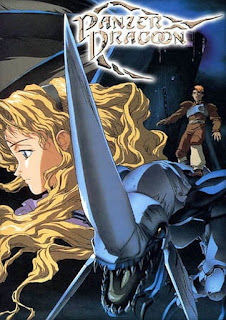
Panzer Dragoon, 1996, dir: Shinji Takagi

For once we can do away with our usual opening question when it comes to these titles that didn't make it past a VHS release: the reason Panzer Dragoon never got as far as a DVD is that it's all of about twenty minutes long minus credits and crap.  So let's begin instead by bemoaning the fact that, of all the video game series there have ever been, it's hard to think of one that would have offered better material for an anime adaptation, and this, this, is what the Panzer Dragoon universe got served with.  I've only ever played Panzer Dragoon Orta on the original X-box, so I can hardly call myself a series expert, but that entry alone offered up one of the richest, most elaborate, most intriguing fantasy worlds I've ever encountered in a video game, and all somehow delivered mostly through the exceedingly limited means of an on-rails shoot-em-up.  Only as I started researching this review did I discover that there's an actual Panzer Dragoon RPG, in the shape of Panzer Dragoon Saga, and the idea of an RPG with the sort of world-building that Orta got up to is a mouth-watering prospect.

But none of that helps Panzer Dragoon the anime.  Okay, not entirely none of it: if there's anything going right here, it's that the world design hints at a vastly more interesting setting than what we're shown.  However, those cool designs are rendered almost entirely in some of the worst CG that's ever made its way into anime, and this at a time when CG was never what you might, from our present perspective, regard as good.  There is, it turns out, bad CG that you can smile along with because, hey, it was the mid-nineties and they were trying their best, plus it probably cost the budget of the average small island nation and took eight months to render, and then there's bad CG that just makes you want to slap the creators for ever thinking people would pay money to have their eyeballs seared by such ugliness.  The models, in fairness, are just about passable, but the backgrounds ... my goodness, the backgrounds are horrible to look upon, and I refuse to believe there was ever a point in history when anyone would have believed otherwise.  Though I can't verify the theory, I think it's likely the CG assets in Panzer Dragoon the anime are in fact the CG assets from Panzer Dragoon the Sega Saturn game from way back in 1995, and what would have looked perfectly okay in that context looks every sort of ghastly in an anime from 1996.

Should I talk about the story?  I don't really want to, plus there basically isn't one.  Our protagonist - Kyle in the godawful dub - gets attacked by a black dragon that kidnaps and kind of semi-absorbs his girlfriend Alita, who, in the closest we get to a vaguely distinctive angle, is blind, though practically nothing will come of this detail.  Another dragon, this one blue, turns up and recruits Kyle as its rider so the pair of them can stop the black dragon getting back to a big metal tower that we saw in a brief opening sequence and thus doing bad stuff.  But can the blue dragon be trusted?  After all, it immediately kills a bunch of folks and ... wait, no, that plot thread gets dropped in all of about two minutes.

Again, I can't say there's absolutely nothing here, though Panzer Dragoon comes perilously close.  The vehicle and dragon designs, as I've mentioned, are theoretically pretty neat, if you pretend they look how they're obviously meant to look and not how they actually do.  The character designs are rather good on paper, which makes it all the more irritating that they were instead brought to life with computer animation that was hopelessly inadequate for the task at this point in history.  There's an ever-so-slightly endearing bonus feature at the end showing how the concept art became the final product - spoiler alert! badly! - and the music that accompanies it is much nicer than anything in the finished product as it was released in the West, leading me to believe ADV mucked with the soundtrack, lest a beautifully sung track in Japanese highlight how their voice cast couldn't even handle stringing simple sentences together.  And now I've run out of good points and I'm off to start a petition to persuade Sega to make an adaptation of Panzer Dragoon that isn't in the running for worst anime ever.  Wish me luck!

Dark Warrior, 1991, dir: Masahisa Ishida

I've been working off the assumption that any titles that never made it beyond a VHS release were by and large quite rubbish, and that rule of thumb has served us fairly well, with a few notable exceptions.  Yet throughout most of the two volumes of Dark Warrior, a show that has very little in the way of reputation and all of it bad, the thought I kept returning was "I've definitely seen worse."  Of course, that's not saying a great deal at this stage, and perhaps the thought that would have been truer to the mark was, "Why did Manga stuff their Collection range of dodgy budget titles with so much garbage when they could have been putting out titles like this that are merely not very good?"

This isn't, I realise, a terribly useful way of starting a review of Dark Warrior itself, and possibly that's me deliberately ducking the issue, because Dark Warrior feels ever so slightly review-proof.  I could tell you, for instance, that it features some truly abominable animation, and I wouldn't be lying: I don't recall the last time I saw this many genuinely dysfunctional shots*, wherein, say, a train jolts around a corner without any inbetweening or a whole conversation takes place without anyone on the staff remembering that people's mouths move when they talk.  However, for all that, the bulk of the animation is perfectly serviceable and it's clear this wasn't the work of incompetents: there's the odd bit of nice character design here, the odd standout background there, and most of the really egregious stuff is confined to the first episode, with the second, by its end, veering dangerously close to looking quite decent.

Likewise, I might suggest that the plot is hackneyed crap of a sort that any vintage anime fan will have seen so often they could predict its every development, and stripped to the essentials, that's true.  A part of me would prefer not to spoil it, for reasons I'll come to in a moment, but since the back of the box couldn't care less, it would be foolish of me to.  In fact, let's just quote that box, because life's short: "Joe Takami had it made ... Then he found out that he WAS made ... And that the people who made him want him back!"  Joe, you see, is actually a clone and for some reason that gives him superpowers, which basically mean he punches real good, and the evil organisation who made him are fascists set on creating a new master-race of humans (that the opening prologue is narrated, without context, from their point of view is an alarming way to kick things off!)  Hackneyed crap, as a say, but it helps that Dark Warrior doesn't seem to realise and so busies itself with strange digressions that arguably make it more watchable than it might have been.  A large proportion of the first episode is devoted to setting up a mystery the box has already given away, and I found myself quite drawn in, perhaps because Takami is a novel character as far as vintage anime is concerned, as though someone thought that what The Guyver really needed was Bill Gates for a hero.  Genius software developers aren't exactly common protagonists in nineties anime, but that aside, Joe is self-absorbed and prickly, and a mass of contradictions in a way that proves to be nice foreshadowing: having established that he spends most of his time talking to the AI he built, it's puzzling when he declares that what matters most to him are his friends and family, but the incongruity will make perfect sense before the episode's done.

All the same, I suppose I'm largely commending the first volume of Dark Warrior for being better than it might have been, and often it's not even that: once it settles on being violent shlock, there's no option except to compare it with endless similar titles and conclude that most of them did the job better; in particular, there's a rape scene that feels like the most horribly shoehorned-in attempt to be shocking and leaves a very sour taste.  So it's probably fair to say that most of my goodwill toward Dark Warrior arises from the second volume, which is arguably more familiar fare but does everything that bit better.  Aside from the much-improved animation, the self-contained plot has enough odd grace notes to make it feel like its own thing: Joe makes friends with a young psychic girl in a manner that's actually quite sweet, a giant cloned killer whale is a major plot element (Dark Warrior really doesn't seem to have the faintest idea of what cloning actually involves!) and the action is more ingenious and relies less on gory punchlines.  Really, then, the fair thing to do would have been to review the two volumes separately, and I would have, except it's a stone-cold fact that no one gives a damn about Dark Warrior and, for all that it kept me moderately amused for a couple of hours, there's no reason they should.

Gude Crest: The Emblem of Gude, 1990, dir: Kazuhito Kikuchi

Gude Crest runs to forty minutes sans credits and has enough material - if perhaps not quite enough of a story - to cover twice that length without breaking a sweat.  It opens with one of those narration-over-still-images prologues that were all the rage in fantasy anime at the time, probably because they were an easy way to save a bit of cash, except that in Gude Crest's case, the prologue isn't done by the thirty second mark as was invariably the case.  No, instead, when we get to what feels like the natural cut-off point, our trusty narrator moves on to another topic, and then another, and before you know it, two minutes have gone by and you've been introduced to a whopping slab of fictional history spanning entire millennia.

Whether or not we choose to consider this as charmingly committed or hopelessly naff, it's a fair indication of where Gude Crest's head is at.  As I suggested, the story, cut to its bare bones, is pretty slight, but the sheer volume of stuff that goes on around it and the numerous plot diversions that serve more to build character and add colour than to move things forward and the intricate window dressing that's strung over every aspect are all so involved that it feels like more than it is - at least until the end, which inevitably winds up seeming a touch rushed and anticlimactic when Gude Crest has invested so much energy in engaging us with its clichéd but elaborate world-building and its familiar but appealing heroines.

Those two are sorceress Efe and swordswoman Jira, and if there's any wrinkle in their Dirty Pair-style characterisation, it's that Jira is the rough one but also a former princess whereas what little we learn of the somewhat more refined Efe suggests she has a much more ordinary background.  So points for slightly subverting a trope, I suppose, but points immediately taken back for how the two voice actors never quite find the spark their relationship requires, unaided by a script that has the feel of bantering dialogue without much in the way of actual humour.  Still, for all that Gude Crest has the air of a comedy, that's not where its heart lies, and what we get instead is a certain energetic light-heartedness that's probably better suited to the show's busy fantasy milieu.  A serious attempt at comedy would be one element too many for something that's already on the verge of being dangerously overstuffed, and anyway, the business Efe and Jira finds themselves mixed up is hardly the stuff of high humour, with an evil cult to be defeated, lots of politicking to be unravelled, and three identical-looking siblings to be defended (though one of them is dead before the five minute mark, so maybe not so much that last one.)

Not much else sets Gude Crest apart, though director Kikuchi is a bit more engaged and imaginative than you might necessarily expect; it's evident, anyway, that he was making actual choices about how to frame shots and such, and often those choices are good and eye-catching, which does a lot to stretch an obviously less than stellar budget.  And even without Kikuchi's going the extra mile, Gude Crest looks pretty nice, with lavish backgrounds and quality character work that does much to plug some of those gaps the script never quite gets to.  All in all, however, it's the ambition and attention to detail that really separate this short fantasy OVA from all the many other short fantasy OVAs from the time, and the earnest, mostly successful attempt to squish a novel's worth of material into so short a running time.  For me, it worked more than it didn't, enough so that the result is one of those rare cases of a VHS-only title where I'm genuinely at a loss to explain why it never made it to DVD: ADV would certainly put out much worse than this charming, jam-packed little adventure.

Iczelion, 1995, dir: Toshiki Hirano

Oh what a tangled mess the Iczer series is!  For Iczelion, AKA Iczer Girl Iczelion, is indeed, as the name sort of kind of suggests, a part of said series, which began with Fight! Iczer 1 and continued with Iczer Reborn, released in the UK and reviewed here as Adventures With Iczer 3.  However, Iczelion is also much more of a reboot, though it has in common with the previous iterations a character called Nagisa, only now she has a different surname and hasn't much to do with the Nagisa we've come to know and tolerate besides being quite useless.

In Iczelion, that's more of an issue than it was in prior entries, since Nagisa has been promoted to protagonist, though the show will forget this regularly over the course of its two roughly half hour episodes, perhaps because it was a terrible idea.  Nagisa, you see, is a high school girl with no special qualities except for a befuddling desire to become a professional wrestler in spite of how she's terrified of violence, and barely have we met her but she finds herself caught up in a scrap between a goofy-looking robot and some sort of alien aggressor.  That robot, as it turns out, is more of a sentient armoured suit kind of deal, going by the name of Iczel.  And Iczel's convinced, despite the abundant evidence to the contrary, that Nagisa is just the sort of person it should be bonding with to defend the Earth from the evil space villains who plan to destroy it.

I realise it's a fool's game to criticise nineties anime for not making a lot of sense, but boy does Iczelion not make much sense at all.  And I'm not even talking about the whole Iczel / Nagisa relationship, which, for some fifty minutes of the running time, involves Iczel attempting to persuade Nagisa to do anything other than attack monsters with wrestling moves or run away, and Nagisa determinedly doing whatever the dumbest thing might be in any given scene.  No, that I found quite charming, given that I suspect most of us, as much as we might prefer not to admit it, would deal with such an outlandish situation in similarly dumb-ass ways, and Nagisa is more an engine to move the plot forward than an actual protagonist.  Rather, the part of Iczelion that's flat-out nonsensical is how there are already three other girls out there who've bonded with Iczel units and all know each other and have even had time to give themselves colour-themed names and personalised special moves and whatnot.  I mean, how long has this alien invasion been going on for?  The implication as we first meet Nagisa is a matter of minutes, but the fact that there's an entire squadron of Iczelions kicking about implies weeks or months.

Am I nitpicking?  Probably.  Is there any value to nitpicking a two-episode OVA from nearly three decades ago?  Possibly, but not when it comes to Iczelion, because everything that makes it kind of awesome comes from the Iczelion squadron, who surely ought to have been the focus from the off.  Far more so than Iczer Reborn, Iczelion harks back to what made Fight! Iczer 1 such a treat, or parts of it at any rate.  The gross-out horror and general weirdness is still largely absent, but the overload of imagination and the neat fight scenes are very much back, and most of the latter involve the rest of the Iczelions, rather inevitably given how fight scenes don't work when one of the participants is legging it toward the horizon.  And fortunately, Iczelion is also something of a technical return to form: if the animation's good rather than great, it's enough to sell those many action scenes, and for bonus points we get a score co-written by the great Kenji Kawai, who could have breathed extra life into this sort of material in his sleep by this point in his career.

I don't know that solid animation, a neat score, and ingenious fight scenes are really enough to qualify Iczelion as legitimately good, but then, I'm not sure that was ever the goal.  For one thing else that's returned from Fight! Iczer 1 is the sleazy, pulpy tone, and whatever you might think of sleaze or pulp, it seems like the right fit for this material.  It's exceedingly trashy - I'd struggle to think of any anime where the transformation sequences were so wholly an excuse for a spot of gratuitous nudity! - but then it's hardly pretending otherwise, and I seem to recall praising Fight! Iczer 1 for much the same approach, which is to say, accepting what it is and trying hard to be the best version of that.

You can knock the Iczer franchise for plenty of things, most noticeably starting on a far better note than it would ever hit again, but the results remain an appealing oddity.  Despite sharing the same director, the hugely inconsistent and occasionally brilliant Toshiki Hirano, they barely feel like they belong together, yet the plus side is that they all have their own specific charms, albeit not all equally.  I've warmed up a bit to Iczer Reborn since I first watched it, having seen it in the original Japanese instead of Manga's preposterous dub and with the context of Fight! Iczer 1, but I'd still rate Iczelion marginally higher.  Its biggest fault, other than arguably focusing on the wrong character, is that it's too short, stopping just as it's about to get going.  Still, this is definitely a title whose failure to reach DVD makes no sense, and I for one would be happy indeed to see this strange, inconsistent franchise be rescued from the rubbish heap of time.

-oOo-

So there we have it: four reviews and only one title that categorically didn't deserve to make it to DVD.  Okay, probably two, objectively Dark Warrior was fairly dreadful, and I probably ought to stop falling back on "but worse stuff got released!" as an argument given how astonishingly low that particular bar got on occasions: not being Sword for Truth isn't grounds for a recommendation!  Nevertheless, that still leaves us Gude Crest and Iczelion, both of which are genuinely quite good and feel like strange omissions, especially the latter.  Probably the explanation lies in how each segment of the Iczer saga found itself with a different publisher, but that's hardly fair on poor Iczelion, is it?

Next up: not another post of VHS-only stuff, I promise!  Well, promise is a strong word, but I'll see what I can do...


[Other reviews in this series: By Date / By Title / By Rating]


* Okay, I do, it was Gundress.