Sunday, 3 July 2022

Drowning in Nineties Anime, Pt. 118

I know things have been awfully uneventful around these parts lately, and they're likely to stay quiet for a while longer, what with me having a new job and more or less zero free time and all.  Nevertheless, I'm not the sort of person who, once they've set themselves the nigh-impossible task of reviewing every bit of anime released in the West in an entire decade, quits with the finish line in sight, and I have one or two posts nearing completion, so hopefully there won't be another gap quite so long as this one.

And more good news!  We're back to having at least a couple of titles that you might possibly have heard of, in among Mad Bull 34, Yu Yu Hakusho: The MovieNinku: The Movie, and Guy: Double Target...

Mad Bull 34, 1990 - 1992, dir: Satoshi Dezaki

I remember saying a while back that I'd finally exhausted all the really notorious video-nasty-style nineties anime, and oh what a fool I was!  There was bound to be at least one more hiding away, and I certainly ought to have remembered Mad Bull 34, which, while not among the most oft-cited shockers, definitely had its share of reputation.  Granted, we're a fair way from something like Violence Jack here, in that the sex and violence (and perhaps most often, sexual violence) are generally leavened by a lick of humour and a cartoonishness that holds them back from proper viciousness.  All the same, we're looking at a title that chooses to call the first of its four episodes "Hit and Rape" and introduces its titular character by having him shoot a man's head to pieces in exceedingly graphic detail, so it's probably not the right choice to stick the kids in front of when they decide they want something slightly edgier than Pokémon.

That protagonist is John "Sleepy" Estes, AKA Mad Bull, the sort of cop who shoots first and pretty much never asks questions or does anything that resembles what those of us who aren't nineties anime writers might regard as police work.  For about three minutes, this looks set to change when he's partnered with the Japanese-American Daizaburo "Eddie" Ban, a straight-laced sort who's disinclined to shoot perps into paste when he could, like, handcuff them or something.  But one of the early twists on its formula that Mad Bull 34 surprised me with is that Daizaburo comes round to Sleepy's way of thinking in barely any time, to the point of defending him impassionedly when his unique brand of policing finally gets taken to task at the end of the first episode.

Another unexpected element is how that first episode is more of a compilation, rattling through four or five largely self-contained plotlines, a format that's already out the window by the beginning of episode two.  Indeed, Mad Bull 34 is hopeless at deciding quite what it wants to be, even down to the most basic level of how committed it is to the whole exploitation thing.  Episode one really goes out of its way to amp up the violence and nudity, and wholly gross as that "Hit and Rape" title is, it's nevertheless pretty appropriate.  And the second episode kind of sticks to that but soon decides comic violence is too much like fun, culminating in a section toward the end that veers hard into what we'd now call torture porn, as a female character the creators have actually bothered to develop slightly gets beaten and sexually assaulted and Daizaburo gets battered to a pulp in a sequence that seems to go on forever.

Seriousness, let alone a serious treatment of violence, is the last thing Mad Bull 34 is suited to, so it's a relief when the third episode shifts back toward material that's, if not exactly more light-hearted, then at least delivered with tongue closer to cheek.  On paper, it's still grim stuff, as Sleepy and Daizaburo take it upon themselves to protect a female reporter determined to expose a serial rapist who's bought his way out of justice and find themselves targeted in turn by a gang of suicidal Chinese assassins; but it manages just the right measure of daffiness, and the violence of both sorts has been toned down to pretty much normal nineties anime levels, so it feels less as though it's going out of its way to shock.  However, Mad Bull 34 being Mad Bull 34, a positive change in direction can't last more than an episode, and so we end on the lowest of notes, with a storyline that's both sillier than anything we've had yet and delivered with vastly more self-seriousness, while also making Sleepy seem like a spectacularly awful human being to a degree that blows right past the high bar the show's already set - the more so because it really seems we're meant to side with him as he sleeps with the deranged, cop-killing daughter of the best friend he got kicked off the force.

It's odd to come across a show that on the one hand seems to have such a clear sense of its own identity and on the other is perpetually losing sight of what it wants to be.  Despite how I've probably made it sound, there are moments when Mad Bull 34 comes together: outside of the irredeemable last episode, the action is energetic, and Sleepy and Daizaburo have engaging chemistry, or do in the original Japanese - I forgot to sample Manga's dub, but, judging by track record, its safe to assume it's dumb and awful.  The animation rarely gets up to anything impressive and nor does Dezaki's direction, but there are some terrific New York backdrops and Sleepy's design is a source of joy, more akin to what Genndy Tartakovsky would get up to later in the decade than what most of anime was doing at the start of the nineties.  As for music, the incidental stuff rarely rises past ignorable, but we do get a James Brown end track for episode one - yet another thing I'd never have predicted! - followed by songs from that master of cheesy nineties pop rock Joey Carbone; if they're not on a par with his Project A-Ko contributions, their presence is still a nice surprise.  Which is a welcome development, really, when most of what's surprising about Mad Bull 34 is how it sets itself the seemingly straightforward task of being exploitative trash and manages to get even that wrong more than half the time.

Yu Yu Hakusho: The Movie, 1993, dir: Noriyuki Abe

What's that you say, imaginary reader who's followed these posts from the beginning and actually remembers some of what I've written, I've already covered Yu Yu Hakusho: The Movie?  Ha!  No, but I can see how you might make that mistake.  What you're thinking of is what was released in the West as Yu Yu Hakusho: Poltergeist Report, and if you weren't entirely paying attention, you might well suppose that, because it's as long as a movie and animated to the level of quality you'd expect from a movie and pretty damn good to boot, it was therefore Yu Yu Hakusho: The Movie.

Instead, what we have before us is, I think, a new first for Drowning in Nineties Anime.  The franchise spin-off cinematic release that runs to about the length of a regular TV episode seems to be something unique to anime, and not many of them found their way over to the US and UK, since their function was presumably to be offered up in double bills that would compensate for their meagre individual running times.  And AnimeWorks deserve a measure of credit, I guess, for attempting to replicate that concept, if only ever the once: Yu Yu Hakusho: The Movie came packaged with the equally short Ninku: The Movie, which we'll be getting to in a minute.

Maybe it'll be great, who knows?  But it seems to me that there are some fairly large problems inherent in making a standalone franchise movie that runs to less than half an hour.  We've seen some pretty good anime titles of that length, and one of my all-time favourite movies that's just outside the purview of this series, Cat Soup, is barely longer.  Only, those weren't tied to a wider property, with all the expectations that involves, and it's that aspect which really sinks Yu Yu Hakusho: The Movie.  It needs to feel bigger than an episode, so rather than tell a fun little self-contained story, it has to aim for world-threatening stakes, except that it has no time to set up those stakes and no way of persuading us that any of its events are likely to have meaningful consequences.

This probably doesn't sound like that big an issue, yet in practice it gets in the way of everything that might otherwise work.  There's some solid action along the way, but since Yu Yu Hakusho: The Movie only has time for a brief setup, a middle act that feels altogether like padding, and an epic climax that still seems rather knocked-off and trivial, it's mostly empty spectacle.  And even putting that aside, the story still doesn't quite function: our heroes are set the task of rescuing someone they don't like and that we're given no reason to like either, and all the end-of-the-world stuff is so woolly that it's impossible to imagine it will come to anything important.

I wish I could be kinder.  In theory, there's nothing that wrong with Yu Yu Hakusho: The Movie, and technically it's perfectly fine, with a couple of standout sequences evidently there to say, "No, look, you're not just watching a TV episode in a cinema, honest!"  But maybe a minute's worth of impressive animation is hardly reason to spend just shy of half an hour watching something so futile and generic.  This has almost nothing to offer anyone bar existing fans, telling a tale we've seen variations of a thousand times and telling it badly, and I can't imagine those fans would be too impressed with a title that presumably offers less on the story front than what the TV show delivered on a regular basis.

Ninku: The Movie, 1995, dir: Noriyuki Abe

I don't know what life-altering experience happened to director Noriyuki Abe between the years 1993 and 1995, but where his Yu Yu Hakusho entry does most everything a short franchise movie ought not to do, his Ninku: The Movie works about as well as you could possibly hope such a thing would.

Okay, so I'm not being altogether serious.  It's not as though Abe was the problem with Yu Yu Hakusho: The Movie, his direction there was perfectly serviceable, and it's not as though his efforts are that much more accomplished this time around, though he certainly does a more than respectable job.  No, where Ninku: The Movie succeeds is more to do with setting itself the proper goals.  Its story is ideally suited to its barely-more-than-a-TV-episode running time, it's so thoroughly standalone that I was never for a moment lost despite knowing nothing about the property besides what the ultra-brief intro chose to inform me, and yet it has just enough scope and style that you can tell it's not merely an extra episode stuffed into cinemas.

Above all else, though, Ninku the series is simply a better fit for this sort of thing.  It's a comedy, which means it doesn't need to have any pretensions of epicness, but it's an action comedy, so it still gets to end on a fight sequence and rustle up the semblance of a three-act structure.  To succeed, it merely has to deliver some solid laughs and a good scrap, and it manages both, and if that was all there was to the matter, I'd still be inclined to give it a thumbs up.  So that the technical values are on the impressive side feels mostly like a nice bonus.  To some extent, I suppose, this comes from a lack of familiarity with the series, which, annoyingly, never found its way to a Western release: that the art style is weird and abrasive and unlike most of what was going on in the mid-90s comes as a novel surprise, as does the extent to which the relatively simple but essentially realistic designs can be distorted in fun, interesting ways, making the brief bursts of action exciting not just on their own terms but as animation as well.

Perhaps, though, nerding out over the animation isn't the best way to go with a show in which, after all, one of the main characters is a penguin.  That there's a measure of movie-style quality to be found here is a welcome bonus, to be sure, but Ninku: The Movie could look like garbage and still deliver twenty-some minutes of consistently funny gags.  The setup sees our heroes, a bunch of highly skilled and highly dim-witted martial artists known as the Ninku, running into a bunch of Ninku imitators, to whom they soon find themselves employed as servants.  To say more would surely spoil things given how little there is to spoil, but suffice to say that the central joke is a good one that makes for an often hilarious middle act, and the film has the sense to ditch it at precisely the point when it might risk getting tired to barrel on into its action climax.

Under normal circumstances, all of the above would still leave us at the point where so many of these reviews wind up, at which I have to concede that, sure, there's enjoyment to be had here, but is it really the sort that warrants hunting for a long out of print and hard-to-find DVD?  And okay, yes, that's going to be the case for the vast majority of folks; but if you're the sort who tracks this stuff down, I'd propose that AnimeWorks' two movies-for-the-price-of-one gimmick narrowly edges this one over the line: Ninku: The Movie is a delight and Yu Yu Hakusho: The Movie is worthwhile enough if you view it as a bonus rather than the main attraction.

Guy: Double Target, 1990, dir: Yorihisa Uchida

Yeah, yeah, Guy: Double Target is hentai - hence, presumably, the faintly rude-sounding subtitle! - and so yet again I'm breaking my self-imposed no-hentai rule, and the only excuses I have are that I'm reasonably sure there was a cut version released in the West that removed all the sexy stuff and that, whether or not that's the case, it absolutely could have been, because the sex scenes here have so little bearing on the narrative that snipping them out would make no difference and would probably leave no-one any the wiser.

Moreover, as is often the case - and I swear this isn't just me being prudish! - the result would be an almost inarguable improvement, because Guy: Double Target is very bad indeed at being hentai and only slightly bad, heck even sometimes okay, at everything else it sets out to do.  There are two substantial sex scenes in the first episode: the first is only a bit unpleasant in that one of the parties is presumably being coerced, though we're led to believe they're altogether happy with the situation, but it slams the brakes on whatever plot momentum has built up to that point, while the second is very deeply unpleasant to an extent that feels out of keeping with everything around it.  As for the second episode, there's one brief, entirely consensual sex scene that's so mild they could have left it in a cut version and still got a pass from the censors.  So whatever way you shake it, Guy: Double Target is crappy hentai.

This is good news for Drowning in Nineties Anime purposes, since hentai isn't our bag, and probably good news for Guy: Double Target, since it seems so disinvested in that side of things.  The problem is that surrendering any running time at all when you only have seventy minutes in which to tell two entire stories is never going to be the best move, and it's not as though the material is to such a standard that the show can afford any more slipups.  It's easy to see what the creators were after: something breezy, sexy, violent but basically fun, a kind of semi-pornographic sci-fi Oceans Eleven sort of deal (or in anime terms, Dirty Pair with half the Pair being, well, a Guy.)  And its easy to see because there are moments when it succeeds and you're left wondering how everything else went quite so wrong.  The opening scene of the second episode, in particular, finds just the right tone, before immediately dumping it with a resounding splat.

Interestingly, and as evidenced by the widely divergent approach to being - or not really being - hentai, each of the two episodes has largely different faults.  Episode one is an exceedingly gory, trashy, rather muddled tale of a tyrannical prison built on a sentient planet that sometimes somehow turns people into monsters, and those two threads only gel when it becomes handy for the A-plot that there be some monsters to fight in the big action climax.  Whereas episode two is the much less gory, somewhat less trashy, far too undernourished story of a religious cult with nefarious plans involving galactic domination and a giant golden statue that our hero Guy and his partner Raina reckon on stealing.  The common thread between them is a lack of clear exposition and unfathomable character motivations: having watched this once while half asleep and again to make sure my half-asleepness wasn't to blame, I can't tell you what those nefarious plans involved, or how Guy and Raina thought they'd escape with a gigantic statue, or why they felt getting themselves thrown into the evil sci-fi prison in the first episode was a remotely sensible idea.  So I'm going to go ahead and put the blame squarely on bad writing.

Generally at this point I'd propose that solid technical values, somewhat appealing character designs, and the odd bit of genuinely imaginative animation go some way to softening the blow; but in truth, none of those help much with nonsensical plotting.  Even if they could, and even if there weren't too many moments of cheap shabbiness to counterbalance them, the first episode only really impresses with its icky monster designs and gross-out gore, while the second devotes too much of its creative energies to an action climax with no stakes or drama and not much ingenuity.  So while a non-hentai cut of Guy: Double Target would allow its occasionally virtues to shine more than they do, that's not to say it would claw its way up to being worth watching.

-oOo-

If this is one of those posts that makes it look as though the best is far behind us, then don't despair just yet!  And by you, I mostly mean me, because there are certainly days when I gaze at the to-watch shelf and think that precise thought - but regardless, it's not altogether true.  I'm far enough along with these posts to know that there's the odd gem yet to come, and as for this one, while it's about as small a triumph as you could hope for, Ninku: The Movie made me thoroughly happy for all of half an hour.


[Other reviews in this series: By Date / By Title / By Rating]

Sunday, 1 May 2022

Drowning in Nineties Anime, Pt. 117

I've been trying my best to keep the number of VHS-only titles I cover here to a minimum, since I'd rather focus on stuff that people might conceivably want to watch and / or be able to get their hands on, but the truth of the matter is that there really isn't much left that falls into either category.  And the even truer truth is that - whispers! - I'd actually rather be delving into that particular rabbit hole; it feels like a return to the earliest days of Drowning in Nineties Anime when I hadn't a clue what I was getting into and every new watch was a strange and baffling adventure.  Plus, it occurs to me that these truly hard-to-find titles are actually really easy to find if you don't mind heading over to Youtube, and while I've been snarky about their exceedingly lax approach to copyright theft in the past, it's hard not to view the way people are finding a home there for releases that would otherwise be long lost as an act of cultural preservation.

Mind you, whether they're worth either watching or preserving is a whole 'nother question!  And one I'm about to have a go at answering in regards to Panzer Dragoon, Dark WarriorGude Crest: The Emblem of Gude, and Iczelion...

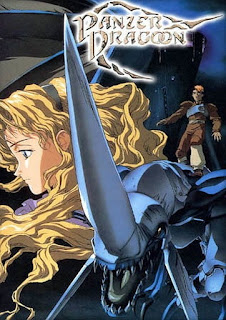
Panzer Dragoon, 1996, dir: Shinji Takagi

For once we can do away with our usual opening question when it comes to these titles that didn't make it past a VHS release: the reason Panzer Dragoon never got as far as a DVD is that it's all of about twenty minutes long minus credits and crap.  So let's begin instead by bemoaning the fact that, of all the video game series there have ever been, it's hard to think of one that would have offered better material for an anime adaptation, and this, this, is what the Panzer Dragoon universe got served with.  I've only ever played Panzer Dragoon Orta on the original X-box, so I can hardly call myself a series expert, but that entry alone offered up one of the richest, most elaborate, most intriguing fantasy worlds I've ever encountered in a video game, and all somehow delivered mostly through the exceedingly limited means of an on-rails shoot-em-up.  Only as I started researching this review did I discover that there's an actual Panzer Dragoon RPG, in the shape of Panzer Dragoon Saga, and the idea of an RPG with the sort of world-building that Orta got up to is a mouth-watering prospect.

But none of that helps Panzer Dragoon the anime.  Okay, not entirely none of it: if there's anything going right here, it's that the world design hints at a vastly more interesting setting than what we're shown.  However, those cool designs are rendered almost entirely in some of the worst CG that's ever made its way into anime, and this at a time when CG was never what you might, from our present perspective, regard as good.  There is, it turns out, bad CG that you can smile along with because, hey, it was the mid-nineties and they were trying their best, plus it probably cost the budget of the average small island nation and took eight months to render, and then there's bad CG that just makes you want to slap the creators for ever thinking people would pay money to have their eyeballs seared by such ugliness.  The models, in fairness, are just about passable, but the backgrounds ... my goodness, the backgrounds are horrible to look upon, and I refuse to believe there was ever a point in history when anyone would have believed otherwise.  Though I can't verify the theory, I think it's likely the CG assets in Panzer Dragoon the anime are in fact the CG assets from Panzer Dragoon the Sega Saturn game from way back in 1995, and what would have looked perfectly okay in that context looks every sort of ghastly in an anime from 1996.

Should I talk about the story?  I don't really want to, plus there basically isn't one.  Our protagonist - Kyle in the godawful dub - gets attacked by a black dragon that kidnaps and kind of semi-absorbs his girlfriend Alita, who, in the closest we get to a vaguely distinctive angle, is blind, though practically nothing will come of this detail.  Another dragon, this one blue, turns up and recruits Kyle as its rider so the pair of them can stop the black dragon getting back to a big metal tower that we saw in a brief opening sequence and thus doing bad stuff.  But can the blue dragon be trusted?  After all, it immediately kills a bunch of folks and ... wait, no, that plot thread gets dropped in all of about two minutes.

Again, I can't say there's absolutely nothing here, though Panzer Dragoon comes perilously close.  The vehicle and dragon designs, as I've mentioned, are theoretically pretty neat, if you pretend they look how they're obviously meant to look and not how they actually do.  The character designs are rather good on paper, which makes it all the more irritating that they were instead brought to life with computer animation that was hopelessly inadequate for the task at this point in history.  There's an ever-so-slightly endearing bonus feature at the end showing how the concept art became the final product - spoiler alert! badly! - and the music that accompanies it is much nicer than anything in the finished product as it was released in the West, leading me to believe ADV mucked with the soundtrack, lest a beautifully sung track in Japanese highlight how their voice cast couldn't even handle stringing simple sentences together.  And now I've run out of good points and I'm off to start a petition to persuade Sega to make an adaptation of Panzer Dragoon that isn't in the running for worst anime ever.  Wish me luck!

Dark Warrior, 1991, dir: Masahisa Ishida

I've been working off the assumption that any titles that never made it beyond a VHS release were by and large quite rubbish, and that rule of thumb has served us fairly well, with a few notable exceptions.  Yet throughout most of the two volumes of Dark Warrior, a show that has very little in the way of reputation and all of it bad, the thought I kept returning was "I've definitely seen worse."  Of course, that's not saying a great deal at this stage, and perhaps the thought that would have been truer to the mark was, "Why did Manga stuff their Collection range of dodgy budget titles with so much garbage when they could have been putting out titles like this that are merely not very good?"

This isn't, I realise, a terribly useful way of starting a review of Dark Warrior itself, and possibly that's me deliberately ducking the issue, because Dark Warrior feels ever so slightly review-proof.  I could tell you, for instance, that it features some truly abominable animation, and I wouldn't be lying: I don't recall the last time I saw this many genuinely dysfunctional shots*, wherein, say, a train jolts around a corner without any inbetweening or a whole conversation takes place without anyone on the staff remembering that people's mouths move when they talk.  However, for all that, the bulk of the animation is perfectly serviceable and it's clear this wasn't the work of incompetents: there's the odd bit of nice character design here, the odd standout background there, and most of the really egregious stuff is confined to the first episode, with the second, by its end, veering dangerously close to looking quite decent.

Likewise, I might suggest that the plot is hackneyed crap of a sort that any vintage anime fan will have seen so often they could predict its every development, and stripped to the essentials, that's true.  A part of me would prefer not to spoil it, for reasons I'll come to in a moment, but since the back of the box couldn't care less, it would be foolish of me to.  In fact, let's just quote that box, because life's short: "Joe Takami had it made ... Then he found out that he WAS made ... And that the people who made him want him back!"  Joe, you see, is actually a clone and for some reason that gives him superpowers, which basically mean he punches real good, and the evil organisation who made him are fascists set on creating a new master-race of humans (that the opening prologue is narrated, without context, from their point of view is an alarming way to kick things off!)  Hackneyed crap, as a say, but it helps that Dark Warrior doesn't seem to realise and so busies itself with strange digressions that arguably make it more watchable than it might have been.  A large proportion of the first episode is devoted to setting up a mystery the box has already given away, and I found myself quite drawn in, perhaps because Takami is a novel character as far as vintage anime is concerned, as though someone thought that what The Guyver really needed was Bill Gates for a hero.  Genius software developers aren't exactly common protagonists in nineties anime, but that aside, Joe is self-absorbed and prickly, and a mass of contradictions in a way that proves to be nice foreshadowing: having established that he spends most of his time talking to the AI he built, it's puzzling when he declares that what matters most to him are his friends and family, but the incongruity will make perfect sense before the episode's done.

All the same, I suppose I'm largely commending the first volume of Dark Warrior for being better than it might have been, and often it's not even that: once it settles on being violent shlock, there's no option except to compare it with endless similar titles and conclude that most of them did the job better; in particular, there's a rape scene that feels like the most horribly shoehorned-in attempt to be shocking and leaves a very sour taste.  So it's probably fair to say that most of my goodwill toward Dark Warrior arises from the second volume, which is arguably more familiar fare but does everything that bit better.  Aside from the much-improved animation, the self-contained plot has enough odd grace notes to make it feel like its own thing: Joe makes friends with a young psychic girl in a manner that's actually quite sweet, a giant cloned killer whale is a major plot element (Dark Warrior really doesn't seem to have the faintest idea of what cloning actually involves!) and the action is more ingenious and relies less on gory punchlines.  Really, then, the fair thing to do would have been to review the two volumes separately, and I would have, except it's a stone-cold fact that no one gives a damn about Dark Warrior and, for all that it kept me moderately amused for a couple of hours, there's no reason they should.

Gude Crest: The Emblem of Gude, 1990, dir: Kazuhito Kikuchi

Gude Crest runs to forty minutes sans credits and has enough material - if perhaps not quite enough of a story - to cover twice that length without breaking a sweat.  It opens with one of those narration-over-still-images prologues that were all the rage in fantasy anime at the time, probably because they were an easy way to save a bit of cash, except that in Gude Crest's case, the prologue isn't done by the thirty second mark as was invariably the case.  No, instead, when we get to what feels like the natural cut-off point, our trusty narrator moves on to another topic, and then another, and before you know it, two minutes have gone by and you've been introduced to a whopping slab of fictional history spanning entire millennia.

Whether or not we choose to consider this as charmingly committed or hopelessly naff, it's a fair indication of where Gude Crest's head is at.  As I suggested, the story, cut to its bare bones, is pretty slight, but the sheer volume of stuff that goes on around it and the numerous plot diversions that serve more to build character and add colour than to move things forward and the intricate window dressing that's strung over every aspect are all so involved that it feels like more than it is - at least until the end, which inevitably winds up seeming a touch rushed and anticlimactic when Gude Crest has invested so much energy in engaging us with its clichéd but elaborate world-building and its familiar but appealing heroines.

Those two are sorceress Efe and swordswoman Jira, and if there's any wrinkle in their Dirty Pair-style characterisation, it's that Jira is the rough one but also a former princess whereas what little we learn of the somewhat more refined Efe suggests she has a much more ordinary background.  So points for slightly subverting a trope, I suppose, but points immediately taken back for how the two voice actors never quite find the spark their relationship requires, unaided by a script that has the feel of bantering dialogue without much in the way of actual humour.  Still, for all that Gude Crest has the air of a comedy, that's not where its heart lies, and what we get instead is a certain energetic light-heartedness that's probably better suited to the show's busy fantasy milieu.  A serious attempt at comedy would be one element too many for something that's already on the verge of being dangerously overstuffed, and anyway, the business Efe and Jira finds themselves mixed up is hardly the stuff of high humour, with an evil cult to be defeated, lots of politicking to be unravelled, and three identical-looking siblings to be defended (though one of them is dead before the five minute mark, so maybe not so much that last one.)

Not much else sets Gude Crest apart, though director Kikuchi is a bit more engaged and imaginative than you might necessarily expect; it's evident, anyway, that he was making actual choices about how to frame shots and such, and often those choices are good and eye-catching, which does a lot to stretch an obviously less than stellar budget.  And even without Kikuchi's going the extra mile, Gude Crest looks pretty nice, with lavish backgrounds and quality character work that does much to plug some of those gaps the script never quite gets to.  All in all, however, it's the ambition and attention to detail that really separate this short fantasy OVA from all the many other short fantasy OVAs from the time, and the earnest, mostly successful attempt to squish a novel's worth of material into so short a running time.  For me, it worked more than it didn't, enough so that the result is one of those rare cases of a VHS-only title where I'm genuinely at a loss to explain why it never made it to DVD: ADV would certainly put out much worse than this charming, jam-packed little adventure.

Iczelion, 1995, dir: Toshiki Hirano

Oh what a tangled mess the Iczer series is!  For Iczelion, AKA Iczer Girl Iczelion, is indeed, as the name sort of kind of suggests, a part of said series, which began with Fight! Iczer 1 and continued with Iczer Reborn, released in the UK and reviewed here as Adventures With Iczer 3.  However, Iczelion is also much more of a reboot, though it has in common with the previous iterations a character called Nagisa, only now she has a different surname and hasn't much to do with the Nagisa we've come to know and tolerate besides being quite useless.

In Iczelion, that's more of an issue than it was in prior entries, since Nagisa has been promoted to protagonist, though the show will forget this regularly over the course of its two roughly half hour episodes, perhaps because it was a terrible idea.  Nagisa, you see, is a high school girl with no special qualities except for a befuddling desire to become a professional wrestler in spite of how she's terrified of violence, and barely have we met her but she finds herself caught up in a scrap between a goofy-looking robot and some sort of alien aggressor.  That robot, as it turns out, is more of a sentient armoured suit kind of deal, going by the name of Iczel.  And Iczel's convinced, despite the abundant evidence to the contrary, that Nagisa is just the sort of person it should be bonding with to defend the Earth from the evil space villains who plan to destroy it.

I realise it's a fool's game to criticise nineties anime for not making a lot of sense, but boy does Iczelion not make much sense at all.  And I'm not even talking about the whole Iczel / Nagisa relationship, which, for some fifty minutes of the running time, involves Iczel attempting to persuade Nagisa to do anything other than attack monsters with wrestling moves or run away, and Nagisa determinedly doing whatever the dumbest thing might be in any given scene.  No, that I found quite charming, given that I suspect most of us, as much as we might prefer not to admit it, would deal with such an outlandish situation in similarly dumb-ass ways, and Nagisa is more an engine to move the plot forward than an actual protagonist.  Rather, the part of Iczelion that's flat-out nonsensical is how there are already three other girls out there who've bonded with Iczel units and all know each other and have even had time to give themselves colour-themed names and personalised special moves and whatnot.  I mean, how long has this alien invasion been going on for?  The implication as we first meet Nagisa is a matter of minutes, but the fact that there's an entire squadron of Iczelions kicking about implies weeks or months.

Am I nitpicking?  Probably.  Is there any value to nitpicking a two-episode OVA from nearly three decades ago?  Possibly, but not when it comes to Iczelion, because everything that makes it kind of awesome comes from the Iczelion squadron, who surely ought to have been the focus from the off.  Far more so than Iczer RebornIczelion harks back to what made Fight! Iczer 1 such a treat, or parts of it at any rate.  The gross-out horror and general weirdness is still largely absent, but the overload of imagination and the neat fight scenes are very much back, and most of the latter involve the rest of the Iczelions, rather inevitably given how fight scenes don't work when one of the participants is legging it toward the horizon.  And fortunately, Iczelion is also something of a technical return to form: if the animation's good rather than great, it's enough to sell those many action scenes, and for bonus points we get a score co-written by the great Kenji Kawai, who could have breathed extra life into this sort of material in his sleep by this point in his career.

I don't know that solid animation, a neat score, and ingenious fight scenes are really enough to qualify Iczelion as legitimately good, but then, I'm not sure that was ever the goal.  For one thing else that's returned from Fight! Iczer 1 is the sleazy, pulpy tone, and whatever you might think of sleaze or pulp, it seems like the right fit for this material.  It's exceedingly trashy - I'd struggle to think of any anime where the transformation sequences were so wholly an excuse for a spot of gratuitous nudity! - but then it's hardly pretending otherwise, and I seem to recall praising Fight! Iczer 1 for much the same approach, which is to say, accepting what it is and trying hard to be the best version of that.

You can knock the Iczer franchise for plenty of things, most noticeably starting on a far better note than it would ever hit again, but the results remain an appealing oddity.  Despite sharing the same director, the hugely inconsistent and occasionally brilliant Toshiki Hirano, they barely feel like they belong together, yet the plus side is that they all have their own specific charms, albeit not all equally.  I've warmed up a bit to Iczer Reborn since I first watched it, having seen it in the original Japanese instead of Manga's preposterous dub and with the context of Fight! Iczer 1, but I'd still rate Iczelion marginally higher.  Its biggest fault, other than arguably focusing on the wrong character, is that it's too short, stopping just as it's about to get going.  Still, this is definitely a title whose failure to reach DVD makes no sense, and I for one would be happy indeed to see this strange, inconsistent franchise be rescued from the rubbish heap of time.

-oOo-

So there we have it: four reviews and only one title that categorically didn't deserve to make it to DVD.  Okay, probably two, objectively Dark Warrior was fairly dreadful, and I probably ought to stop falling back on "but worse stuff got released!" as an argument given how astonishingly low that particular bar got on occasions: not being Sword for Truth isn't grounds for a recommendation!  Nevertheless, that still leaves us Gude Crest and Iczelion, both of which are genuinely quite good and feel like strange omissions, especially the latter.  Probably the explanation lies in how each segment of the Iczer saga found itself with a different publisher, but that's hardly fair on poor Iczelion, is it?

Next up: not another post of VHS-only stuff, I promise!  Well, promise is a strong word, but I'll see what I can do...


[Other reviews in this series: By Date / By Title / By Rating]


* Okay, I do, it was Gundress.

Thursday, 14 April 2022

Drowning in Nineties Anime, Pt. 116

Following on from last entry's worry that I'm getting awfully short of DVD releases to cover, another concern is that, with so few remotely well-known titles left to review, these posts will hit a point where we're wading through the dregs; since one of my goals has been to highlight the fact that, however tacky, derivative, and wantonly commercial it sometimes got, nineties anime was on the whole pretty good, I'd sooner not end up by putting out post after post of irredeemable crud!  Yet, somehow, that point keeps on not coming, in part because the baseline really was pretty decent and even many of the least known titles had something to offer, but also in part because there truly is some brilliant stuff out there that we haven't touched on, whether famous or not.  And so it is that, with well over four hundred reviews behind us, we still have a couple of titles here that I'm tempted to describe as classics.

Though granted we also have a couple of titles that I'd never in a million years consider calling classics!  So what's what from amid Getter Robo Armageddon, Compiler 2, Sprite: Between Two Worlds, and Neo Tokyo?

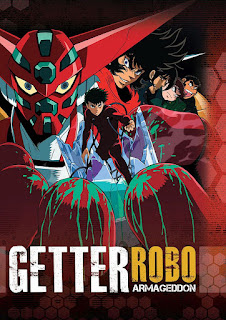
Getter Robo Armageddon, 1998 - 1999, dir's: Yasuhiro Imagawa, Jun Kawagoe

Were all of Getter Robo Armageddon operating at the level of its first three episodes, I'm comfortable in saying we'd be looking at a masterpiece ... maybe a major masterpiece, maybe a minor one, but definitely a masterpiece of sorts, because those introductory episodes are as strong as just about anything that came out of anime in the nineties.  What we have here is one of those gritty reimaginings of a classic property that were so extremely the rage at the time, and which could so easily descend into grimness for its own sake - an accusation you might be inclined to throw at Getter Robo Armageddon if you were going solely off a synopsis.  Because it certainly feels as though its main purpose is to take everything that was sweet and good and innocent about classic giant robot properties and twist it in horrible directions.  The genius scientist is a monster warped by the death of his daughter in a truly ghastly robot-combining accident, and is also back from the dead after apparently being murdered by the guy who surely ought to be our heroic protagonist, and who has to be sprung from prison so he can get right the murder he failed at / was actually innocent of the first time around.  The kid sidekick is practically mute from trauma; the adult sidekicks are angry and bitter; the war against alien invaders that was supposedly won has in fact accomplished not a damn thing.

As I say, all the ingredients for something self-consciously grim and mock-subversive.  But Getter Robo Armageddon gets it right: those opening episodes are like a scream from the subgenre's deepest psyche, plunging its gee-whiz decency into a hell it's wholly unprepared for.  And I feel sure this can't be the first time somebody thought to mix horror with giant robots - that's kind of precisely what Neon Genesis Evangelion did, albeit in decidedly different ways - but I definitely don't recall seeing anything that goes down that road so hard and so effectively as Getter Robo Armageddon.  The enemies feel like they've wandered in from one of Lovecraft's less pleasant nightmares, all claws and eyeballs and an alarming refusal to keep to one shape for more than a couple of seconds, but what's worse is that their presence has infected so much of the rest of the show, both figuratively and literally.  To say more would edge into spoiler territory; suffice to note that there's a real sense of danger and of a world in which goodness is corrupted and transitory.  Heck, even the giant robots are sinister, and all the more so because the average anime fan's brain is trained to see them as kind of quaint and goofy.  It's all just wrong, in ways big and small, and there's something awfully exciting about that, the more so because the animation is good enough to make the material land with sledgehammer force.

I won't suggest things fall apart with episode four, because they absolutely don't.  Getter Robo Armageddon is never less than good.  But after that initial salvo, "never less than good" will still, at points, feel like awfully weak sauce.  What happened, you see, is that original director and project head Yasuhiro Imagawa - he of Giant Robo fame - walked off, or else was kicked off, the project and seemingly left with all the information about where the already convoluted plot was heading locked in his brain.  Thus, the show is forced to reboot itself with that fourth episode, which is fine in that Imagawa had already backed it into a corner where that was happening whatever, but not fine in that Getter Robo Armageddon will only ever feel like the same show Imagawa was making in brief spurts from then onwards.  Let me stress: it could have been much worse.  Kawagoe, his replacement, is no slouch, and while the animation budget dips noticeably at times, along with the near-hallucinatory levels of imagination, there isn't an episode that doesn't manage a few great moments on both counts.

Yet it would be hard indeed not to get to the end of Getter Robo Armageddon - which, let me stress, is certainly a brilliant ending in its own right - and not wonder what might have been.  Shinzo Fujita and Yoshifumi Fukushima, picking up writing duties from Imagawa, make solid efforts to be faithful to the beginning he set out, but how do you be faithful to such a demented fever dream?  There's no hiding the seams, and I suspect even a viewer with no knowledge of the behind-the-scenes shenanigans would notice something amiss.  Of course, it's perfectly likely Imagawa would have messed this up in entirely different ways; I'm not a big enough fan of Giant Robo to believe he was capable of landing such an astonishing opening play.  And maybe that means this was the best Getter Robo Armageddon we were ever going to get, one where reliable craftsmen took over from a visionary better at raising interesting questions than providing satisfying answers - sure, maybe.  Whatever the case, we should be glad for what we got, imperfect but often brilliant as it is.  But damn would it be a thrill to look into the parallel universe where Imagawa's version made it through to the end...

Compiler 2, 1999, dir: Takao Kato

It's impossible to imagine a take on Compiler that wasn't at least a bit strange, but it's easy to imagine one that was much less strange than what was produced, across the course of three OVAs made by three different directors, at the back end of the nineties.  And there already we've touched on part of the explanation for why, in that there's no sense that anyone here was remotely working from the same notes.  Heck, it's hard to believe at points that they were adapting the same manga - said manga, by the way, being the creation of Kia Asamiya, who was also responsible for Silent Möbius and Martian Successor Nadesico, among other well-known works, and so presumably knew how to tell a story much more coherently than you'd ever imagine from watching the anime adaptation of Compiler.

The last time we encountered the series, not so long ago, we got two short episodes, one an uproarious comedy where the main joke was essentially "Ha!  Osakans, am I right?" and the other a gloomy romance between a sentient computer program given flesh and a womanising drunkard.  And I suppose we ought to be thankful that Compiler 2 picks up some threads from what's come before, given how little it seems bothered about making concessions to the returning viewer or indeed the viewer who hasn't already read a good chunk of the manga: at any rate, we're still following the adventures of Compiler and Assembler, refugees from the digital world who've decided they'd much rather hang out in ours with their sort-of-boyfriends than bother to try and conquer it and are happy to scrap with their former masters if that's what it takes to maintain their otherwise carefree lifestyle.  And both the comedy and romance elements are still on the table, this time mixed together rather than held at arm's length, though the focus is equally as much on action and - shockingly for a show as laid back and ramshackle as this one - on the conveying of an actual plot.

This is, in itself, no bad thing, though it's not really playing to Compiler's strengths.  Or rather, strength singular, since the only thing that truly sets it apart is that giddy sense of anything-goes weirdness, and trying to tell a somewhat reasonable story with a beginning, middle, and end doesn't gel with that so well.  Though, to be fair, while the story itself is fairly coherent, the telling is still quite bonkers, if only because nothing about the premise makes a lick of sense, and the more so here in the twenty-first century where the mere matter of flinging around computing terms no longer makes things sound cool and science-fictional.  In this second OVA, we never once see the digital world whose overseers have offered Compiler and Assembler a somewhat contrived choice between returning home in the knowledge that all memory of them will be erased from our reality or staying on the understanding that, if they do, the world will be destroyed; but it's impossible to piece together how the place is meant to function based on the scraps of information we get thrown.

Thinking about it, the biggest failing here is probably the amount of time that goes into making that extremely ginned-up conflict and the world-building in general makes any measure of sense.  If you need to have your characters actively discussing how the evil scheme they're caught up in is kind of nonsense, something's certainly gone wrong somewhere.  It all feels very much like an attempt to wrap things up in a manner that the first OVA couldn't possibly have been less interested in, and mostly for that reason, at no point is Compiler 2 ever quite so much fun as the first episode of Compiler.  But it's a good deal more so than the second episode, and judged by the general standards of anime rather than the highly specific standards of this one series, it's arguably better across the board than either: if nothing else, the animation is rather nice, especially by 1999's low bar, and the balance of comedy, romance, action, and general oddness is just about right.  At any rate, it left me with a definite soft spot for the franchise, bewildering and routinely dysfunctional as it is, and if you enjoyed the original Compiler, I can't think of a good reason why you wouldn't also enjoy Compiler 2.

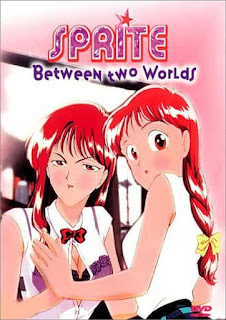
Sprite: Between Two Worlds, 1996, dir: Takeshi Yamaguchi

Of all the strange and dubious decisions made by distributor U. S. Manga Corps, their attempts to bring over a number of milder hentai releases while going out of their way to hide the fact that they were hentai is surely the hardest to wrap your head around.  And of all the strange and dubious titles that were licensed under that strange and dubious decision, Sprite stands out especially in that it's impossible to imagine how this was meant to work.*  It's so clearly pornography that you wonder how anyone supposed they could pass it off as anything else; I mean, Fencer of Minerva was kinky as heck but you could sort of squint and pretend you were watching a regular fantasy anime for much of its running time, and there's no amount of squinting that will get you past the turns that Sprite takes in the second half of its eighty minutes.  Yet take that away and there's not a lot left.  The blurb has to be one of the briefest U. S. Manga Corps ever came up with, and the cover art is noncommittal enough that you have to flip over to the slightly less deliberately misleading back of the box to have any hope of guessing what you're in for.

Then again, perhaps that's not terribly surprising when what you're in for is a soft-porn tale about a teenage girl with severe mental health issues.

Let's be fair, there are absolutely ways you can come at the topic of multiple personality disorder that don't automatically make your story totally traumatic.  It's a concept that's been abused enough that the average viewer's reaction is more likely to be to take it with a pinch of salt than to feel sorry for the poor, benighted soul who has all this going on inside their cranium.  It's entirely easy to envisage a version of Sprite that doesn't have us thinking about this stuff too seriously, one where a female lead who flips to an alternate personality who's bolder, sexier, and more prone to violence is played for laughs - and who knows, maybe that's even what the makers thought they were up to?  I mean, if they did, they were enormously bad at their jobs, but it's conceivable.

Sounds unfair?  Then I guess it's time for a plot summary!  Our protagonist is Tohru Takamura, who we meet as he's about to start living with relatives while his mother's in hospital.  Barely has Tohru set foot on the property before he's inadvertently sprayed water over his cousin Manami and spent what feels like somewhere in the region of seven minutes ogling her sodden breasts, an event we'll later get to see him celebrating in classic teenage boy style with the aid of a box of tissues.  Manami is a shy, retiring sort, the more so since she's recently drawn the ire of a gang of bullies at her school; but when Tohru tries and fails to come to her rescue, Manami responds in totally un-Manami like fashion by beating the crap out of them and generally behaving like an altogether different person.  That person turns out to be Nami, her alternate personality, who's everything she isn't and happy to do all the things she won't, such as getting sexy with Tohru despite his manifest failings as a human being.  The only problem, assuming you don't consider bullying and debilitating mental health issues problems - and there's no real indication the makers of Sprite did! - is that both personalities are convinced they'll disappear if they ever become too subordinate.  Tohru wants to help, or at any rate wants to sleep with both Manami and Nami, but what's a boy to do when the girl he's living with turns out to have a promiscuous alternate personality who's totally up for up it?  If your first guess was not "urgently seek the advice of a qualified psychiatric professional," there's a fair chance you've successfully pre-empted the plot of Sprite.

There's nothing here that truly works: the animation is just about as good as it needs to be and never remotely more and the soundtrack stands out solely for including a tune that brazenly rips off the theme from Top Gun in a way anyone who's ever seen Top Gun couldn't possibly miss.  But that doesn't mean Sprite can't be kind of hypnotic.  Like a lot of bad anime, its refusal to go down the easiest route - indeed, its determination to pursue any number of totally incompatible routes all at once - takes it to places that are more interesting than you might expect from the setup.  And also, in fairness, much more creepy and disturbing.  As with most of the titles U. S. Manga Corps brought over in their bid, presumably, to trick Western audiences into watching hentai without their noticing, it makes for a fascinating time capsule, but unlike most of them, it isn't much actual fun to sit through.

Neo Tokyo, 1987, dir's: Rintaro, Yoshiaki Kawajiri, Katsuhiro Ōtomo

Outside of Studio Ghibli, I don't think it would be an exaggeration to suggest that there were no three more important directors working in anime at the back end of the eighties than Rintaro, Yoshiaki Kawajiri, and Katsuhiro Ōtomo.  In the same year that Neo Tokyo was released, Kawajiri put out Wicked City, the first of a string of seminal works that did as much as anything to set the template of what a certain breed of anime would look and act like throughout the coming decade; Ōtomo, meanwhile, was a year away from Akira, and along with Neo Tokyo would be involved in 1987 with another anthology movie that feels very much like its spiritual twin, the superb Robot Carnival.  And if Rintaro was arguably past the most significant and influential portion of his career, he still had one of his finest works, Doomed Megalopolis, waiting in his near future, a title that's every bit as genre-defining as Kawajiri's efforts.

So how the hell has Neo Tokyo vanished from the face of the Earth and the memories of all but the most hardened of vintage anime fans?  For what reason is its DVD release one of the rarest and most hard to find?  If, as seems likely, ADV just didn't produce anywhere near enough copies, perhaps in the assumption that they could only hope for the niche-ist of niche audiences, even having made up a new title to cash in on Akira's enormous fame and the Ōtomo connection**, why has no one sought out the license since?  Why don't we have a blu-ray of this thing?  Could it be that three of the if not necessarily most talented but definitely most interesting and significant creators of pre-twentieth century anime just somehow managed to produce a sucky movie between them?

Reader, they did not.  But they definitely did produce a very weird one, and now seems as good a time as any to wade into the specifics of each segment.  Rintaro gets to go first, and if his section gives a taste of what's to come, it's only by being random enough that the astute viewer will realise they're better off chucking their preconceptions out the window.  The marvellously titled Labyrinth Labyrinthos follows a young girl and her cat as a game of hide and seek takes them into a fantastical and sinister other world, and - no, wait, that's pretty much the entire story.  But since storytelling was invariably Rintaro's weakest point, the opportunity to go all in on imagery and ideas does him no end of good, especially since (and this is true of all of Neo Tokyo, incidentally) the animation is routinely astounding.  At any rate, other than to slap us around with some delirious weirdness, Labyrinth Labyrinthos mostly serves as a way into the film proper and to Kawajiri's entry, Running Man, which - uh, still doesn't have all that much of a story.  Indeed, until I read the Wikipedia entry, I couldn't have told you what it was about at all, except that there's a racing driver and a private detective who does nothing besides offer up a spot of narration and maybe the racing driver has psychic powers or something?  It's almost as much of a mood piece as Labyrinth Labyrinthos, but with a very different mood, and since Kawajiri was nearly as great a visual stylist as Rintaro, that turns out to be perfectly okay, though it remains probably the weakest segment.

Which brings us to Ōtomo's Construction Cancellation Order, and while I'm sure there's an argument to be made that it's not the strongest part, I can't imagine what that argument might involve.  At last we get an actual, proper plot, though Ōtomo's tale of a beleaguered salaryman trying to convince the robot foreman of an entirely robot-run construction project buried deep in the depths of a South American jungle that the project's been cancelled is still more about mood that anything else.  And here's what, for me, pushed Neo Tokyo past the point of being a good but haphazard compilation of stunning yet faintly unsatisfying short films into the realm of definite greatness: somehow, against all the odds, it feels like a single movie with overarching themes and attitudes, though I'm not convinced even its three creators could have articulated what those themes and attitudes are.  Unlike, for instance, Memories - and say what you like about Ōtomo, the man's certainly had his hand in more than his fair share of excellent anime anthology projects! - it somehow pulls off the trick of feeling like a unified entity and so of being better than the sum of its already strong parts.  Which makes the only real dissatisfaction that, at fifty minutes, it leaves you wanting more than it has to provide; one more piece, from a director on a par with Rintaro, Kawajiri, and Ōtomo, and we'd be looking at an undeniable classic, rather than what for all the world feels like (and couldn't possibly have been!) a trial run for the masterful Robot Carnival.  Still, put the pair of them together and you'd have one of the greatest anime double bills imaginable, so that's really the tiniest of criticisms.

-oOo-

Anything else I might have to say here is overshadowed by the fact that I finally got to watch the somewhat legendary Neo Tokyo and that it didn't disappoint.  It's a fine little film on its own, but more than that, it's such a nexus of everything important that was going in anime in 1987 that it's always felt like a gaping hole in my knowledge.  Taken purely on merit, though, Getter Robo Armageddon was nearly on a par, and while Compiler 2 very definitely wasn't, it was at least a fun diversion.  Would that the same could be said for Sprite, which I'd got my hopes up for on the back of how cheerfully demented some of U. S. Manga Corp's other attempts to bring hentai titles over without anybody noticing were!  Nevertheless, three of out four is still pretty good going this late in the game...


[Other reviews in this series: By Date / By Title / By Rating]


* The more so because their routine pre-credits disclaimer about how none of the characters involved in sexual situations are under eighteen rings more untrue than ever here when the show is transparently set in a high school.

** The actual Japanese title, I believe, translates as the far superior and more appropriate Labyrinth Tales, whereas the English title the film gives itself is Manie-Manie, for reasons I've never been able to pin down.  Though even that's better than the completely meaningless Neo Tokyo.

Thursday, 3 March 2022

The Outfit is Out

 I'm sure there's a pun title there I'm missing, but I'm playing catch-up here, having somehow managed to forget the release date of my own book, so it'll have to do.  Strictly speaking, the e-book and I assume the audiobook are already out as of the first of this month and the UK print edition is released today, which the US print edition should also have been, but mysterious and unforeseen factors have pushed it back a couple of weeks and it'll now be landing on the 16th.  Still, that's only a couple of weeks, right?  With everything that's going on in the world right now, it's hard to begrudge a two week delay!

As for whether or not you ought to grab a copy of The Outfit in whatever format and at whatever time, obviously that's between you and your conscience, and I'm sure there are lots of people out there who have no interest in reading the bizarre ripped-from-true-life tale of how the future Uncle Joe Stalin and his merry band of Bolshevik cutthroats pulled off one of the most outrageous open-air robberies in history, getting away with a small fortune that they then somehow how to smuggle out of a city under total lockdown and find some way to spend when the news of their misdeeds had spread through every corner of Europe.  I admit, that's the kind of cosy, everyday tale that's unlikely to rouse the more thrill-seeking of readers, but hopefully there are at least one or two people out there who can do without the excitement of chases and gunfights and explosions (okay, it has all of those too) and tolerate a few hours of musty history.  Well, if you think that might be you, here's the blurb:

Lies and double-crosses, secret police and explosions, a carriage chase, a mattress stuffed with cash and a one-eyed master of disguise…

In 1907, the revolutionary Joseph Djugashvili – who would later take the name Joseph Stalin – met with an old friend, a clerk at the Tiflis branch of the State Bank of the Russian Empire, for a glass of milk. Over talk of national pride, the spirit of the new century and Djugashvili’s poetry, they agreed the beginnings of a plan.

With the aid of the Outfit, Djugashvili’s hardened crew of “expropriators,” they would pull off the biggest, bloodiest and most daring robbery in Georgia’s history, and ruthlessly change the direction of the Bolshevik revolution forever...

The Outfit is available in e-book, audiobook, UK paperback and very soon US paperback, from all good book retailers.  And probably all bad book retailers, too, I'd imagine, but best not to buy from them, eh?

Friday, 25 February 2022

Drowning in Nineties Anime, Pt. 115

Here's a worry: we're not terribly far off the point where I run out of DVD-released titles to review, and since I'm still unhealthily addicted to vintage anime after all these many years, that's inevitably led me to seek out more and more stuff that never made it as far as DVD.  But while I've never pretended these posts served much of a purpose, filling up entire entries with titles that never even made it onto a remotely modern format seems a bit pointless even by Drowning in Nineties Anime standards.

Thankfully, we're not quite there yet, or even all the way through the relatively well-known stuff; heck, this time around we have a franchise that was revamped not so long ago and two that are still going strong.  But yes, we also have something that never made it past a VHS release, and for better or worse, that's likely to be a feature of most posts going forward.  Put it all together and you get Ushio & ToraCase Closed: The Last Wizard of the Century, Mobile Suit Gundam: The 08th MS Team: Miller's Report, and Compiler...

Ushio and Tora, 1992 - 1993, dir: Kunihiko Yuyama

Is it too much to ask of a comedy action horror show that it be uncommonly great at delivering comedy, action, and horror?  A not entirely serious question, I admit, because obviously it's a big ask that anything be uncommonly great on even a single front, but still, we could all point to any number of anime, or to any amount of genre fare in general, and pick endless examples where more subgenres were crammed in than the creators rightly knew what to do with or where one or more elements felt as though they'd been included more from a sense of duty than any creative passion.

What's most striking about Ushio and Tora, then, is not so much its uniqueness - of which there's not really that much to speak of, though the core concept is a brilliant take on tried-and-tested ideas - but the extent to which it does everything it tries its hand at to such a remarkably high standard and with such obvious enthusiasm.  The action is thrilling.  The horror is ingenious and freaky and really quite shocking in places.  The comedy is actually funny and a welcome relief rather than an annoying distraction.  And even when Ushio and Tora steps outside of those comfortable boxes and dabbles in, say, a spot of light-hearted romance, it still manages not to embarrass itself.

Really, though, it's bromance that's the order of the day, as that title suggests, or as it does if you know that Ushio is a kid who happens to stumble upon the monster his ancient ancestor once supposedly defeated sealed up down in the cellar with a magic spear stuck in him, which Ushio is fool enough to pull out, and that he decides on a whim to name said monster Tora, because he looks as much like a tiger as he does anything else.  From there, you can sort of see how things will go, with Ushio and Tora butting heads and battling other supernatural threats as a grudging team, and Ushio getting into trouble over the presence of a giant carnivorous demon that only he can see, but what sets Ushio and Tora apart is how wholeheartedly it commits to every element of that concept.  To focus on a single example, it's striking how Tora never becomes safe, in spite of the frequent jokes at his expense: even in the latest episodes, where he's notionally on side with Ushio, he's a fearsome, unsettling presence, and that has much to do with Chikao Ôtsuka's outstanding performance in the role, veering between snarling menace and self-satisfied amusement and generally finding the perfect meeting point of the two to conjure up a hundreds-of-years-old hellbeast that we both fear and want to spend time around.

Which isn't to suggest that the rest of the cast and crew aren't doing nearly as good work; bar some opening and closing themes that I never warmed up to, there's no trace of bad craft here.  The writing is thoroughly ingenious, finding a constant stream of fresh takes on familiar ideas and dredging up foes from the darkest corners of Japanese folklore that I, as someone who's seen far too many similar titles, had never encountered.  And the animation and direction are equal to the writing: it helps that the show has such a distinctive look, one of almost unpleasantly rich oranges and blues and character designs that are always a little too dirty and jagged, but that's not to dismiss what a terrific job Yuyama does.  Managing such a range of tones and nailing them all without letting the seams show is nobody's idea of easy, but Yuyama - and Ushio and Tora in general - sure does make it look that way.

Case Closed: The Last Wizard of the Century, 1999, dir: Kenji Kodama, Yasuichirô Yamamoto

The Last Wizard of the Century is, I would say, the first legitimately good film in the Case Closed franchise.  Oh, the first two had their virtues, and certainly both made for an enjoyable watch, but with this third movie, the franchise finally manages to deliver an entry where the virtues are significant and the flaws are trivial enough not to be much of a problem.  It is, mind you, definitely no more than good, and at this point I wonder if Case Closed has any real seeds of greatness in it.  I suspect that you could bend this formula far enough that it would produce a work of genuine excellence - if only because, here in the third film, there are elements moving visibly in the right direction - but we're a fair way from that point yet.

But I came to praise The Last Wizard of the Century, not to bury it, so let's begin by noting that it omits the cardinal sin of the first two entries, that of making its central mystery very obvious indeed.  Granted, the villain of the piece is nearly as immediately guessable as on the last two occasions, but their identity is far less significant this time around, and I think that's the crucial difference: in place of a murder mystery, what we have instead is a Da Vinci Code-esque historical thriller, and there are enough different moving parts that the pleasure is less in getting ahead of its conundrums than in keeping on top of them enough to cling on for the ride.  In this, I'd argue that The Last Wizard of the Century still manages to cheat a bit, in that the crucial details are reliably obvious but thrown at you, sometimes, so rapidly that it's tough to keep track; but then, this being Case Closed, anything at all important gets laboriously repeated once its significance is revealed, so it's barely an issue.

Arguably this is still rather dubious behaviour for what's meant to be a mystery, but as I noted the last time we looked at Case Closed, that evidently isn't high on the franchise's priority list and its probably pointless to grumble too much about its failures to do something that was never on the cards.  Plus, the plot is legitimately fun, even when it's milking some fairly over-explored historical ground: we have the murdered Romanov family, we have Rasputin, we have a previously undiscovered Fabergé egg or two, and chuck in a genius sneak-thief foil for Conan and an assassin with a penchant for shooting people in the eye and there are more than enough spinning wheels to produce something satisfyingly convoluted.  There's an awful lot of narrative to get through, enough to comfortably warrant the film's hundred minute running time, and that has the added virtue of making it feel more like a proper movie and less like a TV special, as per the previous two.

Not that the technical values exactly scream cinema release.  In fairness, the animation is more than respectable, but it's easy to miss how impressive it frequently is when the direction is so leaden.  For this entry, the helmer of the first two and the next few to come, Kenji Kodama, is joined by the man who'd be his successor toward the middle of the 2000s, Yasuichirô Yamamoto, and perhaps the results are a little stronger, but there's still a desperate lack of character and imagination: rare indeed is the shot where it feels like a choice was made that wasn't "let's make sure everyone's in shot."  Fortunately, Kodama is at least good at keeping things moving at a fair lick, and that's enough to keep his limitations from harming the material.  Plus, the rare occasions the film does decide to show off usually come just when they're needed: the climax, especially, manages to use the medium to make what on paper ought to be dull and talky legitimately exciting.  All told, it's a marked shift in the right direction, and if the movies stuck to this upward curve, then I'm a little sad to be saying my goodbyes.

Mobile Suit Gundam: The 08th MS Team: Miller's Report, 1998, dir's: Mitsuko Kase, Takeyuki Kanda, Umanosuke Iida

Compilation movies are a tricky business, or they are if they blatantly don't have the running time to boil a given series down to even its barest essentials.  Miller's Report runs to about fifty-five minutes including credits; Mobile Suit Gundam: The 08th MS Team's twelve episodes contained at least five times that much footage.  So there was never any possibility of condensing the show in its entirety, and where did that leave its creators?  Should they whip through hours of material at lightning speed?  Should they focus on an isolated incident or two, or at any rate a single plot strand?  Should they try and carve out their own story, even if that meant producing new footage?

Miller's Report answers those questions with a resounding, "Yes, yes, yes, and yes."  It recaps discreet chunks of narrative, almost all from The 08th MS Team's first half, while adding what can't be more than a few minutes of new animation to smooth out some rough patches and generally give things a bit of meaningful shape.  Some of the added scenes would have been ill-fitted to the show, but others feel a lot like outtakes, even though outtakes aren't really a thing in animation unless someone's done their job spectacularly badly.  Still, we might cynically suggest that bits of this footage were held back purposefully, or at least were consciously sidelined at the scripting stage, because their insertion would definitely have made certain sequences flow together more smoothly.  Mostly, though, what we get is recapping, with two events covered in considerable depth and a scattering of others whooshed past to give us enough information to follow along.

 It doesn't altogether work, as you might expect, and for a viewer unfamiliar with the series, I wonder how some elements would work at all: major characters pop up incessantly without introduction, even well into the final third, their relationships to the rest of the cast never to be explained, and it would be generous to describe the results as a coherent plot.  What we get, rather, is a series of happenings strung together loosely by theme and more so by a focus on protagonist Shiro Amada, his relationship with enemy pilot Aina Sahalin, and the resulting conflicts both moral and marshal.  But it's here that Miller's Report plays its trump card, in the shape of its titular character, a mysterious government spook who when we first meet her is interrogating Shiro on the eve of his court martial for possibly collaborating with the enemy.  This works on the simple level of offering a mechanism by which Amada can tell us his story, but to their credit, the film's creators dig deeper than that.  Miller crops up again and again, and each time we learn a little more about her, though never so much that we have a clear angle on the character, until a final confrontation that does a fine job of offering a meaningful conclusion even though there's still a third and change of the show left to go.

Miller is an excellent addition, arguably enough so to single-handedly make the film that bears her name worthwhile.  Her existence genuinely improves The 08th MS Team, challenging Shiro's values and judgements in ways that they conspicuously weren't challenged in the show, which always seemed to be largely on his side.  Since we're talking about one of the finest Gundam series ever, though, it's not as though everything going on around her isn't great: it's hard to judge whether the animation's been polished up, because the show was so routinely superb on that front, but it's certainly terrific, and needless to say, the writing and direction are top-tier.  The only real question, then, is who the heck would want to watch the thing when it has the potential to alienate both existing fans by offering them little they haven't already seen and new viewers by leaping over many a crucial detail.  For the former, who'll likely own a copy anyway since it comes with the blu-ray edition, I'd suggest doing what I did and waiting just long enough that your memories have begun to fade, so that the movie becomes a pleasant reminder of how splendid The 08th MS Team was.  And for the latter, though it might be puzzling in places, I can definitely see this working as a bite-sized introduction to Gundam for those wondering what the mega-franchise has to offer, even if there are undoubtedly better places to begin.

Compiler, 1999, dir's: Takao Kato, Kiyoshi Murayama

Imagine, if you will, a take on the Oh! My Goddess formula, whereby one of more supernaturally powered females force themselves into the life of a single, socially awkward male, but one commissioned about a week before it had to be out and created by people who'd never in fact seen Oh! My Goddess or one of its countless imitators and indeed had only ever had the concept described to them at two in the morning after a heavy night of drinking.  So instead of a household of goddesses we have three invaders from what's described as a 2D world but must surely be intended to be some sort of cyber-realm within the Earth's computers, given that their names are Compiler, Assembler, and Interpreter.  And having rapidly lost interest in that invading business, as we meet them Compiler and Assembler are shacked up not with one lone nerdy guy but with a nerd and his hard-drinking, lecherous brother, in between fending off occasional attacks from their former masters, though that's a matter no one appears to be taking remotely seriously.

If I'm being vague, it's because ninety percent of what I've described arrives in a brief introductory villain monologue: by the time we join the show, Interpreter has largely vanished from the picture and Compiler and Assembler have settled into a comfortable groove of hanging out with their kind-of boyfriends.  Now obviously, taking a hackneyed concept, making it much dumber, and then largely forgetting about in favour of some random slice-of-life shenanigans is hardly the obvious route to great entertainment.  And I'd be lying if I said Compiler wasn't a little terrible; but its unwillingness, or perhaps inability, to stick to a genre template that couldn't have been much easier to follow by this point definitely gives it a certain weird energy.  This is truer of the first episode, which is positively demented and seems mostly to have been an excuse to make lots of jokes at the expense of Osaka and Osakans - here, by the way, the unexpectedly decent ADV dub surprised me by leaning hard into the culturally specific humour rather than, like, pretending this was all happening in Pittsburgh or something.  I'd say a good sixty percent of the gags rely on knowledge of Japanese culture that the vast majority of Westerners won't have - the climatic one needs half a dozen screens of helpfully provided text to remotely comprehend - and yet somehow the sheer wackiness and enthusiasm is compulsive in and of itself.  None of which is true of the second episode, which decides to take a deep dive into Compiler's relationship problems, while ditching the humour and the whole cyber-assassins-from-the-digital-world angle in favour of slightly gloomy melodrama.  But while this is obviously much less fun than part one, if only because at no point does it feature a battle between giant animated corporate mascots, it again gains points for the what-the-hellness that's Compiler's main redeeming feature.

Unsurprisingly, neither episode dazzles with its technical accomplishments, though in fairness neither is ever obnoxiously bad.  Its apparent that a lot of the animators' attention was going into getting the bare breasts more or less right, because there are a ton of those on display - sentient computer programs, you see, do not understand this human concept we call "nudity" - but they also wake themselves up for the action sequences, which are commendably solid.  And the music is perfectly fine, with a catchy enough opening track; plus, for the abovementioned mascot battle we get a riff on the Godzilla theme that's just different enough to avoid a lawsuit, and I'll never turn my nose up at a good Akira Ifukube pastiche.

If you've never heard of Compiler - aside from the many reasons I've covered above! - it's because ADV chose not to bring it out on DVD, though based on their advertising, it seems to have come awfully close.  And while they'd release plenty worse titles on the format, I can't altogether criticise their decision: Compiler is a long way from indispensable.  Still, if you're the sort of person who's inclined to dredge through the obscurest corners of vintage anime in search of titles that at least stand out as entertainingly strange, then it's very much worth a look; at any rate, the first episode is, and if that's enough to draw you into Compiler's bewildering world then why not keep going?  Though whether I'll feel the same having watched volume 2 - because, yes, there's more to come! - is anyone's guess...

-oOo-

So our first step in a while back to VHS-land wasn't a total washout, which is good news because, like I said at the top, those truly long-lost titles are going to be more than ever a feature going forward.  As for the rest, the only absolute standout is Ushio and Tora, which I'm amazed doesn't have more of a reputation, but thinking about it, this was one of those rare entries with no real low points.  Okay, except Compiler, probably, but let's not be mean about Compiler, it needs all the breaks it can get.  I mean, you try holding your head high around all the young and up-and-coming animes when you didn't even get as far as a DVD and even your own creators have probably forgotten you exist by now!


[Other reviews in this series: By Date / By Title / By Rating]