Wednesday, 21 August 2019

Drowning in Nineties Anime, Pt. 54

If there's one thing that firmly differentiates nineties anime from Western films and TV of the period, it's the willingness to put female characters front and centre, often to the point where they make up basically the entire cast.  Sometimes - heck, often! - that can be for reasons that are closer to exploitation than feminism, yet there's a great deal of stuff that occupies a weird middle ground that, sure, crowbars in more shots of underwear than can reasonably be justified, but also manages to present an interesting, complex female cast, or else a protagonist who's every bit as capable and more as the men around her.

And yes, this is me flailing for a themed post topic, but hey.  Here we have four titles that focus on female protagonists and largely female casts, and yet take very different approaches, in the shape of: Carcaptor Sakura: The Movie, Idol Project, Kekko Kamen, and Cleopatra D.C....

Carcaptor Sakura: The Movie, 1999, dir: Morio Asaka

Above all else, the first Carcaptor Sakura feature is an extraordinarily pleasant film.  It portrays pleasant characters having pleasant adventures in pleasant locations, via soft and appealing designs and a warm palette and mostly fun and gentle music.  Even when it gets dark and creepy - as it does quite frequently, and more so than the TV series, from what I've read - it feels as though the shift in tone is less to persuade you that something bad might happen to a favourite character, as there's never the slightest suspicion that it genuinely will, but more to offer contrast.  Indeed, the moments that have most potential to be scary are played in a quite different register, a sort of wistfulness that makes perfect sense by the time the plot has reached its end.

Mind you, I use the word "plot" advisedly.  It's hard to imagine a more wafer-thin story supporting eighty minutes of film.  The conflict doesn't get started in any meaningful way until past the halfway point, and is incredibly minor in scope, threatening Sakura and her friends in a rather indirect fashion but never anyone else: at one point, a few random people are rained on, and that's the closest to a city-shaking crisis we get.  Indeed, the movie is much more interested in plucking up its cast and dropping them into a new setting - in this case, Hong Kong - and generally watching them hang out amid that change of scenery.  It's possible that the larger narrative is plugging a few gaps in Cardcaptors law that I'm oblivious to, but if it is, I doubt they're answers anyone was desperately seeking.  It's all incredibly low key and inconsequential, in a way that seems altogether deliberate.

As such, this isn't a criticism, or not really.  The plot was certainly too airy for me, but I fully acknowledge that I'm not the intended audience here: I'm not familiar with the series or the manga, and perhaps more importantly, I'm not a young Japanese girl.  And even with all of that said, I had no trouble following along, or figuring out relationships and crucial details, and no trouble staying engaged either.  It helps that Carcaptor Sakura: The Movie looks terrific, with a generally high level of animation worthy of a cinematic release, some deft direction from Asaka, and frequent moments of real loveliness and artistry; there's a sense of affection for the material that marks this out as no mere knocked-off franchise film.  It's not exactly thrilling and the story won't stay with you past the opening credits, but for what it is, a magical girl adventure that prizes niceness, decency, and inclusivity over all else, it's very good indeed, and it's easy to see why Eastern Star recently chose to save it on blu-ray when many a similar title from the time is lost to obscurity.

Idol Project, 1995, dir's: Keitarô Motonaga, Yasuchika Nagaoka, Yutaka Sato

When I say that Idol Project is hilarious, what I mean, of course, is that I found it hilarious, because nothing's more subjective than humour.  And I think that's truer than ever here, since while I laughed out loud a good many times - indeed, as much as I have at any anime comedy - I can readily imagine someone else barely cracking a smile.  Because Idol Project is also phenomenally stupid, and absolutely expects you to be as devoted to the most absurd aspects of Japanese popular culture as it is.

To set the scene a little: Mimu Emilton wants nothing more than to be a pop idol, like her hero Yuri, an idol so idol-tastic that she ended up becoming president of the world, only to immediately abdicate and set up six other idols as effectively the rulers of the planet, despite the fact that none of them seem to be remotely competent human beings.  Mimu's convinced that if she can just compete in a yearly talent contest, then she can join their ranks, but it seems the universe has different ideas, as both she and the six Excellent Idols get kidnapped by aliens for the purposes of -

Look, there's no point going any further with this, is there?  I mean, that right there is barely the first episode, and things only get more preposterous going forward.  And then more preposterous, and more, until somehow the fate of the galaxy is at stake, though for the most incomprehensible reasons.  I mean, the starting point here is a world run by pop idols!  And it's not even as if they're any good at that; a fair percentage of the jokes involve the characters shouting out at inopportune times the one-word motivational catchphrases that represent their single trait personalities.  Which, I have to stress, is funnier than it has any right to be if you happen to be on the show's wavelength, as I clearly can't guarantee anyone else might be.

What else is there to say?  Well, there's a ton of fan service, which would normally put me off in a big way but here feels like part of the joke, especially since it's mostly confined to the single episode where the idols have to try and desperately reinvent their careers by any means possible on an alien planet.  And needless to say, it's about as sexy as watching particularly unsexy paint dry, given those colossally eyed character designs, which again I'd normally hate and here are perfect in their absurdity.  Meanwhile, the animation is mid-budget OVA stuff, but made with enough passion that you can tell the creators were committed to this madness.  And the music, unsurprisingly for a show about idols, is some of the giddiest bubblegum pop you could hope for, yet with enough of a weird edge to make it funny rather than merely twee.

Actually, I think I've inadvertently summed up Idol Project perfectly, because that's its absolute core: delivering the campiest, most saccharine pastiche of anime and Japanese pop culture, with just enough of a knowing wink to let us in on the joke.  And with that bit of summing up done, I'd better just mention the most bizarre fact about the show, which is that someone thought it would be a bright idea to reuse its barcode on hardcore hentai DVD La Blue Girl, and as such I now own two copies of La Blue Girl that I really don't want.  On the other hand, it feels somehow entirely appropriate that, when you order Idol Project, there's a two in three chance of ending up with tentacle porn...

Kekko Kamen, 1991, dir's: Nobuhiro Kondô, Shunichi Tokunaga, Kinji Yoshimoto

If there's one thing Kekko Kamen could urgently do with, it's some jokes.  I think the creators thought they were there, but there's a big difference between a broadly amusing set of circumstances and a gag of the sort that might make you laugh out loud.  Kekko Kamen is often broadly amusing - and let's be clear, if the humour here is anything, it's broad - but truly funny?  Not so much.

Still, if you're willing to look past how purposefully crass it all is, the sheer ridiculousness of Kekko Kamen's setup is hard not to smirk at.  Sparta Academy has some unconventional attitudes to teaching and a perverse approach to punishing students who don't shape up, to the extent that they even have a member of the faculty devoted to nothing but said punishment: in the first episode, it's a Nazi-themed S&M fanatic named Gestapoko, which should tell you about eighty percent of what you ought to expect here.  Anyway, our villains are particularly obsessed with first year student Mayumi Takahashi, and what better way to express their displeasure at her poor grades than to strap her to a giant swastika and cut her clothes off with throwing knives?  Fortunately for Mayumi, Sparta Academy has just acquired a new hero, and if she's not necessarily the one it needs, she's certainly what it deserves: Kekko Kamen fights in boots, gloves, a mask with goggles and giant rabbit ears, and nothing else.  As she cheerfully proclaims, nobody knows her face but the whole world knows her body, and she's not above suffocating her foes with her crotch if that's what the cause of love and justice demands.

Though, in one of those elements that resembles a joke without altogether becoming one, it's hard not to notice that, for all her birthday suit-clad heroics, Kekko Kamen only ever really seems to rescue Mayumi, and then only ever after she's been stripped down to her pants.  You wonder if she's altogether thought this heroing business through.  Nonetheless, our masked avenger is one of the most outright fun aspects of the four episodes, possessed of a beguiling innocence and lack of common sense which suggests that, yes, she did sit down and conclude that fighting crime in the buff is definitely the way to go.  Which is all to the best given that the rest of the cast aren't half so engaging; the main villains, in particular, are visually intriguing but have one personality trait between them, if lecherousness counts as a personality trait.  Indeed, it's only in the fourth and final part that Kekko Kamen gets to test her skills against a worthy foe, a fallen samurai with a penchant for snapping indecent Polaroids and, er, making umbrellas.

The animation is distinctly mediocre and some of the designs are flat-out horrible - there's something terribly wrong about Mayumi's eyes - though you probably won't be surprised to hear that a degree of loving attention goes into getting all those naked female bodies right.  Weirdly, things improve markedly with the third episode, otherwise the least interesting due to a shift of focus onto Mayumi's infatuation with a beautiful transfer student, and then get worse again for the climax, which is in all other ways by far the best, thanks to being the first to spend time setting up a few real gags.  At least the ludicrous theme tune is a pleasure, an energetic ode to its heroine's righteousness with some immensely dopey lyrics.  But I dunno, add all of that up and the results still feel like awfully little for something trying so hard to be shocking.  Ultimately, I guess that's the problem: cartoon nudity and crass gags are fine if that's your bag, but for me, the only thing that could turn those elements into genuine entertainment is some actual humour.  As such, while Kekko Kamen is a tolerable distraction, it's easy to imagine a version that's greatly more enjoyable than what we get.

Cleopatra D.C., 1989, dir: Naoyuki Yoshinaga

It would be tough to write a review of Cleopatra D.C. that didn't degenerate into a list of all the ways in which it's a bit odd, and given that these reviews are a hobby and not a job, I guess there's no reason I should try!  Though even then, there's the temptation to just say "Pretty much everything" and leave it there.  The thing is, even the basic setup is strange.  Our hero, she of the unlikely name Cleopatra Corns, is the leader of the Corns Group, which basically seems to own half the world, but only uses its corporate powers for good.  This leaves young Cleo with trillions of dollars at her disposal and an excess of time on her hands, both of which she spends getting into adventures that mostly seem to revolve around a combination of damsels in distress and the shenanigans of another mega-corporation that devotes its resources solely to the dirtiest sorts of profit.  So right there we already have a protagonist who's basically a gender-swapped Batman without the angst and flying rodent fetish.

Cleo also couldn't be much higher up in the one percent if she tried, and that would make her awfully hard to empathise with if she wasn't such a fun presence, bouncing from crisis to crisis with the giddy abandon of a sixteen year old who has all the money in the world.  Her idea of problem solving, at one time or another, might involve guns, jet packs, ICBMs, parachuting from a fighter plane so that she can shoot at a space rocket with a missile launcher, or just plain buying up an entire firm.  And this in turn leads to some exceedingly strange plots, which seem to be almost but not quite a pastiche of American action cinema - not quite because the show is ultimately too in love with that sort of preposterous excess to wish it any real harm.  Indeed, it feels very much like what would happen if someone got the wildly wrong-headed idea that Roger Moore-era James Bond was a great template to emulate.  And like so much of pre-twentieth century anime, you're sometimes left wondering who the audience is meant to be.  Cleo is just enough like a real sixteen-year-old girl, hanging out with her ever-expanding band of female friends, to suggest that the answer is other teenage girls, but then there are sufficiently gratuitous shots of her naked butt to imply that, no, it was teenage boys after all, and presumably they're the ones who might be expected to get most out of its Moonraker-esque dementedness.

Add to that the character designs, which are relatively normal for the period when it comes to the men and very weird indeed when it comes to the women: Cleo and co look as if someone tried to funnel a contemporary anime aesthetic through the medium of Betty Boop, and thus become the only characters in all of anime to not only have eyes bigger than their mouths but to have eyelashes as big as their eyes.  And while the animation is fair to middling, it's not the fair to middling of 1989; had I been guessing, I'd have pegged it at maybe a half decade later.  Meanwhile, the jazzy score is a nice fit for the material, but just unusual enough to fit into Cleopatra D.C.'s generally off-kilter landscape.  Heck, the show can't even get its episode structure right: the first two are standard length and the third clocks in at fifty minutes, so why not just split it in two?  But Cleopatra D.C., like its titular protagonist, refuses to do anything in conventional fashion.  Whether that makes the end result worthy of your time is, I suppose, another question.  It's certainly fun, pleasant enough to look at, and full of energy and ideas - though it has to be said that the longest episode is the one that feels most conventional.  Even then, though, if you're looking for something different, it's certainly an intriguing curio.

-oOo-

Dumb themes aside, there was kind of a serious purpose here: I definitely find it interesting that anime from three decades ago was happy to put female protagonists front and centre when there are still large portions of the US film and TV industry that consider the idea a bit of a gamble.  But in honestly, I'm not sure this particular selection tells us a huge deal, though at least we touched on some of the major bases.  And whatever else, I enjoyed the lot: even the basically rubbish Kekko Kamen was fun in its own weird way!

Next up: no stupid themes, hopefully.


[Other reviews in this series: By Date / By Title / By Rating]

Thursday, 15 August 2019

Kickstarting Wells

H. G. Wells is probably my favourite genre fiction author of all time, and The War of the Worlds is very possibly my favourite genre novel of all time, and I don't know that either of those facts quite explains why I felt the need - let alone the right! - to come up with a sequel to it.  I mean, I'm not, as a rule, the sort of person who feels the urge to dabble in other writers' creations, or who wonders after every dangling thread in a story I love.  What happens to the narrator of The War of the Worlds after the book ends?  I mean, who cares, right?

The answer, apparently, is that I did, and enough so to write The Last of the Martians: what my good friend and trusted proof reader referred to as a Vietnam-era sequel to Well's classic, perhaps not entirely positively.  The thing is, as powerful as the book as, as chilling as the Martians are, I can't be altogether comfortable with the concept of an enemy that's just so damn alien that there's no hope of ever rationalising with them: that sort of thinking has led us, as a species, into too many dark places over the millenia, and that's never been truer than now.  So the story I wrote was an attempt to square that circle to my own satisfaction, while at the same time staying as true as I could to Wells's style and themes; no act of angry post-modernism this!  I guess my goal was an epilogue to The War of the Worlds that Wells might conceivably have written if he'd come to think that maybe, just maybe, the Martians weren't all and every one of them quite that bad.

Why does any of this matter?  Because I sold The Last of the Martians, that's why.  And more to the point, because the two volume anthology of Wells-ian fiction that it's due to appear in is being kickstarted at this very moment, and if that kickstarter should fail to fund, my story - along with plenty of other dabblings in Wells's many worlds - might not ever see the light of day, which would suck, frankly!  I don't think it's terribly likely to happen though, since the guys at Belanger Books know what they're about, and have been successfully putting out similar (though mostly Sherlock Holmes related until now) collections for a good long while.  And at time of posting, this one's already almost hit its deadline with the better part of a month to go.  So hey, don't fund it to help me out, fund it because it's an exciting project, and because you fancy a couple of volumes' worth of tales devoted to arguably the greatest science fiction writer ever to have lived.  If that sounds at all appealing, you can find the link here.

Thursday, 8 August 2019

Drowning in Nineties Anime, Pt. 53

I guess lumping shorter titles together is a thing I'm doing now, possibly because there are just so many of them in the world of vintage anime that doing so makes sense.  At any rate, this time we have the treat of four titles that were actually meant to be short, rather than cancelled after an episode or two, which is a definite plus.  Indeed, three out of the four are actual movies, and I do kind of love the peculiar beast that is the vintage anime movie of less than an hour in length, the best examples of which tend to be miniature masterpieces of concise storytelling.

But is that what we're looking at this time around?  Woo, perhaps!  There are certainly a couple of major highlights to be found amid Spring and Chaos, Psychic Force, The Weathering Continent, and Judge...

Spring and Chaos, 1996, dir: Shôji Kawamori

Would that there were more films in the world like Spring and Chaos!  Biopics of famous people are ten a penny, but often as not the goal is more to diminish than to understand, by presenting a greatest hits of the person they're lauding or by showing the rocky path to their most noteworthy accomplishment or by dumbing down their struggles to a point where they can be spoon fed to the viewer over the course of a couple of hours.  But Spring and Chaos, in its attempts at offering an hour-long window into the life of poet and author Kenji Miyazawa (probably best known in the West for Night on the Galactic Railroad) refuses any of that.  It isn't the story of Miyazawa's career in any meaningful sense, nor a beginner's guide to his achievements, and it certainly doesn't end on a triumphant note, since Miyazawa died young and unrecognised.  And because it's told through animation - indeed, through some frequently gorgeous and risk-taking animation - it certainly doesn't confine itself to any prosaic reality, let alone to what may or may not really have happened.

Talking about what Spring and Chaos actually does do is more difficult.  Its goals are numerous and contradictory, a celebration of the joy of creating but also a glimpse at its frustrations and even horrors.  Writer / director Kawamori doesn't shy from the fact that Miyazawa was severely depressive, and perhaps mentally ill in wider ways; his hallucinations are presented as precisely that, and there's no suggestion that his creativity was a pleasant or even a healthy process.  For every moment of rapture, there's another where he stalls agonisingly close to the idea he's seeking, or simply sees visions of corpses crawling out of the earth and trying to suck him down.  Miyazawa is neither understood nor rewarded by his peers; in fact, the response to his art is an endless series of punishments and failures, mitigated in part, perhaps, by his moments of sheer pleasure, but never altogether.  Whether he's wrangling with his loan shark father or trying to comfort his ailing sister or playing at school teacher or throwing himself into becoming a peasant farmer, he fails, and fails, and fails again.

Yet the result is as uplifting as it isn't.  If there's a positive message here, it's that Miyazawa was true to himself, and while that lack of compromise was certainly bad for him, it left us with a legacy of great work that couldn't have come about otherwise.  It helps, maybe, that all the characters are drawn as animals, mostly cats, adding a certain whimsy to moments that might otherwise be just too sour.  More so, the very artistry of Spring and Chaos is uplifting, even when what it's depicting is heartbreaking.  In fact, Kawamori's wisest choice in an exceedingly well written and directed film is to let the medium itself do the heavy lifting of comprehending Miyazawa's poetry: essentially, what we have is one art form celebrating another.  Or rather, two art forms, since the use of music and the score itself are equally superlative.

Contrarily, you might argue that the biggest mistake Kawamori makes is leaning heavily into CG animation way back in 1996, when even relatively good CG was destined to stand out.  However, as he notes in an interview on the otherwise sparse special edition disk, that was at least a conscious choice, and it's notable that all the obvious computer animation is confined to dream sequences and such, where its heightened unreality is a thematic fit.  Frankly, it still ages the material in a manner that the lovely hand-drawn animation doesn't, yet it also allows for some astonishing images that might have been impossible to accomplish otherwise: the opening, in which a train pulls away from a station, only for the world to split beneath it, revealing a disturbing array of subterranean gears, is one striking example.

The upshot is a film that defies easy summary.  Were it not for that dated CG, and perhaps if it were a dash longer than an hour, I'd readily call it a masterpiece.  Yet its apparent flaws are definitely part of what makes it so satisfying.  It's easy to imagine a cleaner, tidier, and even more beautiful Spring and Chaos, but harder to conceive of one so brave and fascinating in its choices.  It's not perfect, but it's certainly special, and deserves to be much more widely known than it is.

Psychic Force, 1998, dir: Tomio Yamauchi

The truth is, I've nothing much to say about Psychic Force, try as I might: it really isn't very good, and it isn't very interesting either.  In fact, my main observation was that it was released by obscure distributor Image Entertainment, who were also responsible for the incredibly shonky edition of Babel II I bought.  Come to think of it, Psychic Force has a lot in common with Babel II, though the comparisons do it few favours.  The latter was basically a mess, but at least had a couple of interesting ideas and a certain goofy charm; strip that away, cram the results into two OVA episodes with perhaps a tenth of the animation budget, and this would be what you had left.  Though while Babel II was the sparsest DVD release I've ever seen, Psychic Force goes almost too far in the other direction, with a host of special features on a release that doesn't remotely deserve the attention.

Psychic Force is based on an arcade beat-em-up, which is rarely a good sign, but assuming there's a right way and a wrong way to go about adapting a game that involves nothing except characters hitting each other, this is a certainly a fine example of what not to do.  For a start, there's very little fighting, and what there is isn't remotely exciting.  Instead, we concentrate on the two main characters, which might have worked if there was a bit more to them, and if the focus had been even tighter: attempts to introduce the rest of the game's cast in brief snatches are merely confusing and annoying.  And even the central arc expects us to believe that a friendship so powerful that our hero Burn Griffiths would devote years of his life to tracking down our sort-of-antagonist Keith Evans could be formed in the space of approximately five minutes.  I swear I'm not making this up: Burn and Keith meet, hang out for a couple of scenes, Keith gets captured by the shadowy government agents who are chasing him, and then Burn spends literally years trying to track his vanished "friend" down.  Seriously, Burn, this is why on-line dating exists.*

Also, Burn is a really distracting name to give someone.  Especially when multiple scenes involve fire, and people being set on fire, and other people shouting "Burn" in a wholly inappropriate fashion.

I'd try to say something positive - heck, I said positive things about the similarly named Spectral Force, and everybody in the world hates that one! - but there's just nothing whatsoever to Psychic Force. The animation is rubbish, with a dire reliance on still frames; such crucial events as the fall of civilisation and the enslavement of mankind are portrayed that way, which is so bewildering that I'm not even sure that's what was meant to be happening.  The opening and closing themes are hilariously tacky celebrations of friendship and the power of love respectively, both quite awful.  And above all else, it's impossible to get past the fact that you're watching an adaptation of a fighting game that can't get round to having its characters fight until the last five minutes or so.  You had one job, Psychic Force, one job that countless other titles have managed before you, and you couldn't even get that right!

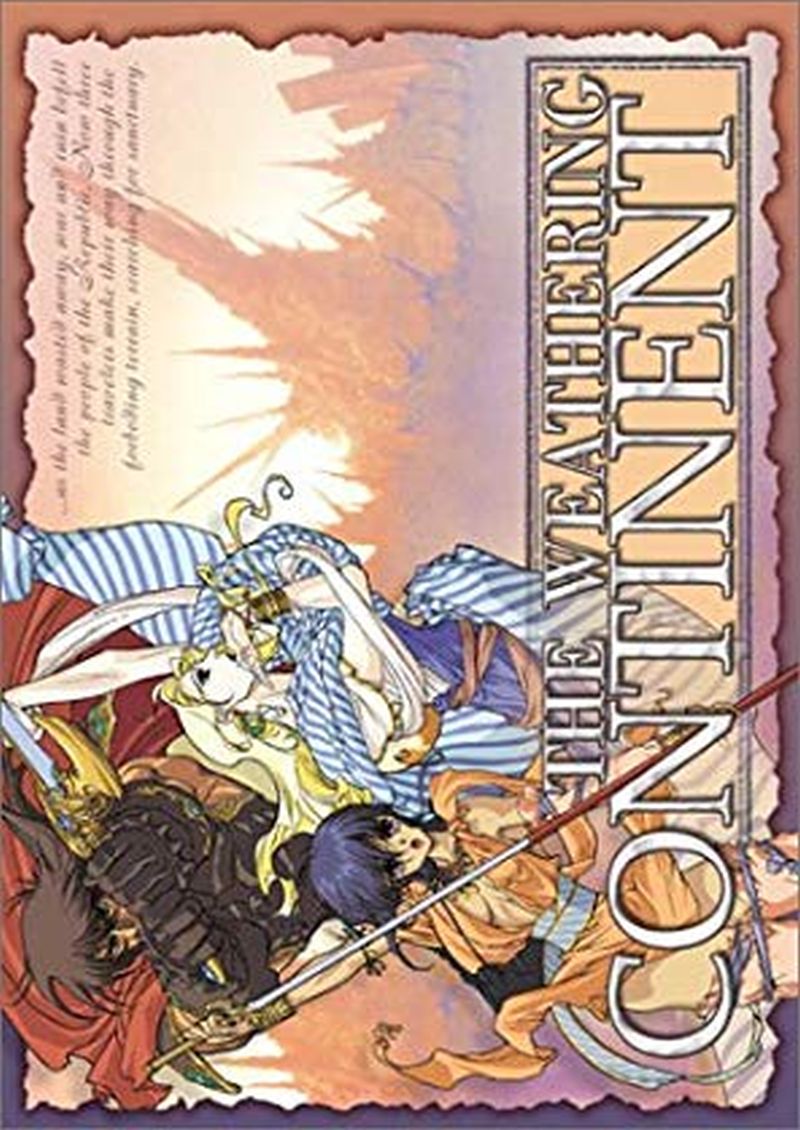
The Weathering Continent, 1992, dir: Kôichi Mashimo

I've often thought that anime in the nineties seems to have been engaged with the traditions of Western fantasy writing in ways that film and TV in the West never were, and nowhere is that truer than with the 1992 short film The Weathering Continent, which - though based on a lengthy series of Japanese light novels - could as easily be an adaptation of some lost story by Fritz Leiber or Robert E. Howard.  That latter particularly: the setting of a land made inhospitable by natural disaster and then intolerable by human desperation and cruelty feels of a piece with Howard's Hyperborea, just as the particular brand of weary, supernaturally tinged fantasy on offer would sit comfortably amid his work.

If that were the case, however, Howard's version would certainly be a lot less moody and meditative.  Certainly in its opening minutes, those are the words that sum up The Weathering Continent most aptly.  Another is desolate; its scenes of three travelers wandering amid the desert, and through ruins of awesome ancientness and magnitude, could as easily be a spiritual successor to Shelley's Ozymandias.  Once our heroes find themselves trapped in a lost and haunted necropolis with a party of bandits for company, the pace inevitably picks up, but at no point does it become what you'd call action-packed.  Director Mashimo foregrounds mood above all else, even when theoretically exciting things are going on.  And if you happen to have a fondness for that particular brand of fantasy writing, this is all enough to make The Weathering Continent a bit of a joy, even before you get to its intelligent script, its haunting score, or the fact that it looks flat-out gorgeous: the backgrounds in particular could any one of them pass as a stunning book cover.  In fact, if you want to imagine the aesthetic, "seventies fantasy paperback book covers come to life" is as good a starting point as any.

If we were hunting for imperfections, the character designs aren't altogether to my tastes, there's some noticeable (though plot-appropriate) reuse of sequences, and on occasions the music veers into nineties goofiness and spoils the tone it's been doing such a good job of helping to maintain.  Also, of course, if you like your fantasy anything but slow and moody, this isn't the title for you.  And it's not as though The Weathering Continent is easy to find these days!  Likely even at the time it was an obscure title that AnimeWorks felt little inclination to push, though the packaging is the nicest I've seen from them, and what I listened to of the dub was a respectable effort.  Still, if it sounds as if it might appeal, it's absolutely worth keeping an eye out for, despite its relatively brief length.  Even at just under an hour, it tells a complete and satisfying story, one with such commitment to tone and world-building that it really does feel like a glimpse of a much larger narrative.

Judge, 1991, dir: Hiroshi Negishi

I'll say this for Judge, it's certainly weird.  And weirdness is precisely right for the sort of thing it is, that being supernatural dark fantasy heavily tinged with horror.  It seems to me that fantasy and horror are both predictable far too often, and sadly that's nowhere truer than in the world of cheap nineties anime, which is definitely what this fifty-minute OVA falls into; watch enough of it and you start to see the same elements appearing time and again.  On the face of things, Judge isn't so very different, and indeed I was expecting a pretty familiar experience.  But I was sure proved wrong!

Our protagonist Ohma is a normal salaryman, or at least relatively normal - even his partner Nanase finds him kind of odd.  Still, by day he's not one to stand out from the crowd, and certainly not one to stick his head above the parapet when dodgy dealings start surfacing at the firm where he works.  However, once he clocks off, it's an altogether different case, for then Ohma becomes the Judge of Darkness, supernatural legal aid to those poor, frustrated souls who find themselves trapped by a lack of justice in the mortal realm.

That setup might still go down a conventional route, with the Judge taking bloody vengeance on behalf of the wronged, and at first it seems like it will.  But it's not long before matters veer off in a much stranger and more fun direction, which I really don't want to spoil given how much I enjoyed coming at it blind.  Suffice to say that Judge's cosmology is less straightforward than it initially appears, and Ohma isn't the only supernatural legal agent out there.  Though while it's the unpredictable twists and turns of the main storyline that feel most unusual, they're not the only element that's unexpectedly fresh: Ohma and Nanase's relationship is appealingly mature and real-feeling, and the focus on corporate subterfuge is a nice change of pace in itself.

This is all to the good, because Judge doesn't have a lot else going for it.  It certainly looks less than great.  Director Negishi would subsequently get some respectable work under his belt, and he shows a degree of flare here, but that's not enough to disguise some decidedly cheap animation, or designs that veer between bland and bizarre in ways that don't altogether benefit the material.  Visually it's rather a shabby little thing, and it's easy to see why it has no reputation these days: on the surface it's awfully close to a lot of other cheap OVA releases from the time.  Nevertheless, I got a fair bit out of Judge, to the point where I found overlooking it's flaws quite easy.  Or all but one, anyway; the ending is incredibly anticlimactic, depending on a deus ex machina introduced all of about a second before it brings the plot to a close.  It's an odd choice from a movie full of odd choices, but at least it didn't kill my enjoyment of what had gone before.

-oOo-

It's a good post that I get a couple of new favourites out of, right?  Spring and Chaos really is a miniature classic, and deserves to be picked up by someone for a blu-ray release, unlikely as that prospect is; and while The Weathering Continent isn't quite as marvelous, it's not far off.  And hey, Judge was good for a laugh, which is fine by me.  Of course, Psychic Force stank to high heaven, but you can't have everything!


[Other reviews in this series: By Date / By Title / By Rating]

Saturday, 3 August 2019

How To Make a Black River Cover (Part 2)

So last time we'd settled on a direction, and our fantastic artist Kim Van Deun was about to embark on the real work of making what would eventually be the cover of the third Black River novel, Eye of the Observer.  That direction wasn't much besides a crude black and white sketch, but it was enough to give us both a sense of what the final image would entail, especially given that Kim and I had already gone over in detail what needed to be on there.

Now, the immediate purpose of a cover is obviously to offer the prospective reader a sense of what the book behind it is going to entail.  But for me, the fun of a cover lies in tailoring it to the reader who's already spent their hard-earned cash and is looking at that same image over and over, trying to relate it back to the story they've developed whatever amount of familiarity with.  In the first case, I figured that you if you were the sort of person who'd enjoy The Black River Chronicles, there was a good chance you'd be grabbed by a party of teenage heroes facing off against a giant floating eyeball.  But I really wanted there to be a definite setting that drew from the narrative, and to include a couple of direct nods to specific plot points: hence the mysterious city cut from the cavern walls in the background, and the fact that the gang have some brand new gear, and especially the fact that, if you look really carefully at the final image below, there's a carving on the stonework that happens to look an awful lot like the head of Arein's staff and also like a certain mythological monster.  All of that was in the pitch I initially sent over to Kim.

However, we weren't quite at the stage where that was going to be relevant yet.  As such, the next versions I saw were the ones to the right, and the process was still very much about ensuring that everything was in the correct place.  Which it mostly was; it was clear that the basic composition was coming together, and that foregrounding Arein and Pootle was going to work just fine.  Already it was really only a case of tweaking details, and you can see what changed between those two versions: Pootle's design is becoming more specific, but the crucial difference is one of shuffling everything around so that we can fit four main characters plus a giant eyeball on the limited real estate of a single cover.


By their nature, the Black River books have busy covers.  Look at the fronts of most fantasy novels and you'll notice that we're somewhat unusual in that respect.  The current trend is much more in the direction of abstract images - oh look, it's a sword! - or single figures of the hot guy with a sword / hot girl in a cloak variety.  Whereas it's pretty much essential that we have four characters right there, and that they're all fully visible.  (It broke my heart a little that we couldn't also get Caille and Pootle on the front of The Ursvaal Exchange, but you can only push things so far!)

At any rate, this was the aspect we worked to get right by degrees through the final stages.  In the images to the right, it's clear that Tia's getting short shrift, and as much as everything else is nearly there in the very-nearly-finished version above, the problem is kind of the opposite: Tia's taking up too much space, and also looks like she's balanced on the tip of Arein's staff!  On the other hand, that was pretty much the only thing wrong by then, and on the whole, I think it's safe to say that we had a stunning image on our hands.  Aside from Tia, the subsequent tweaks were extremely minor: to the colour of Pootle's eye, to the buildings in the background, which didn't quite match their description in the book, and to Hule's outfit, which was drifting a little too far from his usual look.  In general, though, it was obvious that the final result was going to be stupendous ... and sure enough, it was!

Wednesday, 24 July 2019

Drowning in Nineties Anime, Pt. 52

It's nuts how long I've been an anime fan without really engaging with the Gundam franchise, one of the absolute cornerstones of the industry for four whole decades.  The reason, of course, was that there's so much of it: I haven't bothered to check, but I reckon there must be at least seventy zillion different Gundam OVA's, films, and episodes.  It seemed like the kind of thing you need a relevant encyclopedia to even go near, and until recently, most of the early stuff was out of print anyway, and all in all it never seemed quite worth the effort of trying to take that leap.

All of that changed when I heard that the movie Char's Counterattack was reasonably standalone, and then soon after discovered a box set of the movies adapted from the original show.  Here at last was a way in that didn't involve devoting a year of my life!  And so, having had my resistance softened by the terrific OVA miniseries War in the Pocket, I decided I was ready to take the plunge.

The results?  Well, that would be reviews of Mobile Suit Gundam Movie 1, Mobile Suit Gundam Movie 2: Soldiers of Sorrow, Mobile Suit Gundam Movie 3: Encounters in Space, and Mobile Suit Gundam: Char's Counterattack...

Mobile Suit Gundam Movie 1, 1981, dir: Ryôji Fujiwara, Yoshiyuki Tomino

First let's get the negatives out of the way.  The opening Mobile Suit Gundam movie was released in 1981, composed of footage recut from the TV show, and there's no getting around that fact.  It's tough not to start thinking you're watching an ancient Saturday afternoon cartoon, and the designs absolutely don't help, dating the visuals unmistakably.  (The one exception, funnily enough, is the Gundam suit itself, which has aged moderately well.)  At any rate, it rapidly becomes apparent that this is material you need to meet halfway if you're going to stand a chance of enjoying it.  And that extends, maybe even more so, to aspects of the world-building: in so many ways, Gundam is lousy science-fiction, with a universe that hasn't been thought through in ways both big and small.  It's hard not to be pulled out of the moment when, in a future so distant that most of Earth's population live in orbiting colonies, someone's car won't start and you realise that cars work exactly the same way they do now - despite the fact that there are spaceships and giant robots and the sheer idiocy of burning fossil fuels in a sealed environment.  Although, thinking about it, maybe I ought to be ranting about the use of machine guns in a vacuum?  Really, if you're after dumb science, Gundam spoils you for choice.

And now I'll stop being pissy about the lack of future-proofing in a nearly four decade old animated film that, given how the series it drew from had already bombed, probably wasn't expected by anyone to turn into a franchise that would still be going strong in the year 2019.  Because, you know what?  The first Mobile Suit Gundam movie is pretty damn great, and perhaps more shockingly, pretty damn resonant even today.  With not much idea of what to expect going in, I certainly wasn't prepared for a story of civilians forced into combat in a desperate war motivated by political greed and blatant propaganda, or talk of child soldiering, or for a film that takes its narrative backbone from the emotional disintegration of its protagonist, as a chance encounter finds him forced to kill and kill and kill again to preserve the lives of everyone he knows.  Amuro Ray isn't quite Shinji Ikari in the screwed-up lead character stakes, but it's easy to see that here's the spring Neon Genesis Evangelion would eventually drain to its deepest depths.

In short, war in Mobile Suit Gundam is something pretty sodding awful, which destroys everyone and everything it touches, and the prevailing mood, even in the plentiful action sequences, is one of sweaty desperation and encroaching despair.  If that doesn't sound like much fun, well, there's just enough of a goofy giant robot cartoon ticking away under the surface to keep it away from utter misery, and sometimes rather too much.  Nonetheless, it's startling how much the serious stuff insists on rising to the surface, and how readily you can put aside the dated aesthetic and get sucked into the meaty tale of warfare and realpolitik beneath.  In 1981, for the right sort of viewer, it's no wonder this was mind-blowing stuff, and try as they might, the intervening decades can't altogether erase that impact.  It may look dated and frequently act dated, but Gundam's resonance is the sort that doesn't fade easily.

Mobile Suit Gundam Movie 2: Soldiers of Sorrow, 1981, dir's: Yoshikazu Yasuhiko, Yoshiyuki Tomino

I suppose I should have realised it was too good to last!  Not that the second Mobile Suit Gundam movie is terrible; its greatest flaw is merely that it feels like exactly what it is, a bunch of episodes hacked together without much grace or coherency.  Given the rather ambling nature of long-running anime shows, a solid narrative arc was probably too much to hope for this time around.  And let's face it, the first movie was really only held together by Amuro Ray's increasing emotional damage, and to a lesser extent by his nemesis Char Aznable's machinations.

Even that much structure feels like a lot compared with what Soldiers of Sorrow has to offer.  In fairness, I suppose that subtitle does sum things up: the crew of the White Base struggle onward, ground down by unceasing battles and a top brass that clearly don't care about them, except perhaps as lab rats in an experiment, since there's a growing theory floating around that they may all be Newtypes, a next step in human evolution brought on by adapting to existence in space.  But basically what we get is a whole lot of interchangeable fights, a little background plotting, and a series of character-centric short stories that, stripped to their bones, largely fall flat.  The first movie really didn't feel compressed, but this one does, almost permanently.  By way of an example, twice characters are assigned to solitary confinement, only to be let out immediately as it becomes apparent that, with a crew of about ten people, sticking anyone in the brig is inevitably going to be a washout.  You can see how these events would be impactful spread over two or three episodes, but crammed into two or three minutes, they just seem slightly absurd.

Moreover, with Char largely sidelined for the first half, we're even denied an interesting antagonist for the gang to butt heads with, and I honestly didn't appreciate how much fun Char was until he returned in the latter stretch.  His presence makes the last hour an improvement, though not quite enough of one to get around the various other problems.  And with the animation and music very much business as usual, that doesn't leave a great deal to hang onto.  Soldiers of Sorrow is acceptable enough, but two and a quarter hours of acceptable is cumulatively quite a slog.  Ultimately, that leaves the second Gundam movie being roughly what you'd expect if you were being cynical about the whole venture: a necessary slice of connective tissue between an excellent opening and a climax that will hopefully make this slower middle section worthwhile.

Mobile Suit Gundam Movie 3: Encounters in Space, 1982, dir's: Yoshiyuki Tomino, Yoshikazu Yasuhiko

If I'd known the third Gundam movie was as good as it is, I wouldn't have left such a gap after the second before watching it.  And truth by told, even for the first hour of a film that clocks in at well over two, I had my doubts.  A lot of the general fuzziness that afflicted the middle entry was still present, and interminable giant robot fights in space are considerably less interesting even than interminable giant robot fights on land.  Couple that with the fact that it's awfully hard to keep track of the cast, places, and overall conflicts in something that's condensing a vast swath of television, and the result is a start that takes a little too long to settle into its rhythm.

However, what makes Encounters in Space succeed, first and foremost, is the way it steadily narrows its focus.  For all the time it devotes to being space opera on a gigantic scale, it's the personal dramas that are its strongest elements, and they're firmly front and centre by the finish.  In fact, seeing arcs wrap up that seemed like so much time-wasting in part two goes a long way to redeeming that weakest portion of the trilogy.  As such, the entire back end is pretty damn great, and even then it backloads its best material, leading to an action climax that's head and shoulders above anything we've seen so far.

Here it helps that Encounters in Space has a major ace in its hole: the animation this time around is significantly improved.  Oh, not all of it; it's clear that the core is still recycled TV show footage, though even that seems to have received more of a polish.  However, this time there's a good deal of new material too, and it's both significantly better and deployed where it can contribute the most.  Frankly, it makes a heck of a difference, erasing that sense of watching a bunch of badly edited episodes one after another and ramping up to a conclusion that's as visually exciting as it is a satisfying culmination of some very lengthy plot threads.  Seeing the fates of the crew of the good ship White Base wrapped up after spending some seven hours in their company, and watching that happen through the medium of some frequently terrific animation, is both exciting and surprisingly emotive stuff.

Which, I suppose, is the point: given that this is a compilation of a single series, perhaps the best way to approach it is as a single movie in three parts.  From that perspective, it's strikingly successful, a true larger-than-life epic of science fiction that makes up for in scope what it lacks in common sense, and remembers just often enough to keep its appealing characters front and centre.  Here at the end, it's more than possible to see why this was the genesis for something that's still going strong even now.  So while if you come to the Gundam movie trilogy for anything, it'll probably be historical curiosity, be assured that what you'll leave with is a flawed, frustrating, but ultimately rewarding experience.

Mobile Suit Gundam: Char's Counterattack, 1988, dir: Yoshiyuki Tomino

As much as I've listed these reviews in order of film chronology, the truth is, I didn't watch them that way.  Char's Counterattack was actually my second brush with the franchise, after the splendid War in the Pocket.  And given that this was the first original theatrical Gundam release and the culmination of the show's first three arcs, adding up to some one hundred and forty or so episodes, you'd think it would be far from the best watch for someone with almost no experience.  But some random guy on the internet assured me otherwise, I saw a cheap copy, and I thought what the hell?  Worst case scenario, I'd have a couple of hours of incomprehensible giant robot on giant robot action on my hands.*

Fortunately, I didn't find Char's Counterattack incomprehensible, or even particularly confusing, though there were points when it was terribly busy and a fair bit I suspect amounted to shoehorning in characters for the sake of giving them something to do.  But the core is straightforward enough: Char Aznable, having grown angry with the folks of Earth and their disregard for those portions of the human race who've chosen to make their home among the stars, has decided that the best way to teach them a lesson is to drop a couple of asteroids on them, simulating a nuclear winter and nudging them toward abandoning the mother planet once and for all.  Unsurprisingly, not everyone is thrilled with this plan, including Char's long-term adversary Amuro Ray, who also happens to pilot a certain robot suit that was familiar to even a series newbie like me.  Meanwhile, around those two conflicts float a number of subplots, the most prominent of which features teenagers Hathaway and Quess, respectively the son of a prominent military officer and the daughter of the Earth Federation prime minister.

And there, if I may be disparaging about a beloved slice of pop culture, is where the problems begin.  It's noteworthy that the Wikipedia article omits the Hathaway / Quess material entirely, and more so that this has zero impact on its ability to accurately summarise the plot: it contributes nothing, it goes nowhere, and Quess in particular is a screamingly awful character, whose motivations never extend far beyond "I must do the opposite of what people tell me to do, unless those people happen to be genocidal maniacs."  Oh, and everyone immediately falls in lust with her, and she's a natural genius pilot at thirteen, because of course she is.  If Hathaway's a little better, it's only because he barely registers, and because he's the only one of Quess's suitors who's remotely age-appropriate.

There are clearly people out there who love this movie, and I certainly wouldn't question their right to do so.  But I do wonder how the hell they managed to get past Quess, who's like a leaden weight strapped to the neck of Char's Counterattack, dragging it into the depths of mediocrity.  Yet even then, Quess is only a symptom of bigger problems, though ones that are harder to pin down.  I could generally see what the film was supposed to be doing at any given moment, and how series veteran Yoshiyuki Tomino felt he was accomplishing that on a scene by scene basis, but there's a difference between seeing how something should be working and something actually working, and it was rare that Char's Counterattack quite managed the latter.  It doesn't so much juggle plots and characters as fling them in the air and stand there, smirking as they bounce off its head.

Damn, I'm being awfully harsh, and it truly isn't that bad.  Actually, I think I'm being so harsh because it isn't bad, when it really ought to be brilliant.  Like I said, all the pieces are there, and in broadly the right places: Char's master plan is a perfectly adequate arc plot, with his conflict with Ray and the other subplots ticking away in its midst, and it's all very epic and exciting and space opera-y.  Plus the animation is pretty fine, all told - it seems petty to point out that it gets choppy during the action sequences when it's clear it would have taken the budget of a mid-sized country to accomplish such grandiose space battles in any other fashion back in 1988.  And I liked the design work - nothing does cool robot suits like Gundam! - and I'll forgive the universe's flaws as science fiction a lot for the notion of inflatable dummy spaceships.  Char's Counterattack is three quarters of the way to being a glorious late-eighties slice of anime SF; but for me, the apparently random editing, the time-wasting with pointless material, and Quess, queen of the screeching chosen-one teenage heroines, chucked a spanner in the works I could never quite get past.

-oOo-

So am I now a Gundam fan?  I am.  Will I be tracking down the rest?  Probably not, much as I'd like to ... not unless I become a millionaire overnight, anyway, but I certainly feel like I get the appeal.  And while I may not have raved about everything here, I absolutely recommend the experience; these early entries all have their flaws, but they've also endured surprisingly well.


[Other reviews in this series: By Date / By Title / By Rating]


* For the record, I did rewatch Char's Counterattack with the intention of amending my review from the perspective of someone who at least now had a knowledge of the first movie trilogy behind them.  However, to my surprise, other than recognising the odd side character I hadn't before, it really made no difference to my viewing experience.

Saturday, 20 July 2019

How To Make a Black River Cover (Part 1)

I've said half-jokingly that working with artists is my favourite part of being an author, and though obviously I enjoy all that writing stuff too - at least on the good days! - it's not a million miles from the truth;  I never quite get used to the privilege of having someone incredibly talented produce something totally amazing on my behalf.  And while I'm sure not everyone is as emotionally involved in my book covers as I am, still, I reckon there are a few people out there who are curious about how this stuff works, right?  So I thought it might be interesting, with the permission of our terrific Black River cover artist Kim Van Deun, to reveal a little of how these stunning images come to be.  Unfortunately, that's inevitably going to mean a few SPOILERS, so be warned, and maybe don't read this until you've read Eye of the Observer - yet another excuse to grab a copy if you haven't already!

Of course, by the time we got to this third book, I'd already worked with Kim twice before.  I didn't have so much input on the cover of Level One, my co-creator and editor Michael Wills handled that one, but I got to see the work in progress, and so I had an idea of Kim's process by the time we got to The Ursvaal Exchange.  There, Mike and I swapped roles altogether, and I even had strict instructions to surprise him with the finished image, which is a lovely position of trust to be placed in as a writer, but would have been kind of intimidating if I hadn't known I could rely on Kim to deliver!

With that behind us, I had no worries when Mike said much the same about Eye of the Observer; the process had been a pleasure and I felt I knew how to play to Kim's considerable strengths.  However, I wasn't quite so certain about what ought to grace the front of this one as I'd been with the last.  There's a definite balance, especially once you're midway into a series: on the one hand, you want to give enough information to a prospective reader that they'll have a fair idea of why they should pick up your book, but on the other, you don't want reveal anything that might ruin crucial plot points.  This was straightforward enough with Level One, in that we were really just trying to convey the core concept, and The Ursvaal Exchange had a relatively early scene that was an ideal fit.  This time around, the balancing act wasn't so straightforward, and the scene I had in mind occurred relatively late on.

Being the sort of person who tends to think out loud, I'd said all this in my initial pitch to Kim.  There was a lot I was definite on: the underground setting that's basically the whole second half of the book, the ruins, the nod to the Dwarven city and the idea of subtly hinting at what it's hiding.  But the question we started out grappling with was, do we explicitly show Pootle or don't we?  Both approaches had their advantages and disadvantages.  However, initially I found myself leaning toward keeping an air of mystery - and the result was the image up there at the top.  Even at the thumbnail stage, there was a lot that I liked; this is still perhaps my favourite take on Arein, with a perfect balance of yearning and trepidation in the way she's reaching toward Pootle, and the rest of the party look great too.  But it was immediately apparent that, from the back, it was awfully hard to tell what Pootle was.  Are they looking at a big rock?  A beach ball?  The moon?  Hiding a giant eyeball's one distinguishing feature might not be the best way to go!

That discussion left us with four thumbnail sketches, one of them the image here and the remainder variations on these two.  In the alternative designs, there was no ambiguity: Pootle was front and centre.  The result was more immediately striking, but it brought its own share of issues, the most obvious of which being that Arein, effectively our protagonist for this third book, had her back to us.  (You'll probably have noticed that, for obvious reasons, covers don't generally show characters with their backs to the reader!)  And since I couldn't choose between the two, I did what I always do: pester friends, family, and anyone else who'd listen for their opinions.  The result was an ever-so-slight preference toward the second design, one that basically came down to the fact that there was something very cool about Pootle looming there dead centre with that glowing light behind it.  So, after much discussion, we had a direction, and now the real hard work could begin - well, for Kim, at least!

To be continued...

Monday, 1 July 2019

Drowning in Nineties Anime, Pt. 51

This is the second post that I accidentally deleted through Blogger's stupid, buggy awfulness, which means it's also the second time I've written the following reviews, and therefore the second time I've watched the respective titles - with the exception of one I couldn't bear to sit through again.  You'll know it when you see it!  Mercifully, the three titles I did return to were all personal favourites, to a greater or lesser degree, so you could argue that Google did me a favour by leaving crippling bugs in their software because they're too cheap to support it.  Ha!  No, you couldn't really.

This time around, assuming I manage to get the post out there without it exploding or something: Alien Defender Geo-Armor: Kishin Corps, Legend of Crystania: The Chaos Ring, Jungle De Ikou, and Violence Jack...

Alien Defender Geo-Armor: Kishin Corps, 1993, dir's: Takaaki Ishiyama, Kazunori Mizuno

As I've often noted, it can be awfully puzzling why one release is fondly remembered whereas another vanishes into the mists of history.  Alien Defender Geo-Armor: Kishin Corps is today's case in point: an epic four hour OVA, it has enough of what makes other vintage shows popular to suggest it should have fared equally well, along with plenty to make it stand out from the pack.  Which is to say, it's at heart a giant robot show, but one distinctive enough that only the most cynical of viewers could dismiss it on those grounds.

Not that the giant robot stuff isn't great, because it is: the mecha in question are wonderfully weighty, physical-seeming objects, and there's an appealing emphasis on the fact that their operation requires immense amounts of labour and expertise delivered by a whole team of people, the polar opposite of the clichéd "all it takes is one teenager and fifteen seconds of training" approach.  Admittedly, there is a teenage protagonist, and he does eventually get a robot (rather, kishin) of his own, but that happens surprisingly late in the day and in the meantime we have a cast made up mostly of adults, again to the show's considerable benefit.  Moreover, this is inextricably tied up with what really sets Kishin Corps aside from the competition, namely its setting: the story opens in 1941, but a rather different 1941 to ours, given that not only do the Allies have the Nazis to contend with, there's also a spot of alien invasion going on - and with Hitler's predisposition toward all things supernatural, how long can it be until the earthly and unearthly invaders team up?

The first episode is close to perfect, introducing characters and setting up narrative threads with economy without skimping on the little details that allow us to get sucked into this alternate history, while at the same time delivering multiple standout action sequences; Kishin Corps, in general, does tremendous action sequences, nearly every one ingenious and imaginative, but the opening bicycle-versus-automobile chase through crowded city streets is possibly the high point.  And everything's brought to life with some frequently lovely animation and a distinctive aesthetic that's nostalgic and cartoony in precisely the right way for a show that plays so fast and loose with history.  Actually, fast and loose is probably too kind; Kishin Corps more sets fire to the history books and runs around in their ashes, laughing giddily.  For example, one of the people in that chase?  Maria Braun, (nonexistent) sister of a certain Eva Braun, who'll pop up later as a genius scientist in no way married to one Adolf Hitler.

There's plenty more to like.  Kaoru Wada's score riffs gleefully on John Williams in a manner that's a nice fit for the Indiana Jones-esque settings, and many of the cast members are engaging, more so than in most shorter anime titles I can think of.  None of them are terribly complex, but they're appealing takes on familiar types, and it's an extra bonus that the villains are as interesting to be around as the heroes.  And while the history is lousy, the feel of history is spot on, if that makes sense.  Aside from protagonist Taishi's dumb spiky hair, not much disrupts the impression that this is all taking place in a time very different to our own.

Yet mentioning Taishi is to admit that Kishin Corps does fall short in some ways, even if you're happy to buy into its eccentricities.  After that phenomenal start, it steadily loses steam, slowly at first but noticeably in the second half, in large part because it begins to push the rather boring Taishi to the forefront, leading to a finale that feels flat compared with what's come before.  Heck, even the animation sags a little.  And though it comes out of the gates feeling excitingly original, that's largely a veneer for what amounts to a straightforward tale of good guys versus bad guys all centering around an alien MacGuffin.  Nevertheless, at its lowest points Alien Defender Geo-Armor: Kishin Corps is on a par with most of what's out there, and at its best it's borderline classic territory.  Having watched it twice, I'd definitely call it a personal favourite, minor flaws, bonkers history, and all.

Legend of Crystania: The Chaos Ring, 1996, dir: Ryûtarô Nakamura

The first time I watched OVA sequel The Chaos Ring, I did so with a considerable gap between that and the first film, simply titled Legend of Crystania.  This proved a mistake, because as much as that movie felt complete in its own right, this follow-up has very different ideas: if The Chaos Ring is to be believed, what we've seen up to this point was mere preamble.  Arguably this is a bit annoying, given what a wonderful little gem of an eighty minute film Legend of Crystania is and how self-contained it managed to be even when drawing heavily on the wider narrative of the Record of Lodoss War series from which it sprang.  Nevertheless, there's the definite advantage that if you liked the movie, you'll be pushed not to like the OVA, given the extent to which it's a direct continuation.  Indeed, with the same director and apparently the same animation staff in place, and even with the same composers and the film's end theme doubling as the opener here, it's hard to imagine how that wouldn't be the case.

So it's all the more bizarre that, as a sequel, The Chaos Ring is ever so slightly a mess.  Compared with the movie's tight, compulsive plotting, it's a sprawling beast, occupying itself with a huge laundry list of characters and places and narrative threads that only really cohere in the third of its three parts.  To go for an obvious analogy, it's what The Lord of the Rings is to The Hobbit, a follow-up of wildly greater scope and ambition but without a tenth of the restraint.  Though, thinking about it, an author like Salvatore or Gemmell would be a better point of comparison for the movie, whereas here we're more in the realm of weird fantasy authors like Vance, Zelazny, and Moorcock.  Which is to say that somewhere between its two parts, the Crystania saga has essentially switched subgenres.

This shift is sort of a problem, but also sort of not.  On reflection, I definitely prefer the tightness of the film for the most part, yet it's not like there's anything actively bad in The Chaos Ring.  Its many moving parts may not cohere terribly well, but they're all good parts, and plenty of them are great.  Moreover, the ratio improves as it goes along and begins to make some sense, and the last forty-five minutes are pretty damn splendid.  There Nakamura gets to exercise his tremendous visual sense as a director, the consistently strong animation digs into some really wild corners, and the mode of weird epic fantasy truly takes hold.  So the worst that can be said is that it requires a bit more work than its predecessor.  Regardless, and having watched both halves twice now, I can't recommend the Legend of Crystania saga highly enough; it's some of my favourite fantasy film-making, in anime or elsewhere.  Just make sure to see both releases together if you can, while appreciating that each is very much its own thing.

Jungle De Ikou, 1997, dir: Yûji Moriyama

As I began rewatching the three episode comedy OVA Jungle De Ikou, and as director Moriyama bent over backwards to cram as many shots of his ten-year-old protagonist Nasumi's pants as he possibly could into the opening minutes, I felt a vague sense of horror.  Had I really written a positive review of this the last time through?  Had I actually enjoyed it?

I had, and I did again; it gets better very quickly indeed.  Once Nasumi is gifted a pilfered Papua New Guinean relic by her shifty archaeologist father, and has a vision of the god Ahem, thus learning of the threat of his destructive counterpart Ongo, and is taught that she can draw on Ahem's power through the medium of sexy dancing and so turn into the buxom flower spirit Mii, and then meets Ongo himself, only to find that he's about a foot tall ... wait, summarising this plot isn't helping, is it?  And look, those are the sensible parts!  Really, logic-wise, it's all downhill from there.  Let us be absolutely clear, this is some very silly comedy we have here.

But the thing is, while Jungle De Ikou may be immensely silly, it's not stupid.  It has themes.  It has subtexts.  It has an involved and rather well thought through cosmology.  And though it finds the notions of large breasts and old men with giant pointy codpieces hilarious, it's even more amused by the concept that people somehow manage not to find those things hilarious.  In the show's world, human bodies are one more thing to laugh at, as is the idea that throughout our history we've concocted the wildest of tales simply to avoid dealing with that awkward truth.  Jungle De Ikou has it's share of iffy fan service, but at the same time it's actually about sex, from its inbuilt mythology of fertility and the replenishing cycles of nature to the very fact that its protagonist is a girl on the cusp of womanhood.  In the second episode the show openly acknowledges that Nasumi has just started menstruating, something so weirdly taboo that I've seen it mentioned nowhere in film or TV that wasn't Carrie, yet handled here in this absurd comedy with an impossibly light touch.  And is it any coincidence that Nasumi transforms, via the most preposterous erotic dance ever devised, into not a magical girl but a magical woman?

Of course, being about something doesn't necessarily turn dippy comedy into fine art, or even into good dippy comedy.  So it helps that Jungle De Ikou is genuinely a lot of fun, with charming characters, a wealth of imagination, a handful of really good gags, and perhaps most importantly, a constant sense of its own ridiculousness that's smile-raising in itself.  As one example, Nasumi's mortified expression every time she undertakes her summoning dance is awfully hard not to grin at.  Okay, so outside of the big action climax it looks a bit cheap, but the designs are fun and the score is marvelous; the goofy theme tune has become a permanent fixture on my MP3 player.  As such, I guess I've no choice but to recommend this one all over again: it's the sort of comedy I generally find to be a huge turn-off, but handled with glee, invention, and just the right amount of basic sweetness, it works awfully well here.

Violence Jack, 1986 - 1990, dir's: Ichirô Itano, Osamu Kamijô

Violence Jack marks a momentous personal landmark: it's the last of the notorious video nasty titles from the first big influx of anime, those releases that gained a reputation for themselves based on extreme violence, nudity, sexual unpleasantness often involving tentacles, or combinations of the three.  And not only am I glad to say that I'm done with this mostly dreadful muck, I can add the fact that Violence Jack is one hundred percent tentacle-free.  Which is the last nice thing I'll be saying about it.

So it's the future and civilisation has ended, due to an earthquake or maybe a comet, depending on which episode you believe.  Humanity lives in isolated enclaves and the strong prey mercilessly on the weak.  But that all gets shaken up when, in one such miserable community, the dominant group happen to stumble on a giant entombed in the walls of the underground prison they've been living in for goodness knows how long.  Despite the fact that the stranger calls himself Violence Jack - after the jackknife he carries and, er, his fondness for violence - they're convinced he can be the one to save them from the neighbouring tribe of murderers and rapists they're sharing their dank hole with.  They're soon proved gravely wrong.  Nobody gets saved in Violence Jack, because if they did, how could we be treated to scene after scene of gore and sexual assault and wearying, testosterone-fueled cynicism?

So in effect, it's Mad Max, if Mad Max was coming from a relentlessly nihilistic place that laughed at even the notion of empathy or redemption or anything that isn't bad people being awful to marginally less bad people.*  Yet with all that, for the first half of the first episode, I was wondering what all the fuss was about.  Sure there was blood being shed, but it was all rather tame, and really the worst that could be said was that Violence Jack looked dreadful and was thoroughly boring in its trotting out of genre clichés that weren't fresh even back in the late eighties, when these three OVAs were released.  However, by the time the villain started cannibalizing his dead lover's corpse, I was willing to admit that I'd done the show a disservice: Violence Jack genuinely was coming from a pretty vile place.

With all of that said, I admit that what I saw was the heavily cut version that Manga Video released back in the day.  And by 'heavily' I mean sliced to ribbons, though it's hard to say that it effects the plot much, since everything that was excised was just more rape, violence, and general horribleness, and there's so damn much of that anyway, with none of it being terribly plot-essential.  Really, it's only the third part, which loses nearly half its running time, that suffers, and even then it's doubtful that it would make a lot of sense with an extra twenty-five minutes of wanton ugliness.  If I truly wanted to find out, I suppose I could watch the uncut Eastern Star re-release**, which for baffling reasons known only to them is a thing that exists.  I could, but I won't, and the reason why has nothing to do with the gore: try as it might, a cheap eighties OVA can only be so shocking, especially when it's as cut-rate as this one.  No, the reason is that Violence Jack is flat-out crap on every level, and all it really accomplishes is to be wearying.  It's exploitation for the sake of exploitation, without any ingenuity or artistry to give it a spark of life, and I hated every last minute.

-oOo-

Well, that was a sour note to end on, isn't it?  But personally what I'm taking away here is what a pleasure it was to return to three titles as splendid as Alien Defender Geo-Armor: Kishin Corps, Legend of Crystania: The Chaos Ring, and Jungle De Ikou, even if that meant reviewing them all over again.  I guess if Blogger really had to destroy hours of work, then this was one of the best posts it could have gone for.

Though just to clear, Google, I'd still have rather you'd just fixed that damn bug.


[Other reviews in this series: By Date / By Title / By Rating]


* In fairness, Violence Jack creator Go Nagai got there first, but his version is infinitely worse, so I don't think George Miller need have any sleepless nights over the fact.

** Which, three and a half years later, for reasons unknown even to myself, I have actually done.  And while I mostly stand by this review - Violence Jack is a horrid piece of work and almost wholly lacking in artistry, which has the paradoxical effect of making its cavalcade of horrors more dull and numbing than genuinely shocking - I'll say this much: I fell into the mistake of only really reviewing one of the three OVA episodes.  If Eastern Star's release gets one thing right, it's re-ordering the series chronologically.  This makes no narrative sense, Manga actually had it right on the score, but placing the repellent Evil Town as the opening entry made it hard indeed to give the other two a fair shot.  1986's Harlem Bomber is kind of nothing-y and by far the most badly made portion; by contrast, Hell's Wind, from 1990, is actually fairly competent and, by the standards of extreme anime from the period, merely quite nasty, which elevates it all the way to the level of moderately watchable.  Honestly, I should probably crank up my star rating to - I don't know, 2?  Surely not 3?  But since I still hate Violence Jack with a passion, I'm not going to.