Wednesday, 8 February 2023

Drowning in Nineties Anime, Pt. 123

Wait, there's more Gundam?  I mean, I know there's more Gundam, if there's one thing you can say with certainly about possibly the most expansive science-fiction franchise in existence, it's that there'll always be more, but until not so long ago I was labouring under the misapprehension that I'd covered all of what fell under this series' purview, that being the films and OVAs released prior to 2000.

Admittedly, I wasn't that far wrong, except for Mobile Suit Gundam 0083, which I'd had my eye on for a while.  But then along came Mobile Suit Zeta Gundam, or more specifically the film adaptations that were released in 2005 and 2006.  Now, obviously both of those years are a good bit later than 2000, but the original Mobile Suit Zeta Gundam TV series they were drawing upon wasn't, and that leaves us with a definite grey area - one I've gone and ignored by reviewing them anyway.  Which means that up this time we have Mobile Suit Zeta Gundam: A New Translation: Heirs to the Stars, Mobile Suit Zeta Gundam: A New Translation: Lovers, Mobile Suit Zeta Gundam: A New Translation: Love is the Pulse of the Stars, and Mobile Suit Gundam 0083: Stardust Memory...

Mobile Suit Zeta Gundam: A New Translation: Heirs to the Stars, 2005, dir: Yoshiyuki Tomino

I can barely imagine the thinking that went into Mobile Suit Zeta Gundam: A New Translation.  Oh, not the notion of producing a trilogy of compilation movies of what, by the start of the twenty-first century, was already established as being among the highlights of the vast edifice that is Gundam; given that we've already covered the compilation movies of the original series and rated them pretty highly, that bit's perfectly understandable.  And reanimating them, well, that's not quite so easy to get your head around, since you'd suppose part of the point would be that you didn't have to make three new movies from scratch, but Zeta Gundam was heading rapidly toward the big 2-0, and as good as it may have looked by eighties TV standards, there was a gulf between that and what you could chuck into a cinema.  No, the unfathomable part is how the solution settled on was to reanimate only some of the films, with percentages ranging from a third to four fifths.

Compilation movies have become standard practice in the years since: it's almost rarer for a popular anime show not to get cut down, retouched, and thrust into theatres.  But what Tomino and co attempted was very much not retouching or anything close.  A heck of a lot had changed since Zeta Gundam first aired and apparently it never occurred to anyone to disguise the fact, because it would be hard indeed to mistake the old footage for the new.  The TV stuff looks decidedly ropey, the more so for being blown up to fit a cinematic aspect ratio, and the 2000s stuff is nicer but also very of its time, meaning plenty of shots with that awkward glossiness of animation made by people still fighting the contributions of computers as much as they were aided by them.  But what really sucks is the transitions between the two, or rather, the lack thereof: while things settle down somewhat toward the end, where the bulk of the new material is, lengthy stretches chop from one to the other with no rhyme or reason or logic as to why, say, two people having a fairly uneventful conversation needed reanimating at all.

On that last count, the answer is surely that A New Translation, as its name tells us up front, isn't quite the Zeta Gundam of old.  Having never encountered the show before, I'm not well placed to comment, but the internet tells me that there were changes made both big and small, and that's presumably why we get shiny 2000s animation for scenes that don't obviously warrant it.  Then again, keeping track of what matters on a minute-by-minute basis is such a task that it's possible I was just underestimating the significance of certain conversations: this is, after all, a conflation of one third of 50 episodes of TV, and it's not even an especially long film.

To say the results are confusing is an understatement: Heirs to the Stars does most of its storytelling at the most breakneck pace.  Nobody relays details they wouldn't have good reason to, which often means vital information arrives long after you'd expect, and rare are the moments when you entirely feel you grasp anyone's motivations, the more so since we have good reason to suspect numerous cast members.  There is a pattern that emerges whereby every few minutes events slow down enough for your brain to catch up on the essentials, and that combines with a sort of osmosis that lets the bigger picture gradually soak in, as the repetition of names and faces and concepts counteracts the general chaos.  It's mostly frustrating but sometimes exciting, since the effect - and from my experience of Tomino's work, I doubt this was accidental - is less like watching an anime show about a space war and more like learning the essentials of said space war by skipping news channels.

To some extent, that's all well and good for the tale being told.  However, while we can make excuses for Heirs to the Stars and even propose that its flaws are more like features, that doesn't do a lot to improve the experience of actually watching the thing.  It's draining and bewildering, and who wants to be drained and bewildered by their entertainment, especially when there isn't enough to compensate?  Much of the action borders on incoherence, and the better sequences are backloaded, meaning a lot of damage has been done by the time they arrive.  The politicking is more interesting in theory, except that, while it's fairly simple once you get your head around it, it's delivered in the most headache-inducing manner possible.  As with all of Heirs to the Stars, the good stuff is definitely good and the spine is pretty great, but that delivery turns it into work, and I'd be hard pressed to suggest it's worth the bother.

Mobile Suit Zeta Gundam: A New Translation: Lovers, 2005, dir: Yoshiyuki Tomino

What struck me most about Lovers is how consistently it manages to fix some aspects of Heirs to the Stars while breaking others in a fashion that does barely a thing to nudge the overall quality in one direction or another.  So, for example, there's considerably more new animation this time around, and the integration is generally better, and for that matter even the original TV footage seems to have improved somewhat or perhaps was chosen with more care.  But then the new footage is generally less impressive, to the point where I occasionally found myself struggling to tell which was which.  There's also some prominent use of CG, something that was hardly guaranteed to go well back in 2005 and doesn't particularly here, aggravating the general tendency of the "modern day" footage to be too glassily smooth and polished.  On balance, the shift towards visual consistency probably has to be regarded as an improvement, and if nothing else it means we get some action sequences that are legible and thus reasonably exciting, but it's less than I was hoping for when I noted the ratios of old to new footage.

On the plot front, meanwhile, some effort has gone into addressing the aimlessness that afflicted Heirs to the Stars.  The answer Lovers brings - look, it's right there in the title! - is to focus on the relationship side of things, which Heirs to the Stars largely neglected.  Sometimes this pays off, in that there are lengthy sequences where Lovers behaves like a proper film, focusing on the interpersonal conflicts of a manageable bunch of characters in a handful of locations rather than batting madly around the solar system while flinging names and faces at us seemingly at random.  The trouble is, judging by what I've seen of his work and certainly by what's on offer here, Tomino is awful at writing relationships, and the central one, between reliably dull protagonist Camille and enemy pilot Four Murasame, is no hook to hang a movie on.  Possibly it would have worked better with the breathing room of multiple episodes, but it's hard to wish for more scenes of incoherent teenage romance.  Four reminded me strongly of Quess from Char's Counterattack, one of my least favourite characters anywhere in anime, and if she's not quite that bad, her actions are just as unmotivated by anything that could be considered reasonable or believable human behaviour.

Then again, perhaps Camille secretly found her as irritating as I did, since within minutes of their earth-shaking romance reaching its inevitably tragic ending, he's making out with someone else - again, presumably a consequence of cramming hours of footage into ninety-some minutes, but it doesn't make things less absurd in the moment.  And what's worse, the price we pay for this slightly more lucid change in direction on one front is that the wider conflict hardly makes a shred of sense: I could offer no better summary of the plot than "The good people try and stop the bad people from doing bad things while running away a lot."  A degree of that probably comes down to my fuzzy memories of part one, but contemporary audiences had waited five months between entries and it was twenty years since the TV show had aired, so I reckon I can be forgiven for a gap of a couple of weeks, and I don't feel bad about suggesting that the fault lies in some thoroughly inarticulate storytelling.*

Mobile Suit Zeta Gundam: A New Translation: Heirs to the Stars, Love is the Pulse of the Stars, 2006, dir: Yoshiyuki Tomino

I'd naively hoped that this last entry might be the point at which the series really began to pick up, perhaps became the original Gundam movie trilogy managed to end on a high note that made it feel retrospectively more like a trio of proper movies than a massive quantity of TV footage chopped, often clunkily, together.  No such luck: despite containing the largest percentage of shiny new twenty-first-century footage, Love is the Pulse of the Stars is comfortably the worst of three films that only ever succeeded in clawing their way up to fairly good.

Love is the Pulse of the Stars doesn't manage that much.  Oh, maybe there's the odd scene, but if there was, I refuse to be blamed for missing it, since the hundred-minute run time is an almighty slog: with two movies of back story, countless characters major and minor, and not one iota of an attempt made to re-establish anyone or anything, keeping the barest grasp of what was going on was such an ordeal that I had no energy left for discerning okay-ness from mediocrity.

By the end, it's tough to imagine that there could ever have been a worthwhile three movie adaptation of  Mobile Suit Zeta Gundam, at least with this particular approach.  There are elements to this one I personally found wholly off-putting, like a drift into vague spiritualism in a series that's always struck me as avoiding that sort of thing hard, and I could definitely have done without the bizarre "The Zeta Gundam is powered by love or maybe ghosts or some damn thing" twist we get in the back half.  But there is certainly good stuff in here; the problem is that it's so rarely foregrounded.  With the running time hobbled by the determination to re-animate so much of the footage, there isn't room to balance the wider conflict, which is on a particularly enormous scale this time around, and once again that means a focus on interpersonal dramas that simply aren't that interesting.  It really does reach ludicrous heights here, as giant robot fight after giant robot fight is reduced to clashes of personality between people who were once friends, lovers, enemies, or a combination of the three, and always seem to somehow know who they're up against.  Meanwhile, the whole interplanetary war that you might naively imagine would be the point is sidelined so hard that I truly don't think it's followable without having seen the series.

So are there any compensations?  Not really, no.  For all that there's theoretically 80% new footage here (which, yes, makes this vastly more a film from 2006 than a TV series from the eighties, but it's too late to worry about that!) the animation is, on a whole, that bit weaker.  This possibly has something to do with just how much Love is the Pulse of the Stars is mobile suit battles, something Tomino is bafflingly bad at directing given how much experience he'd clocked up by this point.  He routinely acts as though space is a flat plane, the older footage continues to suffer from being awkwardly zoomed in to suit the cinematic aspect ratio, and the balance of CG and traditional animation is never quite right, as it rarely would be for another half decade or so.  So for all that the visuals are the strongest aspect - after, perhaps, a noticeably more novel and interesting score - they're not the sort of strength that could hope to make up for some disastrous narrative weaknesses.  I'm sort of glad I sat through Mobile Suit Zeta Gundam: A New Translation to fill in a gap or two in my Gundam knowledge, but I can't think of any other reason to devote five hours of your life to these movies.

Mobile Suit Gundam 0083: Stardust Memory, 1991 - 1992, dir: Mitsuko Kase, Takashi Imanishi

Throughout most of my watching of Mobile Suit Gundam 0083: Stardust Memory, I was confident I'd be starting this review by declaring that I'd gone from some of the weakest Gundam entries I've encountered to one of the finest, if not the very best.  And now, coming out of its thirteenth and final episode, I still think that's the case, I'm just disappointed that I'm having to hedge that statement a little.  So let's be clear up front: Stardust Memory is superb, both top-tier Gundam and top-tier science fiction in general, not to mention an extremely high water mark for animation and one of the better OVA series ever produced.  It's excellent stuff and I recommend it, I'm merely sad to not be recommending it unreservedly is all.

But that start - oh my!  The first episode, in which the first of two experimental Gundam units is stolen from a base on Earth and rash greenhorn test pilot Kou Uraki borrows the other in an attempt to retrieve it, is as near to flawless as you could dare to hope.  And what's more astonishing is that the level of quality barely slips for its immediate successors, building out the cast and context with slick economy while never losing track of the core conflict and mixing compelling character drama with absolutely thrilling action.  Really, I'd struggle to point to anywhere in the first two thirds where a foot is inarguably put wrong; my heart sank slightly when the conflict left Earth for outer space, since, for me, Gundam is always at its best when it's not just mobile suits whizzing around against a black backdrop, but the actual dip in quality is negligible, in large part because the storytelling is so good that the shift feels both natural and necessary.

Stardust Memory will eventually take that dip, and I could point to the exact moment at which it happens, but I won't because it would be both an enormous spoiler and somewhat unfair: the scene in question is superb in its own right and the partial reboot of the narrative that follows is, again, both earned and dramatically satisfying.  The problem is merely that it pushes Stardust Memory from a track that felt genuinely fresh onto one that's more familiar Gundam fare. Familiar Gundam fare delivered superlatively, no doubt about it, and yet there's an awful lot of Gundam in existence, and there are beats that had been hit many a time by 1991 and would go on to be hit many times more, and so the early freshness is all the more exhilarating, just as its lack is that bit more frustrating - though even then, Stardust Memory is canny enough to use the experienced viewer's assumptions against them to pull off some real shocks.

It helps, obviously, that Stardust Memory both looks and sounds extraordinarily good.  Indeed, if Gundam's ever reliably looked better than this, it's outside of my experience.  Obviously, that means that the giant-robots-fighting stuff is magnificently animated, but so is everything else, from the most mundane conversations through to the most trivial of character details.  Neither Kase nor Imanishi ever get particularly show-offy in their direction, but it's purely because they don't need to when every shot feels like showing off.  Chuck in some left-field soundtrack choices that feel like they ought not to work at all and end up as a triumph of constructing a unique mood and you have the sort of show that you genuinely could enjoy without following the plot purely for its overwhelming quality.

So, yes, it's great, and I'd feel terrible if I left anyone thinking overwise.  It's only that a Stardust Memory that had stuck to its early guns and been largely insulated from the wider Gundam-verse in the manner of other highlights like War in the Pocket and The 08th MS Team would have been both a new favourite and an easy recommendation to more or less everyone, whereas the one we have, which starts out as that and ends up getting awfully busy with filling plot gaps from other shows, isn't quite there.  If you're a Gundam fan, then obviously this is indispensable, and likewise if you're a Gundam casual like me, and if you don't even know what a Gundam is but love sci-fi and outstanding animation, then this should be high on the list of franchise entries you really need to sit down with regardless one of these days.

-oOo-

It gives me no pleasure to be mean about Gundam, the rare series that has absolutely earned its out-sized cultural impact by being far more often excellent than not.  But then, it gave me no pleasure to watch Mobile Suit Zeta Gundam: A New Translation, so what can you do, eh?  Still, I'm very glad we got to say our last goodbye** to the Gundam-verse with an entry that shows off so much of what makes it so special.

Next up: hopefully some stuff that's actually definitely from the nineties!


[Other reviews in this series: By Date / By Title / By Rating]


* If more evidence were needed, I'd point to the crucial scene that relies on two children hidden in a spacesuit failing to hear or even notice a heated conversation taking place roughly a metre from their heads.

** OK, so there might be a Mobile Suit Gundam 0083 compilation movie to get to at some point...

Monday, 19 December 2022

Drowning in Nineties Anime, Pt. 122

 Normally, I'd be feeling bad about rambling on about another thoroughly obscure bunch of titles, but a) it's not as if there isn't worse to come if I don't give up on this madness soon and b) this is the rare post that throws up something I'd never heard of and ended up slightly loving and c) the one title here that's remotely well known is a return to a franchise we'd have been better off forgetting all about.  Yes, it's  the end of Urotsukidôji - at least for our purposes - and of a journey that began with Legend of the Overfiend practically at the beginning of this series.  Can the finale redeem everything that's come before it?  Well, let's just say I'm not sure it's the worst of the batch from amongst Riki-Oh 2: Child of Destruction, Magical Twilight, Gravitation: Lyrics of Love, and Urotsukidôji: Infernal Road...

Riki-Oh 2: Child of Destruction, 1990, dir: Satoshi Dezaki

I remember musing last time as to why no "proper" distributor* ever picked up the two Riki-Oh OVAs that were released in 1989 and 1990 respectively.  Well, here, no doubt, we have part of our answer: Riki-Oh 2: Child of Destruction is abysmal.  And normally I hate to pre-empt a conclusion this far into a review, but there's no use dancing around the facts on this occasion, since I'm not going to have anything nice to say.  No, wait, the closing song is OK.  But that really is it.

It shouldn't need pointing out that Riki-Oh 2 is the sequel to Riki-Oh: The Wall of Hell, yet it's easy to imagine the viewer who could get all the way through the latter without realising it had anything to do with the former.  That sort of thing isn't altogether uncommon in the world of manga adaptations, where it makes sense to focus on discreet arcs that are a fit for your running time whether or not they necessarily link together, yet it feels as though there ought to be some connective tissue - heck, the protagonist being recognisably the same in all but a handful of shots would be a start.  And this is especially weird given that both share director Dezaki, a creator of modest but definite talents who apparently forgot everything he knew in the span of a year.  The Wall of Hell was no masterpiece, but it had style, and that style carried it a long way, injecting energy and tension into some basically schlocky material.

Here he does the opposite, and while I don't think we should be throwing too much shade in Dezaki's direction, it's certainly the case that more could have been done with this setup.  It's overly busy and definitely too reliant on coincidence and storytelling shortcuts, but it's not hard to see from what we get here how the material might have played out better, as it no doubt did in the manga.  Following his escape from the hellish prison of the first OVA (I presume), our hero Riki is intent on tracking down his long-lost brother (I think, maybe) who he abandoned when they were children.  This quest takes him to the southernmost cape of Japan (I'm completely guessing) where, in a distressing bit of fiction foreshadowing reality, a malfunctioning nuclear plant has left a chunk of the country supposedly uninhabitable - though in the world of Riki-Oh, that just means it's been taken over by evil sorts as a base for their vague but no doubt nefarious plans.

Let's cover one example of how spectacularly shabby Child of Destruction's narrative delivery is and move on.  It's self-evident that Riki's abandonment of his brother is the beating heart of this material, yet here's how that vital moment plays out on screen: the two are playing hide and seek and it's Riki's turn to hide; as he's running off, a limousine pulls up and the old man inside says, "Wouldn't you like to come and live with me, though?" which Riki agrees to without a second thought; as the car drives off, he sees his brother sitting waiting in the snow and looks mildly troubled; and that's our lot.  So far as it's possible to judge by what we're shown, Riki left his little brother to die because he kind of forgot about him, and wouldn't it be rude to ask the kindly stranger who's just effectively kidnapped you if there might not be room in his mansion for another random kid?

With no one willing to find space in a 45-minute OVA to explain the lynchpin of the whole plot, this never had much hope of succeeding on a story level.  However, I've had kind words to say about many a narratively disastrous piece of anime before now, and so we return to why I don't know that this shambles was altogether Dezaki's fault, for all that he did nothing to right it: Child of Destruction evidently had no budget, and its animation is horrible, and that horrible animation kills every scene stone dead.  There's stuff that could be fun - the action and gore were clearly intended to be - but apparently there wasn't even cash to splash on what ought to have been highlights, since they're as visually malnourished as the rest, constantly relying on the most obvious shortcuts.  And that pushes Child of Destruction down from being merely bad to the realms of face-slappingly bad, because what sort of early nineties OVA can't find a few yen to make its outrageous gore and over-the-top fights look cool?  Fail that and you've failed everything, which, as I've hopefully established, is precisely what Riki-Oh 2: Child of Destruction does.

Magical Twilight, 1994, dir: Yoshiaki Kobayashi

In spite of appearances, the reason I swore blind I wouldn't review hentai here and then went on to review quite a lot of hentai is not, in fact, that I secretly just wanted to watch a load of hentai and talk about it in public.  No, it's more that, compared with most of what we might categorise as pornography, the boundary between hentai and regular anime is an awfully vague and blurry one, and there's sometimes no sure way to separate one from the other.  But on this occasion I'm pushing that argument about as far as it will go, because, yes, Magical Twilight is most definitely hentai, and yes, I knew that going in, and the only real excuse I have is that numerous reviews suggested it was good enough that, if you squinted a bit, you could watch it as plain old anime.

That's sort of true but mostly not: there's a ton of explicit sex in Magical Twilight and, compared with some of the titles we've covered here, it's hard to imagine how you could snip it out and cobble anything remotely coherent from the remainder.  Though for the first episode, anyway, this seems like it might not altogether be the case: the basic setup, with white witch Chippie and her promiscuous frenemy Irene sent down to the human world to accomplish the practical part of their witching exams by ingratiating themselves with a randomly chosen human, could easily be the setup for your standard comic nineties OVA were events played out a little differently.  This is less true of the two-part follow up, which relies heavily on Chippie's now-love-interest Tsukasa getting jiggy with every remotely appropriate female he lays eyes on, yet its heart remains in the world of romantic comedy and so does the bulk of the material.

Marking on the exceedingly slidey scale of vintage hentai, the sexy stuff is relatively innocuous, which means there's a bad witch who gets sexually assaulted into giving up on her quest to kill Tsukasa and a teenaged girl who wants to sleep with him because she watched her mum sleeping with him and got awfully horny as a result, and actually, now that I think about it, probably more of the sex is non-consensual than not, though that generally means Irene using her magic to have her way with Tsukasa, and there's no indication that he's particularly traumatised by the experience.  Again judging entirely by the standards of nineties hentai, I guess that leaves us somewhere around "only a bit gross"?  At any rate, the animation is respectable enough that these look like real people conducting recognisable acts that horny naked people might get up to, which is by no means a given, so I'm willing to suppose that as hentai it's fairly successful, if perhaps a bit on the unimaginative side.

Which leaves us with everything else, and as often seems to be the case, the everything else fares a good deal better.  Magical Twilight is fairly half-hearted as pornography, whereas as a comedic fantasy it's entirely solid and occasionally much better than that.  The animation is respectable, the character designs are appealing, and there are a handful of properly good gags, most memorably a magically assisted game of ping-pong that gets wildly out of hand.  Sad to say, though, it's still too committed to being hentai to make the most of its fun setup and characters and as hentai it devotes a lot of time to scenes that are staged largely identically, and so, at the end of ninety minutes, it finds itself sat uncomfortably between two rather nondescript stools.  If a fantasy comedy with lots of generic but competently handled sex scenes is the one thing in the world you're craving, it's hard to see how this would majorly disappoint, but for the rest of us, there isn't enough here that's at all special.

Gravitation: Lyrics of Love, 1999, dir: Shin'ichi Watanabe

One of the nice things about this whole reviewing-abolutely-all-of-the-'90s-anime deal is that I've been obliged to give attention to a lot of titles that, for one reason or another, I'd otherwise have skipped.  And OK, that hasn't always been a positive since some of that stuff was eminently skippable, but it's nice to sometimes have your preconceptions proved wrong and be entertained by something you wouldn't normally have given the time of day.  Such is the case with Gravitation: Lyrics of Love, and a cover that does practically nothing to sell what lies within to the viewer seeking anything besides romance between a couple of unusually pretty (well, unusually by non-anime standards) guys.

Now, it's not that Lyrics of Love - a subtitle nearly as off-putting as the cover art! - doesn't offer that.  Our hero Shuichi Shindo, lead singer of the band Bad Luck, is certainly head over heels for author Yuki, and though it's not altogether evident for much of the running time, there are clues enough that Yuki feels the same way, albeit in a more stand-offish and cynical fashion.  For Shuichi's love is very much of the puppyish, unfiltered kind, and so it is that, as we join the story, a period of coolness on Yuki's part has sent him into such a spiral of misery that he's incapable of writing lyrics for the band's upcoming new album.  While that mightn't normally be an issue, since everyone else would be happy to bring in a songwriter from outside, Shuichi is just as outspoken when it comes to his musical career, and he's already bragged to the media that nobody but him can do Bad Luck's music justice.

So we have hot guys being in love, not to mention a fair bit of lust - which is quite refreshing given how much anime of the period tends to veer towards prudishness when it's not being out-and-out hentai - and we have music as a central story element, and all of that you could certainly work out from the DVD art and accompanying blurb.  But that Lyrics of Love happens to also, maybe even primarily, be a comedy?  That you'd never guess, which sucks when what we have here is among the funnier comedies to come out of anime in the nineties.  Indeed, it's all the funnier for being ostensibly not much of a comedy at all, since much of the best humour rises out of situations that aren't, on the face of it, especially humorous.  The benefit is that it gets to be wildly goofy at points without ever just being goofy; somehow, the push and pull of extreme silliness and high emotions works in harmony rather than opposition.  Were this not a comedy, Shuichi would be a bit obnoxious and Yuki even more so, but seeing a lighter side to them actually makes their tumultuous romance more engaging and sympathetic, such that when, towards the end of the second of its two episodes, Lyrics of Love is obliged to take its plot seriously enough to bring things to a conclusion, it's drummed up ample good will for a theoretically contrived conclusion to be warm and satisfying.

Had this arrived a few years earlier, then, we might be looking at something of a minor classic - but as I'll never tire of pointing out, 1999 was a bad year indeed for anime as an art form and long after the point when OVA meant the sort of budget that got you near the realms of feature-film animation.  Frankly, Lyrics of Love barely holds up compared with the TV of the time, and that's quite the damning criticism.  I get that not all anime fans are obsessed with the niceties of animation, I do, but there's no avoiding how it hurts the material here, with the musical numbers suffering the most: judging by what we see, there are Punch and Judy shows with more stage presence than Bad Luck.  Thankfully, their songs hold up better, enough to be toe-tapping even if not quite enough to convince you they'd be much of a big deal in real life.  Still, that leaves us with a musical romantic comedy where all three core elements are good to great and only one significant weakness, which is mostly more of an annoyance, so I think we can comfortably call this a recommendation.

Urotsukidôji IV: Infernal Road, 1993 - 1995, dir's: Hideki Takayama, Shigenori Kageyama

I've frequently been disgusted by the Urotsukidôji franchise, and sometimes angered by it, and often bored, and just occasionally amused, but until now, I can't say I ever felt sorry for it.  Yet that was my main reaction to Urotsukidôji: Infernal Road (or Inferno Road, as it appears to be known to everyone but UK distributor Kiseki.)  I haven't exactly been quiet about how much I dislike this series, and yet I don't know that even I would have wished upon it such a paltry nothing of a finale.  For all that this has been mostly nasty, silly, juvenile stuff, in its best moments, as far as the first two entries go at any rate, there was a certain apocalyptic grandeur to be found, not to mention some really determined cynicism and wallowing in the deepest depths of human ugliness and suffering, and the one thing you'd have a right to hope for from a franchise that sets itself those sorts of goals and intermittently hits them is that it go out with a bang and not the most strangled of whimpers.

But that's not what fans were given in the mid-nineties, and it's certainly not what eventually arrived on the shores of the UK, since the first two episodes of the three-episode OVA were banned outright and appeared merely as scripts on Kiseki's otherwise bafflingly thorough DVD edition.**  That leaves us with some 40 minutes or so of actual footage including credits, presumably cut down from the more standard 45-minute run time: a whopping 40 minutes to send off multiple hours of narrative spread over three not-entirely-reconcilable timelines, and boy is Infernal Road not remotely up to that task.  Nor is the problem the missing episodes, which appear to have been a self-contained tale that didn't move the main story forward one iota, which is in itself a weird move and probably a clear pointer to what went wrong here: everything was in such a mess by this point that it's almost impossible to imagine what a satisfying conclusion would look like, all the more so since we've already had a couple of conclusions that were about as satisfying as it was reasonable to hope for from a property where apocalypses are practically an everyday occurrence.

I admit that I couldn't remember much of the events of previous entry The Return of the Overfiend, since it was bad and I haven't wasted any thought on it since I watched it, so I guess it's my fault that I couldn't recall who most of the characters were that we meet racing in a tank through the ruined remnants of Japan on a mission to defeat the probably-bad messiah the Chōjin with the aid of the possibly-good messiah the Kyō-Ō.  Nevertheless, Infernal Road couldn't possibly do less to reintroduce them or to re-establish their goals or to ease us back into the wider context or to explain who their antagonists are or what their beef is.  Indeed, Infernal Road has no time at all for the viewer who isn't 100% steeped in Urotsukidôji lore, which is ironic given that they, presumably, would be the selfsame viewer who'd be most frustrated by its manifest failings both as a final send-off and a story in its own right.  For that mission to get the Kyō-Ō to the Chōjin and the various attempts to impede it is really all there is here, meaning a fair amount of violent action and the odd dash of demon rape - but much less of both that in any previous entry, even accounting for the reduction in length - and then an ending that I won't spoil except by saying that I couldn't even if I tried.

Nothing could have saved this material, and given the track record it had to work with and the fact that even the best Urotsukidôji entries were deeply flawed, and taking into account that the taste for this sort of stuff was already dwindling fast by 1993, saving was likely never on the cards; but the one thing that frequently pushed past instalments up to the level of intermittently entertaining is the odd bit of quality animation, so it's a further blow to Infernal Road that it contains no quality animation whatsoever and not much that would pass as basically competent.  It's ugly, small scale, and achingly cheap, with a palpable sense of creators who just wanted to get something out the door so they could move onto doing anything else with their lives.  So I suppose the only real plus is that, even for the most devoted fan, there's no reason to track this down: on its own merits it's effectively worthless, and as a conclusion to Urotsukidôji's grand, gross, baffling saga, it's truly bad enough that anything you care to make up will likely be better.  No, seriously, try it: in my version, the Kyō-Ō and Chōjin hugged it out and ended up living together in post-apocalyptic Tennessee raising demon llamas, and that's still an improvement.

-oOo-

So probably not a great post for anyone else, but a definite win for me in that Gravitation: Lyrics of Love was a nice and out-of-the-blue surprise and I'm at last completely done with Urotsukidôji, although knowing me I'll probably feel the need to pick it up on Blu-ray at some point in the future to make absolutely sure it's as unpleasant and basically shabby as I remember it being, the way I did with Violence Jack (which was and wasn't but mostly was.)

Next up: probably the Gundam special in which I bend the definition of nineties anime far past its breaking point...


[Other reviews in this series: By Date / By Title / By Rating]


* Both were put out by a company that I think is called AVP, unless that's just a random bit of text on the box.  They did a relatively acceptable job with Riki-Oh: The Wall of Hell, for all that nothing about it looked what you'd call professional.  Riki-Oh 2: Child of Destruction, however, which needed all the help it could get, is lumbered with some of the most incoherent subtitling you're ever likely to see.

** Seriously, if you want a great summary of Urotsukidôji's by this point exceedingly dense and tangled mythology and enormous cast, this is the place to find it.

Saturday, 12 November 2022

Drowning in Nineties Anime, Pt. 121

To be clear, I'm definitely not going to start reviewing different releases of the same titles because that would be nuts and there would be no end.  And I feel like I'm opening a dangerous door just by setting the precedent, but there's no getting around the fact that there's a meaningful difference between reviewing all of the first run of Project A-Ko sequels together - as they were compiled on DVD under the banner of Project A-ko 2: Love and Robots - and reviewing them separately as they're now being put out on Blu-ray by our good friends at Discotek.

Or to put it another way, I justified double-dipping on the Project A-ko 2 Blu-ray by convincing myself it was okay because I'd cover it here, and don't think that means I'm necessarily going to pick up the other two when they arrive, Discotek!  Frankly, compiling the three together was by far the more reasonable way to go, and who am I kidding, my money is basically yours at this point.  Hold on, I'm pretty sure I still have a kidney left that I can hock.  While I search, why don't we take a look at Project A-ko 2: Plot of the Daitokuji Financial Group, Super-Deformed Double Feature, You're Under Arrest: Mini Specials, and Riki Oh: The Wall of Death?


It's hard to say what the perfect sequel to Project A-ko would have looked like.  But my instinct is that, at the very least, it would have needed to be ambitious in the ways the original was.  And that immediately rules out all the usual avenues because if there's one thing that made Project A-ko stand out, it's the extent to which it did the unexpected.  In a sense, that's all it does: what narrative there is ricochets from idea to idea based on little more than what will be funny or interesting in the moment, and its most arresting aspects, like that gloriously singular soundtrack, feel like conscious attempts to stand out from anything that was happening at the time.  What sets A-ko apart is an impish inclination to rush off down any rabbit hole that takes its creators' fancy while giggling at the conventionality of its peers.

Ironically, the final A-ko entry, released under a dizzying number of titles but reviewed here as Project A-ko: Uncivil Wars, took a decent swing at doing the same by chucking out almost everything except the title and the barest bones of the characters, and I remember it as being pretty sucky and probably the worst of the bunch, so maybe I have no idea what I'm talking about.  Or maybe you can only pull off that sort of trick the once, the more so since Project A-ko's moment was a brief one indeed: barely any time had passed before the market was heaving with anime that parodied other anime, many of them recycling exactly the same jokes in a fashion that must have rapidly made A-ko look a mite dated if you didn't know how many of them it had got to first.

Let's commend Project A-ko 2: Plot of the Daitokuji Financial Group for one thing, then: it sure did come out quickly, in less than a year in fact, and that was probably a wise move.  Given that turnaround time, it's safe to say ambition was firmly off the table, and so all hope of a sequel that would push the envelope in the ways Project A-ko did, and with that being the case, what we got was hardly the worst-case scenario.  A-ko 2 goes down a pointless route, but it's an earnest and faintly ingenious attempt to continue a narrative that had no need of being continued.  Picking up a matter of days after A-ko's events, it finds that show's alien invaders now stuck in an immobilised spaceship and trying to make the best of a bad situation by selling themselves as the city's new hot tourist spot.  Or is it all a cunning plan to kidnap the chirpily obnoxious C-ko, who they regard as their lost alien princess for reasons I can't remotely remember?  Probably, but that's not enough to prevent our hero A-ko from agreeing to try and fix their ship in exchange for a free meal.  And in the meantime, wealthy genius B-ko's latest scheming gets waylaid by her father's even schemier scheming, as he pilfers her latest design and convinces the authorities to let him use it in an attempt to loot the crashed ship for its neat alien technologies.

Writing it all down like that, A-ko 2 sounds both busy and nonsensical, much as the original A-ko was, and you'd think that might be a good thing.  It does have a degree of the same energy, which is probably its biggest asset: there's not a lot that unquestionably, consistently works, but nothing doesn't work for long enough to become a drag.  With the same production values as its predecessor, I think I'd go further: the big action climax is well-conceived enough that it might have been something quite special.  But even with barely more than half the running time to be filled, A-ko 2 is a tremendous step down, and while that mostly just leaves it looking a bit cheap, there are moments when it looks really, really cheap*, with designs going wildly off-model and, for some reason, the absolutely worst lip-synching I can recall ever seeing in anime.  Can we blame that on a diminished budget?  How exactly did they get lip-synching so wrong that it's noticeable in scene after scene?  Was it a joke?

Hey, at least the soundtrack's pretty good, which makes it another step down if you're as in love with what Zito and Carbone conjured up for the original A-ko as I am, but on its own merits it stands up well against anything else that was happening at the time.  Can we say the same for Project A-ko 2, I wonder?  Not when it comes to the animation, no, it really is objectionably sloppy at points, but for the rest... Sure, why not?  Project A-ko 2 is a fun little time-waster that likely as not will leave you in a better mood than it found you, and that's fine and dandy, while also making for a crushing disappointment on just about every level.

Super-Deformed Double Feature, 1988 / 1992, dir's: Katsuhito Akiyama, Tatsuya Masaki

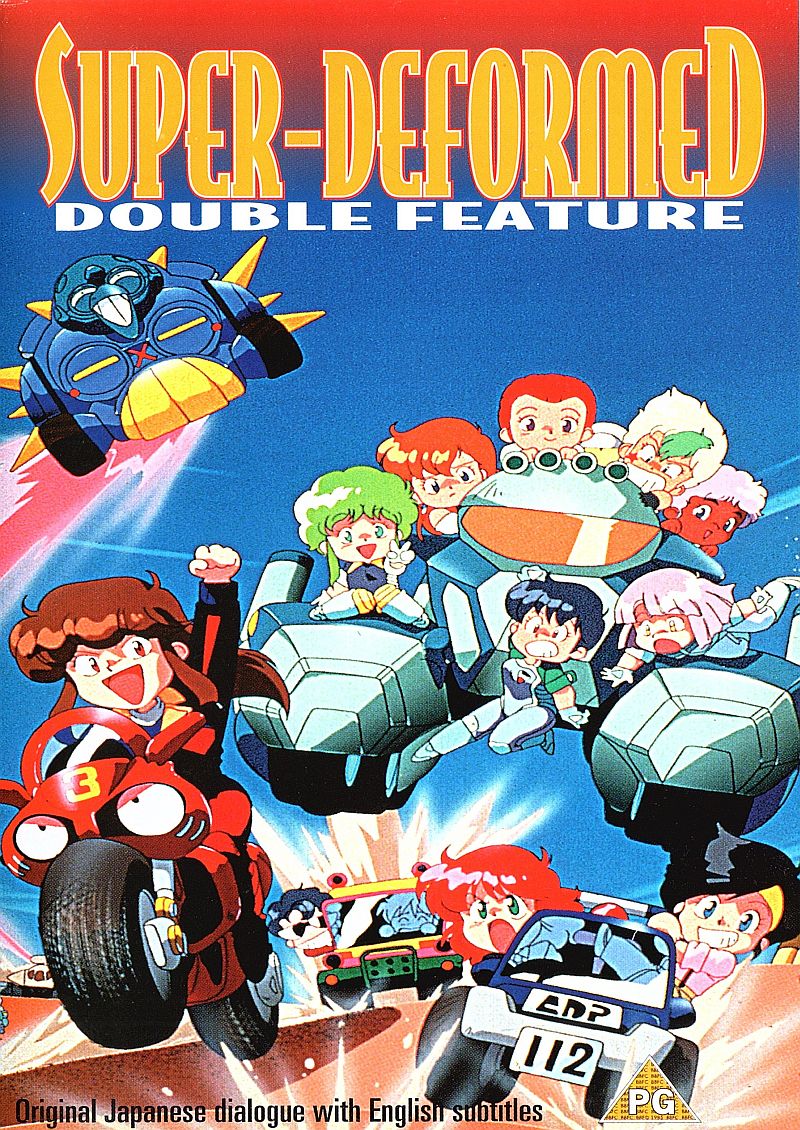
I've never pretended to be writing these reviews for much besides my own amusement, but occasionally we come to a title where it really does feel like I'm talking to an audience of one.  For a start, the compilation known to Western audiences as Super-Deformed Double Feature was only ever released on VHS, so far as I know, and while you can find its crucial portions on YouTube, that's not quite the same experience, for reasons we'll return to.  At any rate, the difficulty of laying hands on a video tape from thirty years ago is barely half the battle.  Of the two short animated features included, the first, Ten Little Gall Force, requires that you be a substantial fan of the first Gall Force series, while for the second, Scramble Wars, you'll also need a fair knowledge of the second wave of Gall Force entries plus Bubblegum Crisis, AD Police, and Genesis Survivor Gaiarth of all things. I know there are plenty of Bubblegum Crisis fans still around, and Gall Force has its following, but Gaiarth? I'd be surprised if anyone who isn't me has watched that one in the past five years.  All of which is a massive shame because, if you fall into the miniscule demographic that ticks all those boxes, Super-Deformed Double Feature is a blast.

Ten Little Gall Force is a comedic making-of of the first two Gall Force features, except that, outside of the recycled footage, all the cast and crew are represented by cutesy chibi versions of themselves, leaving the bizarre implication that what we call anime is actually the outpowering of some parallel cartoon universe striving for what we'd consider realism.  At no point do the chibi actors comment on how bizarre their in-film counterparts look to them, but that's about the only comedic stone left unturned across a frantic 16-minute run time.  There are clever gags, there are dumb gags, there are sight gags, there are surreal gags, and there are even quite a few rude gags, which begs the question of whether we truly needed to see the Gall Force gang both chibified and naked.  And obviously we didn't, but it does feel in keeping with the Gall Force ethos of matching the most high-concept sci-fi with the most low-brow exploitation; I'd forgotten quite how seedy Eternal Story got amid its heady pacifist space opera musings, but Ten Little Gall Force wasted no time in reminding me!  Then again, I ought to have expected fan service from something that couldn't possibly have been made more for a specific fanbase: this was unmistakeably made by people who loved Gall Force for people who loved Gall Force, with the caveat that if you truly love a property, it's OK to make fun of it in some fairly mean ways.

The same goes for Scramble Wars, if not more so, which is only appropriate for something that pits the casts of Bubblegum Crisis, AD Police, Genesis Survivor Gaiarth, and other properties from studio Artmic against each other in a Wacky Races-style contest with an outrageously huge cash prize at the end of it.  Scramble Wars takes up the lion's share of the tape and so gets to develop a bit more, which means it's that bit better for being able to set up jokes rather than rattling about like a pingpong ball in a spin dryer as Ten Little Gall Force did.  Though requiring a wider breadth of knowledge in theory, it's also less reliant on in-jokes, though there's a truly joyous one for the Gall Force fans; but front and centre it's a Wacky Races rip-off, and I'm happy to call it the best of that plentiful subgenre.  It's also probably technically superior, though a startling aspect of both is how well made they are, even if each cheats in its own ways, Ten Little Gall Force by pilfering footage from the Gall Force movies and Scramble Wars by setting the action on Gaiarth and so getting its background art for free.

Admittedly, I was always likely to say nice things about this one, since I love Gall Force and Bubblegum Crisis and and even have a soft spot for Genesis Survivor Gaiarth - which is why I'd argue that watching Ten Little Gall Force and Scramble Wars back to back won't quite substitute the true Super-Deformed Double Feature experience.  The reason being that AnimEigo saw fit to include a couple of short documentaries, and while the animations are the obvious stars, the live action stuff is charming in its own right.  The first focuses on Kenichi Sonoda and is worth watching for his one-man anime movie alone, while the second follows the Gall Force cast as they record one of the songs for the soundtrack and is nearly as fun if you're the kind of person who'd consider watching that sort of thing.  But put all four segments together and what you have is seventy minutes of vintage anime nerd nirvana.

I have an abiding hope that one day we'll get a Gall Force blu-ray set - it's crazy how ignored the franchise has been given some of the rubbish that's been rescued over the years - and if and when that magical day should come, it only makes sense that Super-Deformed Double Feature will make its welcome return as a bonus feature, that being more or less what it always was, albeit in an age when bonus features were another thing you were expected to splash out for.  Should that not happen, I guess you can always go ahead and watch Ten Little Gall Force and Scramble Wars on YouTube; just remember to feel slightly sad that you're not getting the whole of one of vintage anime's most charming, if phenomenally niche, experiences.

You're Under Arrest: Mini Specials, 1997, dir: Junji Nishimura

Here's how bad the You're Under Arrest Mini Specials are: this was one of the very first DVDs I bought to review here, many a year ago, and I got most of the way through it before giving up in despair, since when it's been gathering dust on my shelf, taunting me with its grimy presence.  This is also how bad the You're Under Arrest Mini Specials are: amid a collection of twenty stories of seven or so minutes, three of them pit our heroic traffic cop pair Natsumi and Miyuki up against panty thieves, and those three episodes occur one after the other.  I can imagine the writer so devoid of imagination that they'd fall to so miserable a cliché of bad anime, and if I really stretch, I can imagine the writer who'd go back to that well not once but twice more, but to then tell those stories back to back?  No, that beggars belief.  And it's hardly the only idea that gets reused here, either, though I suppose "idea" is too strong a word for most of what's on offer.

By the law of averages, not all of those twenty mini-episodes are terrible, though the failure rate is impressively high.  Nevertheless, they're practically all bad in a few basic ways: almost all the humour (and humour is definitely the goal here, for all that it's one more occasionally brushed against than hit) is broadly sex-based, in that the antagonists are creepy guys of one sort or another that Natsumi and Miyuki have to put in their places, generally through violence.  But the whole thing is so leering that it feels far more on the side of the men than our heroes, who are generally treated with no real respect whatsoever; if I told you they spend ten minutes out of the two and a half hours of material here doing anything that resembles actual police work, I suspect I'd be exaggerating.  There are also some strikingly nasty gags at the expense of trans character Aoi Futaba, who I'm fairly sure was treated with a heck of a lot more respect in both the OVAs and the film, and in general, none of the cast feel like they have much to do with their earlier incarnations: they're stock types plugged in to stock narratives, many of which could have wandered in from any show.

The better sections, then, tend to the be the ones that remember what You're Under Arrest is about and that the concept was never, "Oh my god!  Women cops, whatever next?"  Whenever Natsumi and Miyuki are behind the wheel of a car, proceedings pick up considerably, but that amounts to a minute of two, presumably because animating cars costs money and nobody wanted to spend more than the bare minimum on this: it's distressingly cheap-looking from start to finish and if there was ever a point where director Nishimura brought any flair to the proceedings, I must have blinked and missed it.  Heck, even the music is actively dull, and I struggle to think of any anime from the period that couldn't muster at least one decent tune.  Really, the whole business has the feeling of something made as an obligation by people with no affection for the source material and no sense of what to do with it; not that it was ever a good fit for these bite-sized episodes, but the eagerness to veer as far as possible from what the show was traditionally good at in favour of the most generic plotlines imaginable is truly baffling.

I'll say this much: by the end of what amounted to a second watch, the You're Under Arrest Mini Specials had worn my down from active dislike to surly indifference, and there were points, albeit brief ones, when I got caught up in a couple of the better stories.  Aside from the nastiness toward Aoi, there's nothing here that's worthy of real anger or contempt, though that only makes it more frustrating from a reviewing perspective, since I'd always rather have a terrible title that I can merrily tear into over one I'm bored just thinking about.  And it's conceivable that were this mess not dressed up in the ill-fitting clothes of one of my favourite anime franchises, I'd be a little more kindly disposed to it.  But it is, and I'm not, and it's thoroughly depressing that this tacky, lifeless nonsense will be our last brush with You're Under Arrest after the highs of the OVA and movie.

Riki-Oh: The Wall of Death, 1989, Satoshi Dezaki

As a prime example of the mission creep that's overtaken this review series, I offer the fact that once, very long ago, the plan was to cover only films and OVAs from the nineties that had been released in the UK and were readily available, and now here we are with something from the eighties that has seemingly never once had what you might call a "proper" release anywhere outside of Japan.  The only physical copy of Riki-Oh: The Wall of Death you're likely to come across was, so far as I can tell from the shonkily produced inlay, distributed by a company called AVP, on whom the internet yields precisely no information.  It looks awfully like a knock-off, yet you do occasionally see a new, sealed copy floating about, so maybe it's legitimate in some loose sense of that word?

Whatever the case, it's probably not the sort of thing we ought to be concerning ourselves with, any more that it would make sense to be reviewing, say, fansubs of shows videotaped off Japanese TV.  Except for two things: one is that, against all the odds, this 45-minute OVA has managed to retain something of a reputation for itself, as perhaps the least known but still occasionally talked about member of the fraternity of video-nasty-style titles that were so many people's introduction to anime back in the day; and secondly because the wider world of Riki-Oh has left its own legacy, in the shape of the live-action film Riki-Oh: The Story of Ricky, a film prestigious enough to recently get the deluxe Blu-ray treatment - a fact that makes it all the weirder that no one in the West has seen fit to pick up this OVA and its sequel.  (Media Blasters apparently did, but lost the rights before they could do anything with them.)

The Story of Ricky is a gleeful dive into violent excess on a par with any splatter movie you can name, at least as far as delivering maximal quantities of latex and stage blood to provide some ingeniously horrible gore effects goes.  Whether it's a "good" film is perhaps besides the point, though it's certainly put together with a degree of craft that you mightn't expect from something that's aiming, above all, to be shocking and gross.  Personally, I was exhausted well before its end, so the notion of the precise same story told in half the time had a definite appeal, the more so since that story is better fitted to 45 minutes than 90: our hero, Riki-Oh / Ricky, has been condemned to a privatised prison run by a hierarchy of increasingly monstrous tyrants, from gang leaders up to the warden and beyond, and while they're initially willing to leave him be due to his nigh-inhuman martial arts abilities and seeming obliviousness to pain, that status quo barely outlasts the first proper scene.  With the prison's fragile totalitarianism at risk, the only way to go from there is a series of ever more over the top efforts to put our hero in his place, especially as it becomes evident that he didn't end up in this particular prison by accident and won't be done before he's settled some business of his own.

Both live action film and OVA tell a largely identical tale in superficially identical fashions, in that both are primarily vehicles for lots and lots of bloody violence.  So nothing could have surprised me more than how The Wall of Death approaches that violence.  It's certainly there, and it's certainly graphic, but what it isn't is fun in the manner that the movie's take on identical scenes tends to be.  And here, of course, I'm referring to a very specific sort of fun, but there's an undeniable gleefulness to the movie's take on this material that's largely absent from The Wall of Death.  The gore is off-putting and very much seems as though it was meant to be, even in its more absurd moments, of which there are considerably less this time around.

Is this a bad thing?  Is it a good thing?  Truly, I'm not sure.  I can't say I enjoyed The Wall of Death less, but that's arguably just because it didn't outstay its welcome, and while I'd give both interpretations a similar score, here it would be averaging out a much narrower range of highs and lows.  It's relatively well-made, though rarely strikingly so; the animation is resolutely fine and all that visually sets the title apart is some unusually nifty editing, which adds a punchy, unnerving rhythm that's a definite boon.  And while would be easy to condemn the focus on plot over spectacle when surely no one would come to any version of Riki-Oh for the plot, it's hard to see how the narrative could have been trimmed back more without straying into incoherency.  Still, the fact remains that the only reason anyone's likely to seek out The Wall of Death is for its place in the video nasty pantheon, and while it warrants inclusion, I suspect the measure of seriousness it applies to material that's arguably better suited to The Story of Ricky's gleeful excess will make it slightly unsatisfying for most.

-oOo-

My goodness, this is really getting to be an exercise in futility!  Two recommendations for things that are nigh-impossible to watch (I mean, I guess I recommend Riki-Oh) and two titles that I hadn't much time for but that are easy to find - or, wait, no, a quick check suggests that the You're Under Arrest Mini-Specials are even getting a bit rare, and goodness knows that's not likely to ever get a rerelease because, as I think I may have mentioned in my review, it sucks goat nostrils.


[Other reviews in this series: By Date / By Title / By Rating]


* And for all the deservedly nice things I've said about Discotek, their Blu-ray print needed a fair bit more work or perhaps was from a source that was beyond entirely salvaging.  At any rate, it's nowhere near on a par with what they delivered for the first A-ko.

Monday, 10 October 2022

Drowning in Nineties Anime, Pt. 120

So much for posting more regularly!  Ah well, I've a few of these on the go and my day job situation is hopefully settling down a bit, so there's hope yet, though I dimly remember saying much the same not so long ago.  As for a common thread, the closest we have is "titles that are really hard to find these days," which is likely to be an extremely prominent theme for the foreseeable future.  All of which is to say that I have nothing to say and we might as well just get on with looking at Dragoon, Megaman: Upon a Star, Voltage Fighter Gowcaizer, and Iron Virgin Jun...

Dragoon, 1997, dir: Kenichi Maejima

If there's one thing you need to know about Dragoon, it's that it has nary an original idea anywhere in its head, except perhaps for the incorporation of science-fictional elements like giant airships into an otherwise fantasy-style narrative - only, by 1997 that had in itself become a cliché in the wake of Hayao Miyazaki's Nausicaä of the Valley of the Wind and Laputa: Castle in the Sky, and thinking about it, if there's one thing you really need to know about Dragoon, it's that it wants very much to be mentioned in the same breath as those two classics.  Though the conversation would need to be along the lines of "Laputa sure is a great movie, but have you ever considered how much better it would be with lots of bare breasts?"

And having summed up Dragoon as Laputa with a fraction of the budget and endless shots of boobs, I could certainly call this review done, with the only caveat being that, depending on your preferences, I've either made it sound awful or awesome and it isn't either.  The word I'd opt for, rather, would be "pleasant", in the way that only something wholly predictable and unchallenging can be.  While its obsession with lingering over its female characters' exposed upper halves, regardless even of whether they're adults or not, is certainly sleazy, that aside it's all quite sweet and good-natured and relatively bloodless.  If you like straightforward fantasy tales, and if you especially like straightforward fantasy tales that toy at incorporating the odd sci-fi element, it's safe to say you'll get on fine with Dragoon.

None of this would be half as true, mind you, were it not for some surprisingly and consistently decent animation, which makes an out-sized difference in pushing Dragoon up from the realms of not-badness.  Were there more to visually differentiate it, was the world-building more imaginative, say, I'd go further, but as it is, only some reasonably nice character designs do much to make the show stand out.  Still, anime that's made with a measure of talent and care is generally better than anime that isn't, and Dragoon's tendency to punch above its budgetary weight is a definite boon.

All of which would add up to a modest recommendation were it not for one last problem, the only one I'd consider a reason to definitely avoid Dragoon if you should find yourself craving some hackneyed nineties fantasy anime: as rote as its storytelling is, the characters are sympathetic enough that I wanted to see how things played out for them, so that the three episodes here end without so much as a cliff-hanger, having resolved nothing, is quite frustrating - and more so for how the opening sequence is a flash-forward to major events we'll never see play out.  It's not ruinous, simply because what's come before isn't good enough and the tale it's been telling isn't unpredictable enough that never finding out where it's heading is especially painful.  The best of endings wouldn't have nudged Dragoon into the realms of greatness, but the lack of even a half-decent one definitely does it no favours.

Mega Man: Upon a Star, dir's: Katsumi Minoguchi, Naoyoshi Kusaka, Itsurô Kawasaki, Minoru Okazaki

Given what an extraordinary amount of anime we've covered here, it's surprising how little we've come across that was expressly and primarily made for kids.  Probably it's my memory being rubbish, but Mega Man: Upon a Star feels like practically a first.  It has no interest in adding one iota of sophistication or nuance to cater to an older viewer and is wedded so hard to the perspective of its child characters that regular logic immediately flies out the window.  On discovering that their reality has been invaded by video game characters, for example, the first concern of our young protagonist Yuuta's parents isn't to wonder at how the heck such an obvious transgression of the basic laws of reality might occur or what dangers having a mad scientist of apparently unlimited power and ingenuity running around their nation might pose but to question how their son is meant to fit all this commotion in around his schooling.

Honestly, that's kind of refreshing.  Mega Man: Upon a Star is dumb as bricks, but it's the right sort of dumb, the sort that gets that we - and by "we", I definitely mean the under-ten viewer - want to be amused and entertained, and maybe if we get enough amusement and entertainment we must possibly tolerate a dash of education entering the mix.  It strikes me only now that one aspect that sets this apart from most of what's aimed at children is that it's not very interested in humour.  Its stakes are ridiculous, but Mega Man: Upon a Star takes them as seriously as can be.  It actually plays quite fairly toward its young audience, and while it's absurd, it isn't pandering.  Even that educational aspect I touched on comes from a charming, albeit baffling, place: since Mega Man the character is apparently American, the show is determined to have him learn a bit about Japanese culture, geography, and identity, for all that there's nothing here you wouldn't expect the average Japanese schoolchild to already know.

This makes no sense, but it makes no sense in harmless, appealing ways, which is Mega Man: Upon a Star all over.  Its three stories are energetic and fast-paced enough that the silliness never becomes obnoxious.  In the first, Mega Man escapes because Yuuta falls asleep at the controls of Mega Man 5 - which raises so many questions the show hasn't the tiniest interest in exploring! - and is rapidly followed by the nefarious Dr. Wily, who immediately builds an army of robots and takes over an amusement park so that they can enjoy themselves, a plan that's actually not very nefarious at all, come to think of it, though once foiled, he does try and harness the tectonic forces of Mount Fuji to annihilate Japan.  Maybe you should have just let him entertain his robots for a few hours, huh, Mega Man?  Then in the second episode, Dr. Wily steals a time machine and uses it to travel back to kill Mega Man in the womb.  Ha!  No, he uses it to visit various of Japan's annual festivals and at one point steal some sweets, and also to gather a bunch of meteorites to drop on the nation, something it's fair to assume he could have done just as easily without a time machine.  Though his half-hearted attempts to muck with the fabric of time still make more sense than what Mega Man gets up to in part three: suspecting that Dr. Wily is again up to no good, he starts roving forward into the future in search of a point when something outright bad enough is happening that it's definitely the work of an evil genius.

It's a lazy approach to hero-ing that has no right to succeed as well as it does, and by that point I have to admit I was firmly on the side of Dr. Wily, who's a good bit more proactive and benefits from Kenichi Ogata's delightful performance, which brings him to life as both gleefully wicked and ever-so-slightly senile.  By comparison, Mega Man himself is rather dull, as are Yuuta and his sister, though it's fair to suppose that everyone involved is aware of this failing given that we're never apart from Wily for long.  Still, all the voice acting is pretty good, and mostly so is the music, so long as it's adhering to what I take to be revamps of the game's themes and not hurling terrible rock ballads at us over the closing credits.  But what surprised me was the animation, which is never what you might call impressive, exactly, yet always stays on the right side of decent to a degree it's fair to say would be wasted on its target audience.  (Granted, the designs are a bit ghastly, but I guess we have to blame the game at least partly for that.)  And so, as seems to be routinely the case these days, we're left with a title that I'm happy to recommend on its own merits - assuming you have a handy child you want to keep amused for an hour and a half while gently teaching them a bit about Japanese culture - and which is almost totally impossible to find.  Hey, at least the crummy dub is on YouTube...

Voltage Fighter Gowcaizer, 1996, dir: Masami Ôbari

Of all the directors active throughout the nineties with a distinctly recognisable style, I'd argue that Masami Ôbari was unique in that he never once made anything you could hands-down describe as good. Oh, I know the Fatal Fury movie has its defenders, and sure it could be worse, but who else was there who combined such a unique MO with such a thudding lack of genuinely stand-out work? Once you know what you're looking for, you can't miss an Ôbari character design, and there are other elements that carry over from project to project as well; the only one I have any wholly positive feelings for is his sure grasp of how bodies look in motion, which, when your CV contains a disproportionate number of fighting game adaptations, is certainly a virtue to cultivate.  But then at the other end of the spectrum, he had a marked tendency towards levels of misogyny that stands out even in a decade when female characters being treated as victims, window dressing, or both was more or less the standard in anime: his women are invariably vixens or airheads and, whichever category they fall into, it's a safe bet their breasts will be bigger than their heads.

Now, this isn't a review of Masami Ôbari.  I mean, obviously it has been for the whole of a paragraph, but it's not meant to be.  Still, it seems to me a fair way into talking about Voltage Fighter Gowcaizer because Voltage Fighter Gowcaizer is about as Ôbari-ish as it's possible to be.  It has all of his flaws on unmistakeable display, and, to be fair, all of his virtues as well.  And, like Fatal Fury before it and Battle Arena Toshinden, released the same year, it's based on a video game beat-em-up, in this case one Ôbari also provided the character designs for.  It's definitely possible to imagine this material in the hands of another director, but the result would have been a very different beast: better, perhaps, and surely more coherent, but perhaps a bit less interesting.

On paper, Voltage Fighter Gowcaizer has no right to be any level of interesting.  The plot is boilerplate and stupid, unnecessarily overwrought boilerplate at that.  It dances around the crucial elements enough that everything seems vastly more complicated than it really is, and that's primarily the fault of Kengo Asai's script, which dresses up the stuff of fighting game plotting as though it were Greek tragedy, but Ôbari makes no moves to check that tendency.  Barring an eleventh-hour twist that's only a twist if you've never played a video game, this could barely be more of a straightforward tale of disparate heroes banding together against an evil villain, yet it somehow drags that threadbare material out for a hundred minutes, for a good proportion of which the central conflict barely rears its head.

There was probably never going to be a good version of Voltage Fighter Gowcaizer, and it's even harder to imagine such a version flowering out of Asai's florid prose - though I guess he had to pad the material somehow, and why shouldn't that be by having the cast spout nonsense philosophy at every opportunity?  At any rate, I don't know that it's reasonable to criticise Ôbari for not transforming this into a classic for the ages.  He does his own share of harm, though, and that's even supposing you aren't as horrified by his character designs as I am; but if you are, their flaws are harder to miss when he's this determined to show off their tackiest aspects.  Even by nineties anime standards, the number of times a dialogue scene is shot from crotch or bum height is astounding, and there's so much unmotivated jiggling of boobs that at one point I burst out laughing because it kind of looked as though two characters' breasts were having their own private conversation.

Actually, Voltage Fighter Gowcaizer is generally quite obsessed with sex, and the bouncing bosoms and endless shots of barely concealed crotches and bottoms become somewhat less noticeable when they're up against, say, an antagonist who's a monstrous hermaphroditic hybrid formed by an incestuous brother and sister.  Yet, in common with all of Ôbari's work, it's also resolutely unsexy, in part because it's so hard to reconcile these designs with actual human beings.  So the sexiness becomes yet another way for Voltage Fighter Gowcaizer to be strange and unexpected, and that's what really saves it, in so much as anything does.  Well, that and some frequently terrific animation, along with a few moments of visual genius: the "secret" final antagonist, in particular, is such a superb bit of design work that you can't but wonder how Ôbari managed to screw up so many of the others.  Which is why, I suppose, I've spent so much of this review discussing him rather than the title in question: here as elsewhere, I find myself just impressed enough - by a terrific bit of action there, a perfectly composed image there, or just by the distinctiveness the man brought to such generic subject matter - to wish Ôbari had managed, just once, to conjure up a masterpiece.

Iron Virgin Jun, 1992, dir: Fumio Maezono

The perfect, they say, is the enemy of the good, and perhaps that explains how Iron Virgin Jun can be both a largely faultless version of what it's trying to be and at the same time slightly hard to recommend.  Then again, maybe that's inevitable when what it's trying to be is a 45-minute OVA adaptation of a short Go Nagai series.  I'm not exactly a fan of Nagai's oeuvre on the whole, and I can't imagine a time when I'll ever be on side with the mean-spirited efforts to be vicious and gross that mark out a title like Violence Jack, yet the list of anime based on his creations that I have a measure of affection for is getting surprisingly long by this point.  But with most of it, I fall into a middle ground of being amused by the absurdity and over-the-top imagination but let down by the lack of much else: there are plenty of solid Nagai adaptations but vanishingly few that push beyond that.

The manga of Iron Virgin Jun sounds startlingly unpleasant: if the Wikipedia entry is anything to go by, its "highlights" include a spot of bestiality and the potential rape of the protagonist as a major plot point, and the anime loses the former and tones down the latter, so it's already ahead of the game for those of us who aren't on Nagai's wavelength.  Still, there's only so much you can do to sanitise a work by someone who's so eager to shock, and, in fairness, only so much you should do without losing the gleeful bad taste that's one of Nagai's hallmarks.  So the threat of rape is still there, it's just introduced late and not taken terribly seriously, which arguably doesn't make it better but at least leaves room for Iron Virgin Jun to put its best foot forward.  Plus, while my heart sank when the Golden Cherry boys were introduced, they being the gang dispatched to rob our hero Jun of her virginity, their character designs perfectly nail the balance of crass and ridiculous that Nagai thrives on: I won't spoil the gag, but I'll admit I laughed.

The Golden Cherry boys, however, are much nearer to the back of Iron Virgin Jun than the front, and what we start out with is the kind of goofy setup that's ideal for one of these shorter OVA films.  Jun's - perhaps literal, to judge by appearances - ogre of a mother wants her to get married.  Jun disagrees, and strongly enough so that she's gone on the run to make her point.  But her family is outrageously wealthy and has no end of colourful henchpeople at their disposal and Jun's mother isn't beyond squandering those resources if it gets her daughter to comply, all the more so since her motives have little to do with wanting to ensure Jun's future wedded bliss.  Fortunately for Jun, and for us since there'd be no plot otherwise, her iron physique and stock of wrestling moves mean she's more than capable of taking care of herself, which doesn't stop the sympathetic and slightly smitten servant Ohnami from tagging along.

There's plenty of material there for comedy, romance, and regular bouts of action, and that would probably suffice for something this short; but having set out its wares, Iron Virgin Jun then delivers enough of a larger plot that it actually manages to have a bit of meat on its bones.  The animation is entirely fine, Maezono's direction is suitably energetic, and so is the unusually present score, which does more than its share of keeping the pace lively.  As far as the source material goes, it's a mostly triumphant attempt at fitting it to the form of a short OVA movie, and thus we return to the opening point: it's possible to get most everything right and still end up with something that's merely okay.  If you were determined to adapt a Go Nagai work that has many of his flaws and not quite enough of his virtues, and you had less than an hour to play with, I can't imagine how things would have turned out an awful lot better, but that's not to say it was ever a brilliant idea to try.

-oOo-

I guess it's always nice to have nothing bad, right?  Then again, it's also nice to have at least one thing that's categorically good, and I want to say that's Mega Man: Upon a Star, but that would be a lie brought on by going in with low expectations and being pleasantly surprised.  Still, if we're looking at four distinctly average titles, at least they're the interesting sort of average: where else but in the world of vintage anime could you apply such a word to titles as merrily bonkers as Iron Virgin Jun and Voltage Fighter Gowcaizer?  So I'm calling this one a win regardless.


[Other reviews in this series: By Date / By Title / By Rating]